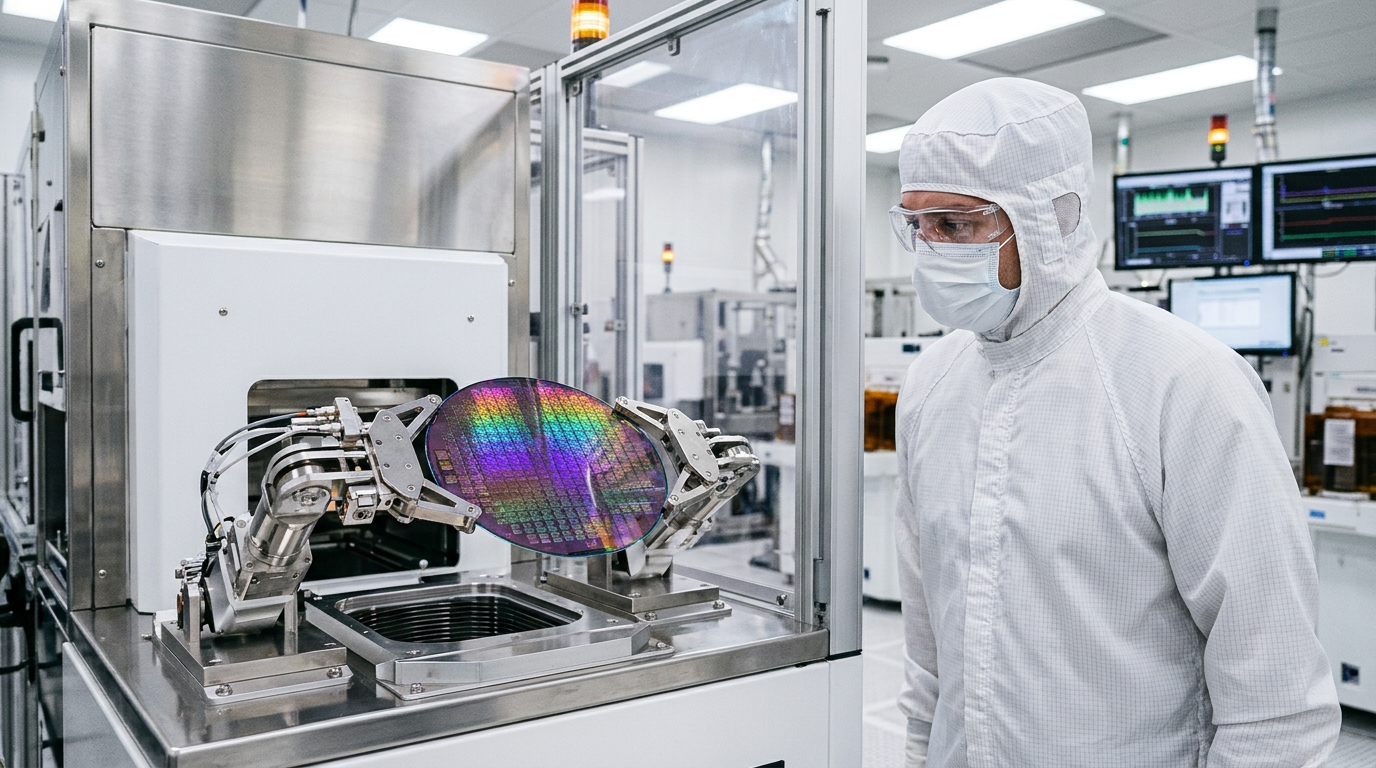
A comprehensive state-of-the-art review published in Autonomous Intelligent Systems reframes modern semiconductor manufacturing not as an unmanned fully automated factory, but as a closed-loop human-supervised autonomous decision-support system. Semiconductor fabrication facilities operate as some of the most capital-intensive, high-stakes cyber-physical environments in global industry, coordinating thousands of wafer lots, processing tools, recipes, reticles, and internal transport systems under re-entrant material flows and volatile product mixes. Rather than proposing a singular algorithm, the authors synthesized existing manufacturing execution software and advanced algorithmic techniques into a cohesive reference model that balances algorithmic automation against verified human authority, runtime assurance, and auditable safeguard records.
The study establishes that semiconductor manufacturing cannot be governed by an isolated optimization formulation or an autonomous black-box neural policy because production decisions span drastically different temporal and spatial dimensions. Macro-level enterprise planning operates across rolling horizons of weeks, months, or quarters, establishing wafer release schedules, customer order fulfillments, and strategic capacity allocations. A production plan that fails to consider operational scheduling feasibility leads to bottleneck starvation or excessive work-in-process accumulation, while myopic real-time dispatching actions that optimize local machine utilization can create severe downstream queue-time violations, line congestion, and delivery instability. Consequently, the authors show that modern fab management must function as a multi-tier closed-loop system where top-down operational intent meets continuous upward feedback from tools, metrology stations, and inspection steps.
To investigate this interconnected landscape systematically, the researchers conducted an analytical review structured around four core research questions rather than a prospective systematic protocol like PRISMA. The review evaluated peer-reviewed literature published primarily between 2009 and March 2026, placing distinct emphasis on post-2015 advancements while selectively integrating foundational studies on dispatching heuristics, human automation trust, and runtime control assurance. The literature identification process retrieved 159 full-text documents from major scientific databases including IEEE Xplore, Scopus, Web of Science, ScienceDirect, and SpringerLink, alongside targeted investigations of preprints from platforms such as arXiv and PMLR for emerging machine learning architectures. After removing duplicates, an irrelevant candidate, and adding 14 sources assessed directly on publisher websites, the team subjected a reconstructable pool of 166 full-text sources to formal relevance boundaries, ultimately filtering out 26 publications for irrelevance, nontechnical content, non-semiconductor contexts, or redundant evidence.
The final reviewed corpus comprised 140 cited publications, which the authors categorized using a dual-track analytical classification. Within this body, 114 sources were identified as semiconductor-specific, addressing production planning, factory scheduling, shop-floor dispatching, automated material handling, and fab-wide execution infrastructure. The remaining 26 sources were cataloged as transferable evidence from broader autonomous intelligent systems, computer science, human-automation interaction, digital twin engineering, and general discrete manufacturing. To assess methodological contributions objectively, the team applied a five-dimensional coding scheme covering decision layer, method family, autonomy role, evidence type, and deployment maturity across 121 method-oriented and system-oriented papers. The remaining 19 publications represented conceptual overviews, broader literature reviews, and high-level artificial intelligence governance frameworks that served vital background roles in defining architectural boundaries, authority escalation protocols, and operational safety envelopes.
At the highest operational tier, the review examines planning as the production-intent loop, where enterprise resource planning and advanced planning and scheduling systems define what the manufacturing enterprise seeks to achieve. Constraint-explicit mathematical programming, including mixed-integer programming, stochastic formulations, and robust minimax regret models, remains the indispensable foundation for this layer. Because fab managers, customer-facing planners, and business executives must inspect, negotiate, and validate production commitments, capacity models must explicitly represent bottleneck equipment, qualified toolsets, reticle availability, chamber dedications, and queue-time constraints. While discrete-event simulation provides a dynamic sandbox to evaluate planned completion dates against stochastic tool downtimes, emerging machine learning methods are increasingly deployed for predictive state estimation. These data-driven models forecast lead times, dynamic work-in-process bottlenecks, and demand fluctuations, but the authors emphasize that predictive analytics only achieve closed-loop value when they directly trigger automated scenario evaluations or controlled schedule revisions.
Beneath enterprise planning sits factory scheduling, which the authors formalize as the executable-plan repair loop linking high-level targets to physical shop-floor workflows. Scheduling models ingest weekly capacity envelopes and transform them into detailed job sequences, furnace batching configurations, and photolithography mask allocations. Because unanticipated tool breakdowns, yield drops, and hot lots continuously disrupt theoretical schedules, modern scheduling functions less as a static optimization run and more as an ongoing repair mechanism. Optimization techniques like mixed-integer programming, constraint programming, and hybrid genetic algorithms provide mathematically sound, auditable schedules that enforce complex fab constraints. Meanwhile, deep reinforcement learning, deep Q-networks, and convolutional neural networks have demonstrated strong potential for rapid heuristic selection and adaptive sequencing. However, the review emphasizes that learning-assisted schedulers cannot replace deterministic baselines; instead, they function most effectively as recommendation engines where proposed schedule repairs remain inspectable and subject to supervisor authorization before execution.
On the physical factory floor, dispatching, real-time dispatching software, and advanced process control operate in concert to form what the review characterizes as the guarded-action loop. Although deep reinforcement learning agents and artificial neural networks are increasingly researched to dynamically modulate dispatching weights under fluctuating shop-floor congestion, their live deployment is severely hindered by safety risks and generalization gaps. The synthesis stresses that an autonomous dispatch controller cannot be granted unrestricted decision rights. Instead, it must be constrained by rigorous action masks dictated by advanced process control systems that evaluate chamber health, drift signals, virtual metrology, and run-to-run recipe calibrations to immediately suppress actions that threaten wafer yield.
The review also scrutinizes cross-layer intelligence, specifically examining the real-world utility of simulation models, digital twins, sustainability initiatives, and large language model orchestration. The authors establish a strict technical boundary between traditional offline discrete-event simulators and authentic digital twins, noting that genuine twins require automated bidirectional synchronization between physical fab telemetry and virtual models. Regarding large language models, the study highlights applications in failure-maintenance diagnostic retrieval, equipment interface scripting, and batch-tool heuristic assistance, but firmly rejects portraying these models as standalone fab controllers. Because language models remain susceptible to hallucinations and unpredictable tool invocations, their safe application requires strict semantic translation roles where outputs generate verifiable structured code or constraints.
To evaluate where technologies stand on the path toward implementation, the authors developed an evidence-based deployment maturity matrix classifying methods into mature, transitional, emerging, and conceptual tiers. Mature status is reserved strictly for systems with documented operation inside actual industrial production workflows, such as standard enterprise resource planning, manufacturing execution systems, rule-based real-time dispatchers, and traditional advanced process control loops. The transitional tier encompasses advanced methods validated using authentic industrial datasets or high-fidelity models embedded in operating fab contexts, but lacking permanent daily workflow authority. The emerging category captures the majority of published deep reinforcement learning algorithms, laboratory-scale neural dispatchers, and experimental digital twins that have been evaluated solely through academic benchmarks or ungrounded simulations. The conceptual level designates theoretical architectures lacking rigorous empirical verification, reminding industrial leaders that algorithmic sophistication must not be conflated with genuine industrial readiness.
A critical analytical contribution of the study is the formalization of runtime assurance architectures as the mandatory safety net for advanced fab autonomy. Drawing from established cyber-physical systems principles, the review details how an advanced decision controller, such as an adaptive neural policy, should operate within a continuously monitored operational envelope. Furthermore, comprehensive audit trails must record the precise triggering state, evaluated alternatives, selected actions, and authority escalation paths to preserve full post-incident traceability, providing industrial engineers and process technicians with transparent records necessary to foster trust and system accountability.
Ultimately, the review reframes the trajectory of semiconductor smart manufacturing away from speculative visions of lights-out automation and toward robust, human-supervised autonomous decision support. Fabs represent highly vulnerable economic assets where unverified algorithmic exploration during live manufacturing runs is prohibitively expensive and operationally perilous. By grounding enterprise software infrastructure, classical optimization, predictive machine learning, and emerging artificial intelligence within an integrated reference architecture, the study provides a pragmatic roadmap for production engineers and software architects. Future advancements will depend less on isolated algorithmic breakthroughs and more on the engineering of dependable execution interfaces, standardized validation protocols, and fail-safe supervisory mechanisms that allow humans and intelligent systems to govern complex wafer fabrication safely, transparently, and sustainably.
Subject of Research: Autonomous decision support architectures in semiconductor manufacturing
Article Title: Toward autonomous decision support in semiconductor manufacturing: a review of planning, scheduling, dispatching, and execution control
Article References: Li, L., Li, Y., Tang, J., & Yu, Q. (2026). Toward autonomous decision support in semiconductor manufacturing: a review of planning, scheduling, dispatching, and execution control. Autonomous Intelligent Systems, 6(1), Article 24. https://doi.org/10.1007/s43684-026-00146-z
Image Credits: AI Generated
DOI: 10.1007/s43684-026-00146-z
Keywords: semiconductor manufacturing, autonomous intelligent systems, production planning, scheduling, real-time dispatching, advanced process control, manufacturing execution systems, digital twins, reinforcement learning, large language models, Toward, autonomous
News Source: Denise Maddox. (November 7, 2026). Review Explores Human Supervised Decision Architecture for Smart Semiconductor Manufacturing. Scienmag.