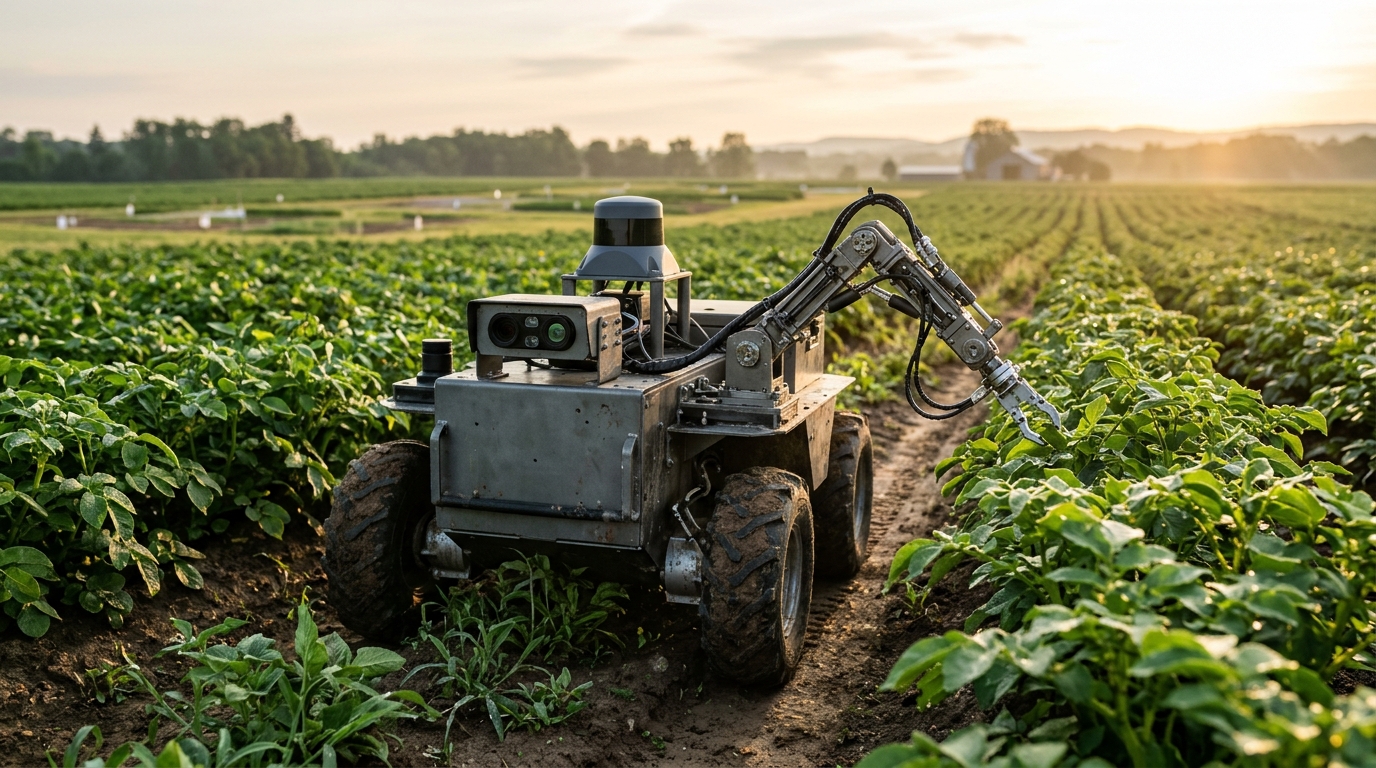
Artificial intelligence researchers are outlining a transformative shift in agricultural science and farming operations, moving beyond static predictive algorithms toward autonomous multi-agent systems capable of perceiving dynamic environments, executing complex reasoning, and coordinating physical field interventions. According to a comprehensive scientific review published in npj Sustainable Agriculture by an international research team led by Daoyuan Jin, agentic artificial intelligence represents an evolving technological paradigm designed to tackle operational hurdles in global crop production. Unlike earlier agricultural software relying on rigid dashboards or isolated machine learning models, agentic systems deploy autonomous entities that receive high-level objectives rather than granular instructions. These systems iteratively gather environmental data, query external tools, generate structured plans, and execute multi-step workflows with minimal human intervention. While artificial intelligence has begun entering agriculture through specialized chatbots and diagnostic models, the review emphasizes that agentic workflows expand these capabilities by coupling reasoning-capable foundation models with structured planning, active environment interaction, and modular tool use across phenomics, crop management, field robotics, and policy.
The review traces the technical taxonomy underpinning these systems, delineating the progression from basic autonomous entities to intelligent agents and coordinated multi-agent architectures. In artificial intelligence research, an intelligent agent is formally characterized by three operational hallmarks: reactivity to environmental dynamics, proactivity in pursuing designated objectives, and social capability to communicate and cooperate with other autonomous entities or human managers. While early agent research in the 1990s and 2000s relied on rigid multi-layer frameworks such as Touring Machines and InteRRaP, the integration of large language models provides unprecedented flexibility, contextual comprehension, and dynamic problem-solving capacity. Modern architectures combine these foundation models with retrieval-augmented generation and external memory modules. Retrieval-augmented generation enables models to ground reasoning in external agronomic databases rather than remaining confined to static pre-training weights, while external memory retains critical seasonal context beyond the restrictive boundaries of standard model context windows, facilitating sustained adaptation across changing farm conditions.
At their architectural core, agricultural intelligent agents operate within a continuous four-part feedback loop comprising perception, reasoning and decision-making, action, and continuous learning and adaptation. Perception captures ambient conditions through diverse sensory channels, including visual, thermal, olfactory, haptic, and acoustic sensors tailored to specific biological and field tasks. The action component translates computational choices into real-world outcomes, utilizing software application programming interfaces in digital spaces or physical robotic actuators, mobile bases, and end-effectors in field settings. To standardize interactions, emerging systems adopt the Model Context Protocol to decouple tool development from underlying foundation models, enabling dynamic tool discovery, schema negotiation, and asynchronous execution. Simultaneously, inter-agent coordination is mediated through standardized communication channels like the Agent-to-Agent protocol. The authors observe that specialized, domain-tailored agents consistently outperform generic general-purpose foundation models, which often suffer from hallucinations, misinterpret complex biological trade-offs, and lack technical grounding in agricultural engineering or agronomic realities.
To map the existing research landscape, the authors conducted a systematic literature search in the Web of Science Core Collection spanning November 30, 2022, to November 30, 2025, using the query agent AND (agriculture OR food) AND Large Language Model. The three-year window intentionally tracked developments following the public launch of ChatGPT. The initial query yielded 19 results, which were screened to exclude general systems engineering, health, climate modeling, and review publications, leaving ten indexed papers that were augmented by citable arXiv preprints to establish a final corpus of 19 works. The authors categorized these studies into three structural levels: Single Agent Chat, Single Agent Action, and Agent Systems. Chat implementations such as AgriBERT, ChatAgri, PLLaMa, and PlantGPT focused on textual knowledge retrieval, whereas Action agents like ChatLeafDisease and Wu et al.’s expert systems executed diagnostic tasks and management decisions. Multi-agent systems, representing the most complex tier, coordinated specialized autonomous workflows across agricultural domains.
The review highlights PhenoAssistant as an exemplary conversational multi-agent system designed to democratize high-throughput plant phenotyping for biological researchers lacking advanced computational coding skills. Powered by an orchestrator manager agent using GPT-4o, PhenoAssistant guides users through a structured four-stage workflow consisting of plan generation, tool selection, tool execution, and result summarization. Researchers submit natural-language instructions detailing target parameters, such as leaf area measurements or growth rate calculations. The manager agent then decomposes the prompt into discrete steps, queries a specialized toolkit comprising computer vision models, literature retrieval, and statistical code generators, and synthesizes outputs into structured tables and growth curves. During systematic empirical evaluations across twenty phenotyping tasks, the framework achieved an average tool-selection score of 4.55 out of 5, recorded 100 percent accuracy in two vision-model selection tests, and achieved 85 percent accuracy across twenty phenotype data-analysis tasks, with remaining errors occurring during fine-grained plot interpretations while keeping biological hypothesis oversight with human scientists.
Demonstrating autonomous scientific exploration, the authors examined Aleks, a multi-agent framework developed by members of the author team to conduct plant science discovery. Aleks deploys three collaborative agents—a Domain Scientist, a Data Analyst, and a Machine Learning Engineer—that communicate through a shared reflective memory recording intermediate hypotheses, code executions, and analytical errors for iterative debugging. In an empirical pilot evaluation focused on grapevine red blotch disease, the system was provided with raw vineyard datasets and an open-ended natural-language instruction to predict disease emergence. Without manual technical steering, Aleks formulated testable hypotheses, engineered canopy and epidemiological features, trained predictive algorithms, and produced reproducible analytical pipelines. Across five independent experimental runs per target year, Aleks generated classification models for 2023 predictions achieving accuracy and weighted F1 scores reaching up to 0.95, while regression models for 2024 attained R-squared values up to 0.82, highlighting key predictive traits including historical disease incidence and vegetation indices.
The review also details the Peanut Agentic AI System, an unpublished conceptual multi-agent architecture devised by team members to support in-season peanut cultivation decisions. Structured around a central orchestrator named OrchestratorAgenticAI, the framework maintains an auditable Task and Evidence Ledger tracking task identifiers, assigned agents, processing statuses, sensor sources, timestamps, and returned recommendations. Coordination is managed via Agent Cards and the Agent-to-Agent protocol, which delegates subtasks to five specialized modules: PGRAgenticAI for growth regulators, IrrigationAgenticAI for water scheduling, LeafSpotAgenticAI for aerial disease severity estimation, DiggingAgenticAI for maturity and harvest timing, and BuyingInputAgenticAI for agrochemical procurement. Each specialized agent couples a Claude Opus 5 reasoning core with an MCP client that accesses external tools and databases through MCP servers. However, the authors explicitly emphasize that this peanut system represents a conceptual blueprint rather than an evaluated physical deployment, noting that integrated end-to-end performance metrics remain unavailable prior to empirical field testing.
Despite theoretical promise, the review identifies formidable technical bottlenecks that complicate real-world deployment across production agriculture. Prominent among these are pervasive knowledge gaps and uneven digital resources, where localized agronomic wisdom remains unformalized, causing foundation models to generate confident hallucinations regarding fertilizer dosages or pest diagnoses. Anchoring reasoning to structured domain knowledge graphs provides a potential remedy. Concurrently, physical embodiment exposes the simulation-to-reality gap, wherein algorithmic policies trained in digital simulations fail when confronting noisy sensor readings, mechanical wear, semi-structured mud terrains, and delicate, easily bruised biological produce under extreme weather. Furthermore, the authors caution against naive assumptions regarding multi-agent collaboration. Citing recent empirical studies, they highlight that unstructured multi-agent setups frequently perform no better than single agents provided with identical context, with token consumption driving much of the observed performance variance. Without disciplined consensus mechanisms, specialized agents may issue contradictory recommendations across interdependent agronomic, economic, and environmental farm priorities.
Beyond mechanical and algorithmic hurdles, the review evaluates intricate social, legal, and privacy dilemmas surrounding agricultural artificial intelligence. As precision machinery captures extensive farm-specific data, growers harbor legitimate fears regarding commercial exploitation, regulatory penalties, and sensitive data leakage resulting from parameter memorization during model fine-tuning. The authors advocate privacy-preserving methodologies, specifically federated learning to keep proprietary data on local machinery and retrieval-augmented generation to restrict private records to inference operations. Concurrently, because farm operations carry irreversible economic and ecological consequences, system safety requires treating agent recommendations as probabilistic advice rather than infallible commands. Deployers must institute transparent verification protocols, anomaly monitors, and mandatory human-in-the-loop review before executing high-stakes field actions. Furthermore, autonomous agency disrupts traditional legal doctrines: existing frameworks governing duty of care and reasonable foreseeability offer no clear guidance for apportioning liability among model developers, software integrators, and farm operators when autonomous recommendations cause crop failure or environmental damage.
Looking toward future horizons, the authors outline strategic priorities across autonomous scientific discovery, precision management, embodied robotics, and agricultural policy intelligence. In plant breeding, agentic frameworks inspired by chemistry’s self-driving laboratories could autonomously design crosses, model Genotype-by-Environment interactions, and segment noisy 3D rhizosphere root scans to isolate core architectural genes like DRO1. In production management, coupling physics-based crop models with reinforcement learning offers locally adaptive, constraint-aware irrigation and nitrogen policies that optimize long-term sustainability rather than single-season yields. For field robotics, developing agriculture-specific Vision-Language-Action models will enable aerial drone swarms to identify stress zones dynamically and direct ground robots for selective harvesting or targeted weeding. In governance, automated injury-surveillance agents can parse unstructured news to guide farm safety regulations. Concluding their review, the researchers assert that realizing safe, resilient autonomy requires shared evaluation benchmarks, calibrated uncertainty metrics, and auditable provenance, transforming agentic artificial intelligence into an accountable partner for global agriculture.
Subject of Research: Agentic artificial intelligence systems and multi-agent workflows in agricultural research and crop production
Article Title: Agentic AI in transforming agriculture: a review
Article References: Jin, D., Petti, D., Zhou, X., Ngimbwa, P., Rains, G., Sun, S., Li, C., & Jiang, Y. (2026). Agentic AI in transforming agriculture: a review. npj Sustainable Agriculture, 4(1), Article 91. https://doi.org/10.1038/s44264-026-00199-w
Image Credits: AI Generated
DOI: 10.1038/s44264-026-00199-w
Keywords: Agentic AI, Precision Agriculture, Multi-Agent Systems, Plant Phenotyping, Agricultural Robotics, Decision Support Systems, Foundation Models, Crop Management, Agentic, transforming, agriculture, review
News Source: Alan Morgan. (November 6, 2026). How Agentic Artificial Intelligence Is Reshaping Agricultural Research and Farming Operations. Scienmag.