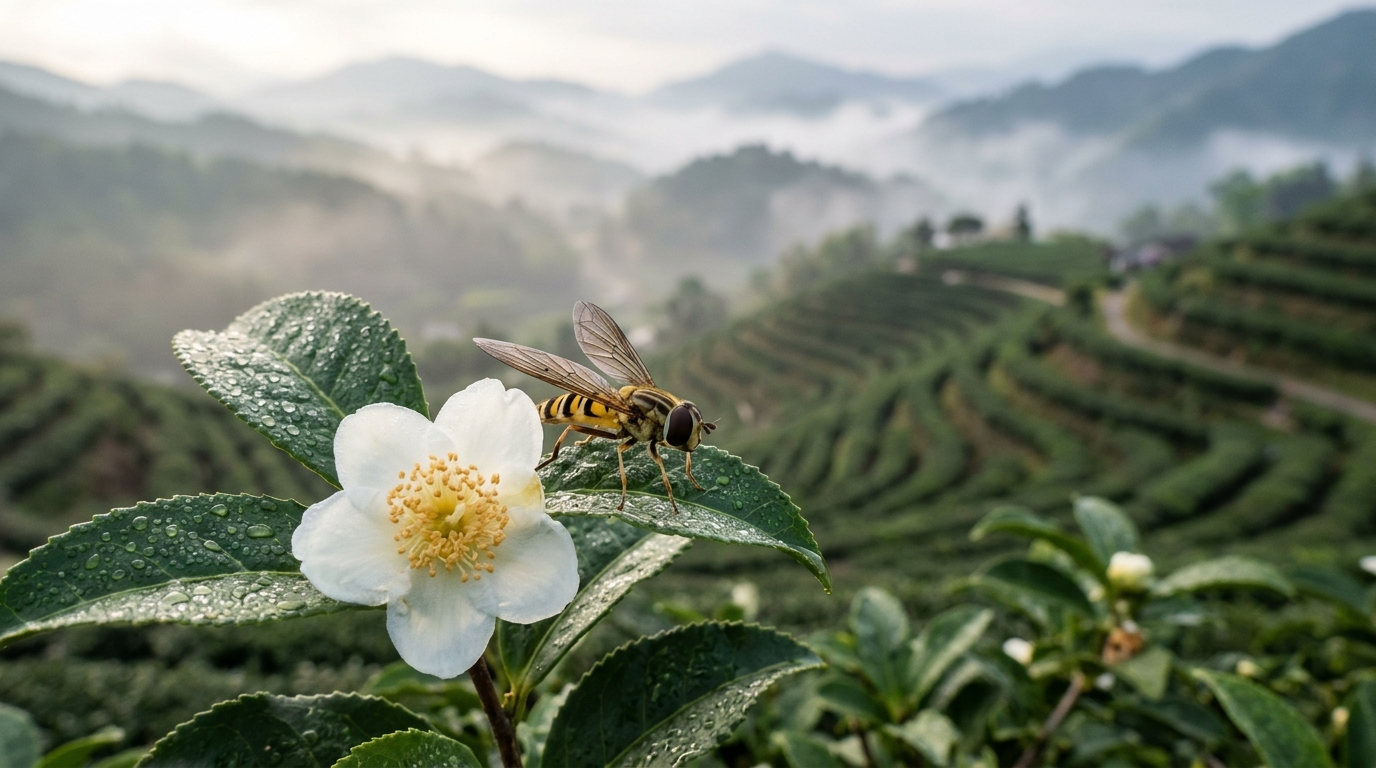
Across four contrasting tea-growing habitats in Southwest China, community-level DNA metabarcoding of Malaise-trap catches identified 5,669 flying arthropod operational taxonomic units over a six-month sampling campaign. Field surveys conducted from May through October 2024 within the Shuangjiang Mengku Ancient Tea and Cultural System in Yunnan Province documented marked differences in diversity metrics and taxonomic structure among traditional agroforests, a wild tea forest, and a recently planted shrub plantation. Researchers utilized high-throughput sequencing of the mitochondrial cytochrome c oxidase subunit I gene to characterize entire assemblages of actively flying insects and related taxa, establishing a comprehensive baseline for biodiversity monitoring across high-elevation tea-producing landscapes.
Perennial tea agroecosystems maintain relatively continuous vegetative cover and retain varying degrees of overstory canopy, understory plants, and woody vegetation, making them capable of harboring diverse biological communities. However, production contexts across Southwest China vary considerably in their elevation, disturbance history, cultivation intensity, and structural complexity. In the mountainous terrain of Mengku Town, where forests cover roughly 72 percent of the land area and elevations range from 1,040 to 3,233 meters above sea level, the researchers established 300-meter by 300-meter sampling plots across four distinct sites along the mountain range west of the Nanmeng River. These contrasting contexts included Daxueshan, a wild ancient tea-tree community located within the Lancang River Provincial Nature Reserve at approximately 2,300 meters; Dahusai, a village-adjacent ancient tea garden at 1,900 meters featuring poultry presence and intercropped crops; Wujiacun, a forest-adjacent ancient tea garden at 1,600 meters; and Yongquan, a 15-year-old shrub plantation at 1,900 meters established following forest clearance.
To capture flying insects across spatial microhabitats while minimizing edge effects, three Malaise traps were set within each plot at northwest, central, and southeast positions, spaced at least 100 meters apart and located at least 100 meters from plot borders. Collections containing 95 percent ethanol were retrieved biweekly, and to optimize operational costs, samples collected during the initial two weeks of each month were selected for sequencing. Catches from the three traps within each site were pooled into a single composite sample for each of nine temporally matched sampling occasions, creating an analytical unit based on site-by-occasion composites. After bioinformatic processing, one composite sample from Wujiacun yielded no retained arthropod reads and was excluded, leaving 35 composite libraries representing eight complete four-site sampling periods and one occasion lacking the Wujiacun station.
Molecular processing relied on an insect soup homogenization protocol that digested smaller insects whole while taking small tissue biopsies from specimens larger than 5 millimeters. DNA was extracted using Qiagen DNeasy Blood and Tissue kits with elevated digestion buffer volumes, and polymerase chain reaction amplification targeted the Leray-FolDegenRev marker region using twin-tagged primers. This tagging approach permitted bioinformatic identification and removal of tag-jumping artifacts. Merged sequence reads from an Illumina NovaSeq 6000 platform underwent quality filtering through fastp and Begum, retaining only sequences confirmed across at least two of three independent PCR replicates with a minimum of four reads per replicate. Sequences were clustered into 9,507 preliminary operational taxonomic units at 97 percent sequence similarity using vsearch, and subsequent curation through LULU at an 84 percent minimum match similarity consolidated 568 daughter units into 8,939 units, of which 5,669 survived the removal of ultra-low-frequency reads and non-arthropod contaminants.
The resulting dataset showed substantial variation in total detected operational taxonomic units among the sampled landscapes. Wujiacun, the forest-adjacent cultivated ancient tea garden, accumulated the highest overall richness with 2,319 units, followed by the young Yongquan plantation with 2,172 units, the wild Daxueshan reserve forest with 2,111 units, and the village-adjacent Dahusai garden with 1,949 units. Five major insect orders accounted for 97 percent of all detected units. Diptera dominated the catches entirely, representing 3,262 units or 57.5 percent of the total pool, followed by Hymenoptera with 835 units (14.7 percent), Lepidoptera with 654 units (11.5 percent), Hemiptera with 428 units (7.6 percent), Coleoptera with 319 units (5.6 percent), and other arthropod groups comprising 171 units (3.0 percent).
Analysis of community overlap revealed that only 196 operational taxonomic units, representing 3.5 percent of the total pool, were detected simultaneously across all four study locations. In contrast, 3,713 units, or 65.5 percent of all detected taxa, appeared at only one location throughout the entire survey. The wild forest community at Daxueshan hosted the highest proportion of unique diversity, with 1,171 units found exclusively within its traps, representing 55.5 percent of that site’s total detected richness. Wujiacun followed with 1,071 exclusive units, Yongquan with 934, and Dahusai with 537. Pairwise sharing demonstrated greater affinity among the cultivated sites: Dahusai and Wujiacun shared 863 units, Dahusai and Yongquan shared 780 units, and Wujiacun and Yongquan shared 704 units, whereas Daxueshan and Wujiacun shared only 455 units.
Statistical evaluation of alpha diversity was performed on 35 libraries rarefied to 161,951 reads each. Wujiacun exhibited the highest average values across all measured indices, with an observed mean richness of 625.75, Shannon diversity of 5.142, Simpson diversity of 0.981, and Pielou’s evenness of 0.801. A Skillings-Mack test treating sampling occasion as an incomplete block identified significant overall differences among the four locations for observed richness (SM = 9.181, p = 0.027) and Shannon diversity (SM = 8.271, p = 0.041), while Simpson diversity (SM = 6.738, p = 0.081) and Pielou’s evenness (SM = 6.980, p = 0.073) did not differ significantly. Pairwise comparisons evaluated by Wilcoxon signed-rank tests did not retain statistical significance after Holm adjustment. Dahusai recorded the lowest observed richness at 458.67, while the young plantation at Yongquan exhibited lower diversity and evenness scores despite relatively high observed counts, reflecting uneven read distributions.
Multivariate analyses of beta diversity demonstrated clear differentiation among the arthropod communities inhabiting each landscape context. Permutational multivariate analysis of variance blocking by sampling occasion confirmed significant compositional separation (pseudo-F(3, 23) = 4.373, R-squared = 0.283, p < 0.001), with all six pairwise comparisons remaining statistically significant after Holm adjustment at an adjusted p-value of 0.023. Permutational analysis of multivariate dispersion indicated that this separation was not driven by differences in multivariate dispersion among sites (F(3, 31) = 0.997, p = 0.185). Principal coordinates analysis and non-metric multidimensional scaling ordinations confirmed distinct clustering among the locations, with the first two coordinates accounting for 12.6 percent and 10.1 percent of positive-eigenvalue variation.
The top 20 insect families accounted for approximately 60 percent of all detected richness across the study, with true flies comprising half of these dominant lineages. Dominant families represented varied ecological roles, including parasitoid and predatory natural enemies such as Ichneumonidae, Braconidae, Tachinidae, and Dolichopodidae; herbivorous and potential pest lineages such as leafhoppers (Cicadellidae), leaf beetles (Chrysomelidae), and leaf-miner flies (Agromyzidae); and ecologically mixed or neutral groups such as scuttle flies (Phoridae), fungus gnats (Sciaridae), and non-biting midges (Chironomidae). These families occurred across multiple locations without forming distinct site-restricted clusters, though their relative contributions fluctuated across individual sampling events.
Community composition and richness exhibited pronounced temporal turnover from May to October, with peak richness occurring during May, June, and September, followed by marked declines during the peak July–August rainy season and late-autumn October sampling. The authors emphasized that because each landscape context was evaluated through a single focal site without independent spatial replication, observed variations cannot be causally attributed to specific management actions, elevation gradients, or canopy structures. Instead, the findings establish that diverse ancient tea agroforestry landscapes maintain rich, distinct flying arthropod assemblages, providing a rigorous empirical baseline for future landscape-scale ecological surveys.
Subject of Research: Flying arthropod diversity and community turnover across ancient tea agroforestry landscapes in Yunnan, China
Article Title: DNA Metabarcoding Reveals Flying Arthropod Diversity and Community Turnover Across Ancient Tea Agroforestry Landscapes in Southwest China
Article References: Xie, Y., Wang, Y., Liu, S., Wu, D., Huang, F., He, M., Tan, W., Xu, B., Zhang, H., & Liu, Y. (2026). DNA Metabarcoding Reveals Flying Arthropod Diversity and Community Turnover Across Ancient Tea Agroforestry Landscapes in Southwest China. Ecology and Evolution, 16(11), Article e74627. https://doi.org/10.1002/ece3.74627
Image Credits: AI Generated
DOI: 10.1002/ece3.74627
Keywords: DNA metabarcoding, arthropod diversity, tea agroforestry, Malaise trap, community turnover, Yunnan, Diptera, agroecology, Metabarcoding, Reveals, Flying, Arthropod
News Source: Drew Townsend. (November 6, 2026). Metabarcoding Uncovers Flying Arthropod Diversity Across Ancient Chinese Tea Landscapes. Scienmag.