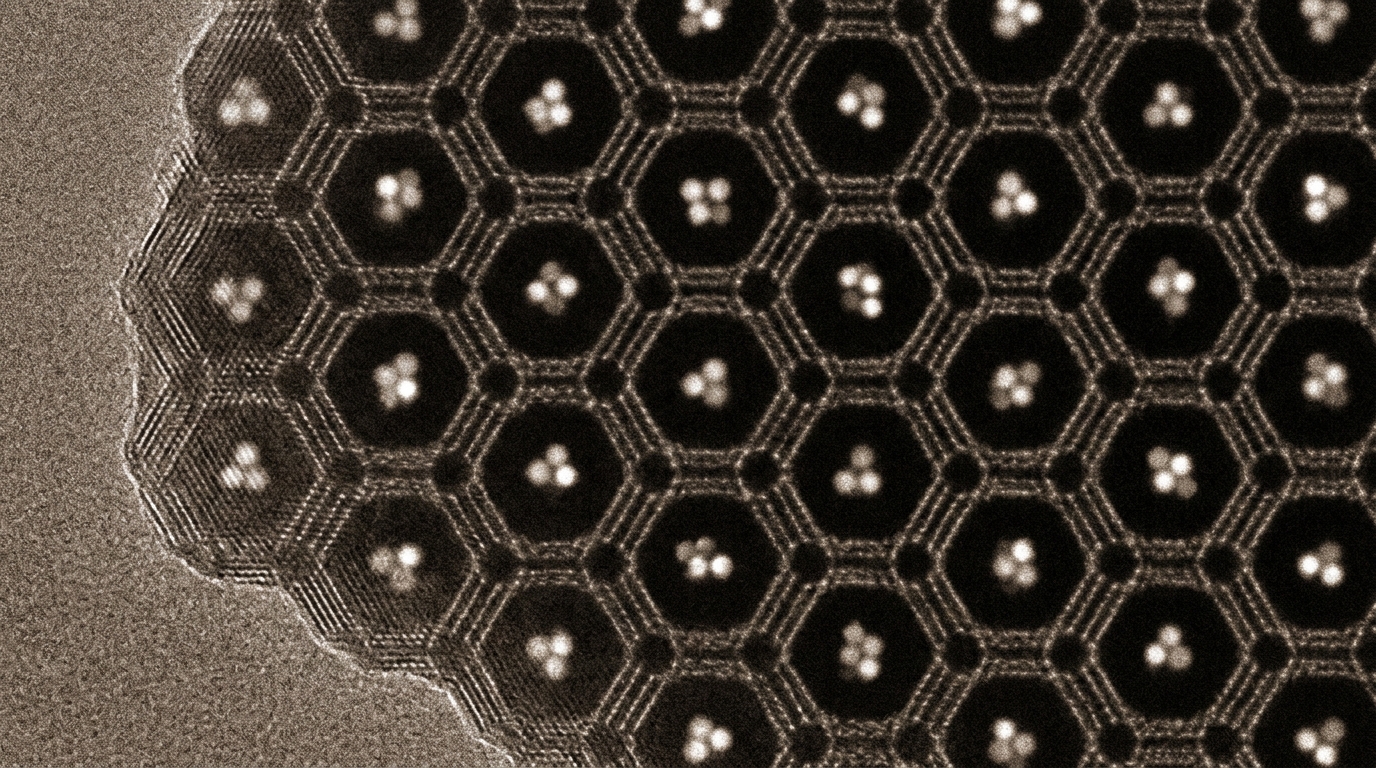
Chemists have built a hybrid catalyst in which an iron coordination complex sits trapped inside the nanocavities of zeolite-Y, and the resulting material shows exceptional catalytic efficacy in the oxidative coupling of β-naphthol. The work, published in Catalysis Letters, describes a host–guest architecture designated [Fe(pabmbn)Cl]-Y, in which the iron complex is immobilised within the zeolite pores using a flexible ligand strategy. The ligand pabmbn is (2,2'-(1,2-phenylenebis(azanylylidene))bis(methanylylidene))bis(naphthalen-1-ol), and the iron coordination complex was encapsulated within the nanocavities of zeolite-Y using a flexible ligand strategy.
The guest is an iron complex, and the authors describe the encapsulated metal-complex system as an environmentally benign catalytic platform for driving advanced organic oxidations.
Characterisation of the hybrid material was extensive. Elemental analysis and ICP-MS quantified the iron guest within the framework. N₂ sorption isotherms analysed by the BET method probed the porosity of the host, while FT-IR spectroscopy tracked the vibrational fingerprints of both framework and ligand. Thermogravimetric analysis assessed thermal stability, SEM-EDS mapped elemental distribution, UV-vis spectroscopy probed the electronic environment of the complex, and powder X-ray diffraction confirmed the crystalline structure. Together these methods clearly confirmed the structural integrity of the zeolite framework and the uniform, stable immobilisation of the [Fe(pabmbn)Cl] guest.
With the material in hand, the researchers turned to the oxidative coupling of β-naphthol, a reaction that joins two naphthol molecules through a new carbon–carbon bond to form BINOL. Systematic optimisation of the reaction parameters yielded exceptional conversion, TON, and TOF metrics, meaning the catalyst achieved high turnover numbers and high turnover frequencies under the optimised conditions. The structural identity and purity of the resulting BINOL product were unambiguously confirmed via rigorous FT-IR, NMR spectroscopy, and mass spectrometry.
A central question for any confined catalyst is how the host shapes the reaction. The authors propose a plausible mechanistic pathway for this targeted C–C coupling, highlighting the critical role of the confined zeolitic microenvironment in guiding selectivity.
Recyclability is where heterogeneous catalysts must prove their worth, and the encapsulated system performed well. The hybrid material exhibited robust stability and recyclability, enduring four consecutive catalytic cycles. The authors describe the encapsulated metal-complex system as a durable, structurally stable, and environmentally benign catalytic platform for driving advanced organic oxidations.
The study, published in Volume 156 of Catalysis Letters as article number 315, comes from a team including Kuldip P. Parmar, Anwar H. Saiyad, Umang P. Mehta, Dinesh R. Godhani and Jignasu P. Mehta. Their reported metrics for conversion, TON and TOF were obtained through systematic optimisation of reaction parameters, and the structural identity and purity of the resulting BINOL product were confirmed via FT-IR, NMR spectroscopy, and mass spectrometry.
Subject of Research: Encapsulation of an iron coordination complex in zeolite-Y nanocavities creates a heterogeneous catalyst for the oxidative coupling of β-naphthol to BINOL.
Article Title: Synergistic Catalysis in Zeolite-Y Encapsulated Metal–Ligand Composites
Article References: Parmar, K. P., Saiyad, A. H., Mehta, U. P., Godhani, D. R., & Mehta, J. P. (2026). Synergistic Catalysis in Zeolite-Y Encapsulated Metal–Ligand Composites. Catalysis Letters, 156(11), Article 315. https://doi.org/10.1007/s10562-026-05561-8
Image Credits: AI Generated
DOI: 10.1007/s10562-026-05561-8
Keywords: zeolite-Y, iron complex, heterogeneous catalysis, oxidative coupling, BINOL, β-naphthol, host-guest chemistry, encapsulation, TON, TOF, recyclability, Catalysis Letters
News Source: Bethany Barker. (November 6, 2026). Iron Complex Locked Inside Zeolite Nanocavities Drives Efficient Oxidative Coupling. Scienmag.