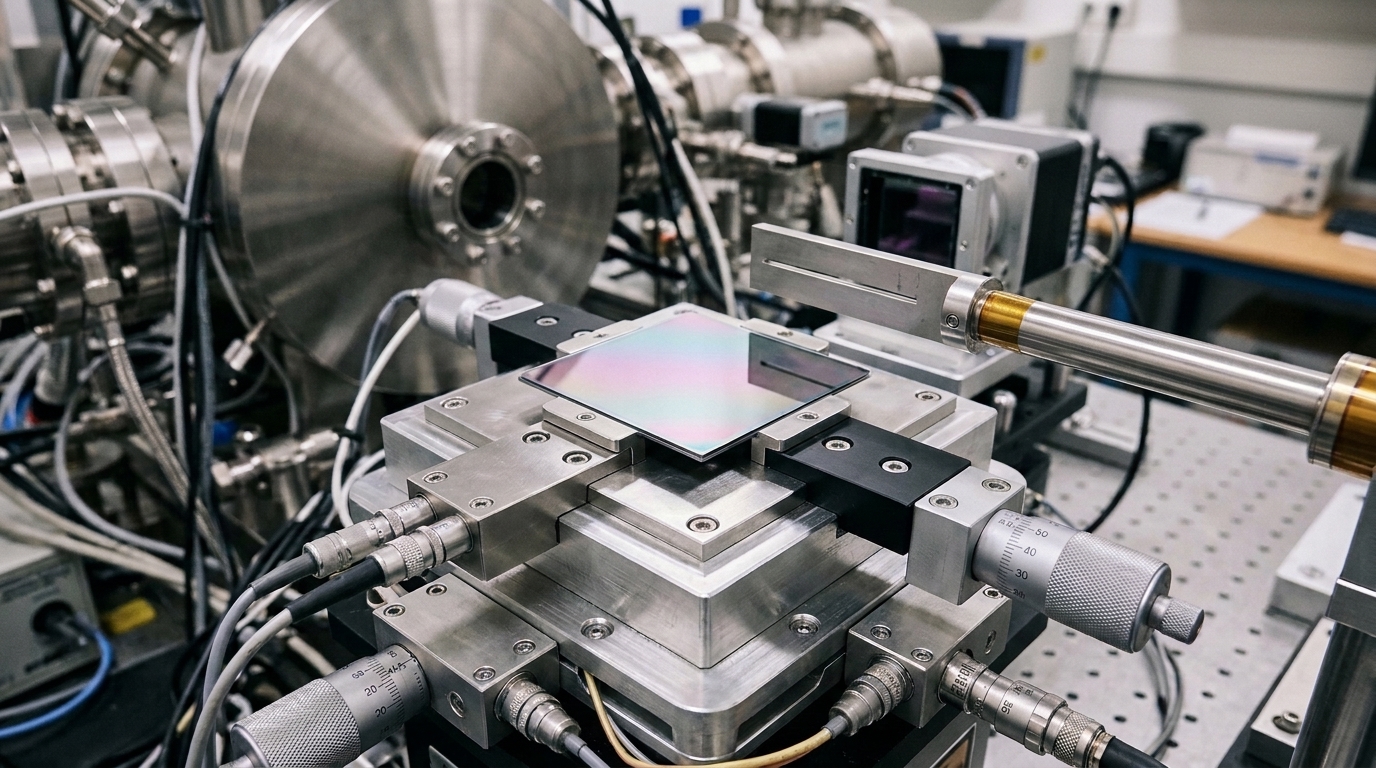
Block copolymers, in which two chemically distinct polymer chains are linked into a single molecule, self-assemble into periodic nanoscale domains, and their usefulness in next-generation nanofabrication and optoelectronics depends on how well those microphase-separated domains order over long ranges with precise periodicity. A study published in npj Flexible Electronics describes a closed-loop workflow that combines synchrotron grazing-incidence small-angle X-ray scattering (GISAXS), automated scattering data analysis, and Gaussian process-driven Bayesian optimization to find processing conditions that maximize this structural fidelity.
The team applied the workflow to the swelling-induced assembly of poly(styrene-b-2-vinylpyridine), known as S2VP, blends. The optimization navigates a two-dimensional processing space defined by the polymer blending ratio and the solvent uptake. Two quantities were optimized jointly: the domain spacing and the peak sharpness, which serves as a measure of structural ordering. Rather than treating both as equal objectives, the researchers formulated a constraint-aware acquisition strategy in which domain spacing acts as a feasibility constraint while structural ordering is optimized within the feasible region.
This task-specific formulation matters because the landscape contains both monotonic and highly nonlinear responses, and the authors note that their constraint-aware strategy differs from simply applying a standard Gaussian process-driven Bayesian optimization workflow. The efficiency gain is the headline result: the workflow identified target-satisfying conditions using approximately 30 experiments, which the authors report is more than two orders of magnitude fewer than the number required for uniform coverage at the stated resolution. Conventional optimization in this field relies on Edisonian trial-and-error, an approach the study characterizes as resource-intensive, slow, and often unable to identify the global optimum.
The experimental backbone of the loop is synchrotron GISAXS. Each iteration feeds scattering data into an automated analysis pipeline, which extracts the domain spacing and peak sharpness metrics that the optimizer needs. Because the measurements and analysis are automated, the loop can run without a human deciding where to point the X-ray beam next, which is what makes the approximately 30-experiment result achievable in practice.
The study appears as an open-access article in npj Flexible Electronics, published on 31 October 2026, with a shared early version that is citable and carries a permanent DOI ahead of the final Version of Record. The author list spans researchers including Yunfei Wang, Raja Vyshnavi Sriramoju, Saroj Upreti, Ka Hung Chan, Marcus M. Noack, Eric Schaible, Damon English, Alexander Hexemer, Wiebke Koepp, Chenhui Zhu, and Xiaodan Gu, pairing polymer science with synchrotron beamline expertise and computational optimization.
For the broader materials community, the significance lies in the framing rather than any single recipe. Treating one measured property as a hard constraint and optimizing another within the feasible set gives experimenters a template for problems where the desirable operating window is bounded on one side. Synchrotron beam time is scarce and expensive, so any method that reaches a target with tens of measurements instead of thousands changes what kinds of parameter sweeps are practical, and the S2VP demonstration shows the approach working on a real swelling-induced assembly problem rather than on simulated data.
Limitations remain worth noting. The published demonstration covers a two-dimensional processing space for one polymer blend system, and the reported efficiency claim is tied to the stated resolution of the uniform-coverage comparison. The early-release version is subject to further edits before the final record appears. Even so, the combination of automated scattering analysis with constraint-aware Bayesian optimization offers a concrete path toward faster exploration of processing spaces in self-assembling polymer systems.
Subject of Research: Closed-loop Bayesian optimization of block copolymer blend morphology using synchrotron X-ray scattering
Article Title: Bayesian optimization-guided closed-loop morphology optimization of block copolymer blends via synchrotron X-ray scattering
Article References: Wang, Y., Sriramoju, R. V., Upreti, S., Chan, K. H., Noack, M. M., Schaible, E., English, D., Hexemer, A., Koepp, W., Zhu, C., & Gu, X. (2026). Bayesian optimization-guided closed-loop morphology optimization of block copolymer blends via synchrotron X-ray scattering. npj Flexible Electronics. https://doi.org/10.1038/s41528-026-00658-x
Image Credits: AI Generated
DOI: 10.1038/s41528-026-00658-x
Keywords: block copolymers, Bayesian optimization, Gaussian process, GISAXS, synchrotron X-ray scattering, self-assembly, morphology optimization, S2VP, automated data analysis, npj Flexible Electronics, nanofabrication, optoelectronics
News Source: Denise Maddox. (November 6, 2026). AI Steers X-Ray Experiments to Perfect Block Copolymer Films in About 30 Runs. Scienmag.