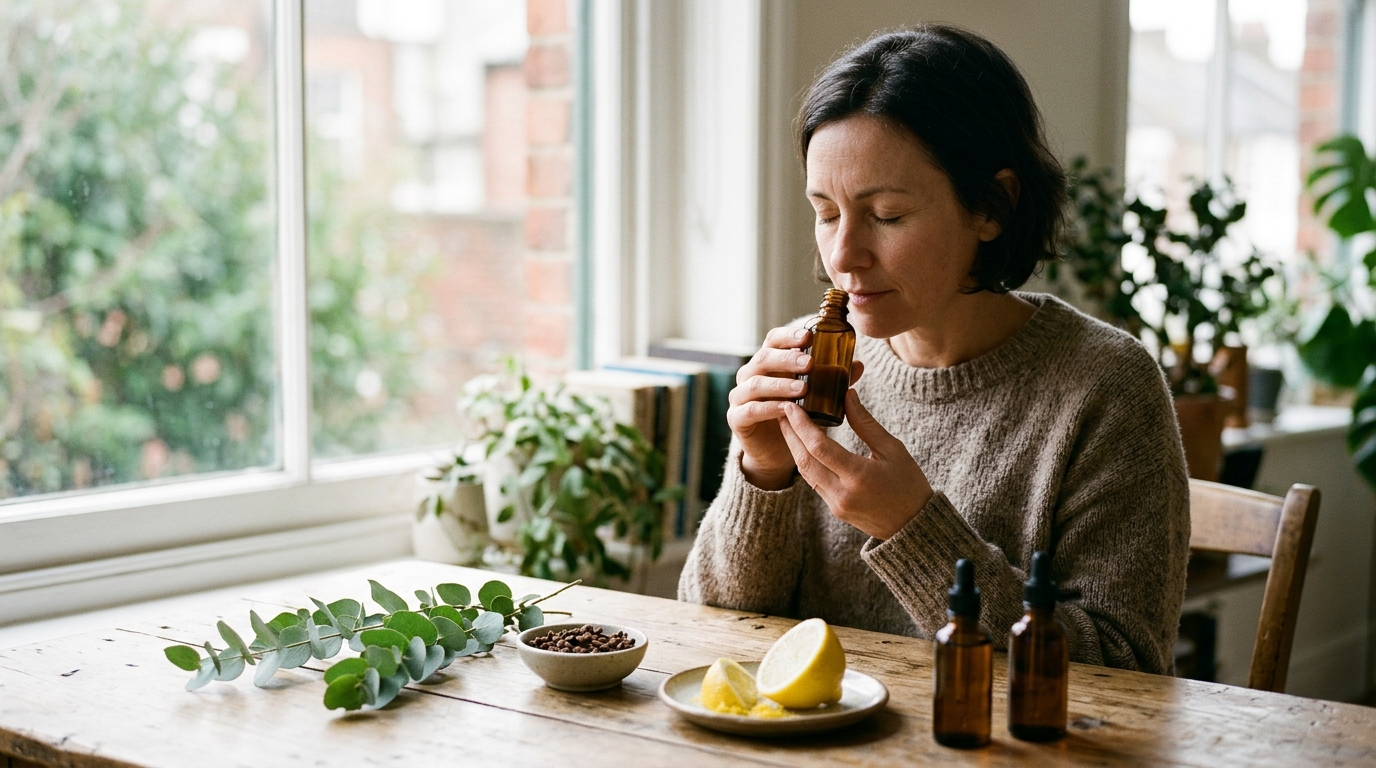
A twelve-week regimen of structured olfactory training led to significant and clinically meaningful improvements in smell function among adults experiencing persistent olfactory dysfunction after SARS-CoV-2 infection, according to results from a single-centre, randomized, controlled, assessor-blinded trial. The study, designated as the SMELL trial, addressed a condition that is common, prolonged, and disabling following infection, and for which validated therapeutic options have remained limited. Investigators evaluated adult participants aged 18 years and older who had experienced at least three months of ongoing olfactory dysfunction after a documented SARS-CoV-2 infection and who demonstrated measurable baseline impairment on Sniffin’ Sticks identification testing.
Because the trial protocol was designed during the COVID-19 pandemic under contemporaneous infection-control recommendations, the researchers implemented specific methodological modifications to ensure participant safety. Olfactory assessments were performed by drawing an odor line onto single-use filter paper strips rather than presenting the reusable Sniffin’ Stick pen directly beneath each participant’s nose. This technique proved feasible for conducting both Sniffin’ Stick identification and Sniffin’ Stick discrimination testing; however, it was not feasible for odor threshold assessment, which was consequently omitted. To account for this adaptation, the study used a prespecified modified Sniffin’ Sticks total score, calculated by combining the identification and discrimination scores, with the primary study endpoint defined as the change in this modified total score from baseline to twelve weeks.
Study screening proceeded through October 31, 2024, during which a total of 77 candidates were assessed. From this screened group, 70 participants were randomly assigned either to undergo twelve weeks of olfactory training or to receive no intervention, representing the natural course of recovery. A total of 68 participants completed the randomized phase of the trial and were included in the primary per-protocol analysis, consisting of 38 participants allocated to the active olfactory training intervention and 30 participants allocated to the untreated control group.
The trial demonstrated that twelve weeks of olfactory training significantly improved modified Sniffin’ Sticks total scores compared with the control condition, yielding a statistically significant time-by-group interaction of F(1, 66) = 29.95 (p < 0.001; partial η² = 0.31). Statistically significant interaction effects favouring the intervention were likewise observed across both subcomponents, with identification scores achieving p < 0.001 (partial η² = 0.27) and discrimination scores achieving p < 0.001 (partial η² = 0.19). Protocol-defined clinically relevant improvement in the modified total score occurred in 22 of 38 participants (57.9%) in the olfactory training arm compared to 2 of 30 participants (6.7%) in the control group (φ = 0.53, p < 0.001). Furthermore, assessments of global improvement reported by patients and evaluated by clinicians independently favoured the olfactory training group.
Predefined subgroup evaluations confirmed consistent treatment benefits among individuals whose olfactory loss had persisted for more than 6 months as well as those with ongoing loss exceeding 12 months. In addition, participants initially assigned to the control group who subsequently received training during an exploratory extension phase demonstrated significant gains in total modified scores, identification scores, and discrimination scores. No serious adverse events occurred throughout the trial, leading the study team to conclude that structured olfactory training offers a safe, practical, and scalable treatment option for persistent post-COVID-19 smell dysfunction.
Subject of Research: Olfactory training for persistent post-COVID-19 olfactory dysfunction
Article Title: Olfactory training for COVID-19–related smell loss: the smell trial
Article References: Heim, B., De Cleene, N., Jagusch, F., Peball, M., Cerejo, C., Schmutzhard, J., Löffler-Ragg, J., Göbel, G., Djamshidian, A., Weiss, G., Seppi, K., on behalf of the SMELL study group, Cleene, N. D., Ellmerer, P., Gottfried, T., Helbok, R., & Kindl, P. (2026). Olfactory training for COVID-19–related smell loss: the smell trial. BMC Medicine. https://doi.org/10.1186/s12916-026-05375-w
Image Credits: AI Generated
DOI: 10.1186/s12916-026-05375-w
Keywords: olfactory training, COVID-19, smell loss, olfactory dysfunction, randomized controlled trial, Sniffin' Sticks, SMELL trial, post-COVID conditions, Olfactory, training, related, smell
News Source: Ophelia Keating. (November 6, 2026). Twelve-Week Olfactory Training Improves Persistent Post-COVID-19 Smell Loss in Randomized Trial. Scienmag.