A perspective study published in Frontiers in Sustainable Cities by researcher Abdulaziz I. Almulhim from Imam Abdulrahman Bin Faisal University evaluates how conflict-related maritime disturbances surrounding the Strait of Hormuz challenge conventional assumptions regarding urban resilience. Examining disruptions that began on February 28, 2026, the analysis demonstrates that while cities depend fundamentally on expansive infrastructural lifelines extending far beyond their municipal boundaries, resilience is still predominantly conceptualized through internal territorial capacities. The strategic waterway connecting the Arabian Gulf and the Gulf of Oman handles a substantial share of global energy commerce with minimal immediate alternatives during geopolitical crises. By assessing emergent rerouting responses across the Gulf region, particularly within Saudi Arabia, the paper underscores that rerouting vital supplies across alternative pipelines, Red Sea maritime gateways, and overland highways constitutes a potential mechanism of adaptive capacity. However, the study emphasizes that such infrastructural adaptations should not be conflated with demonstrated systemic resilience, because shifting logistical flows frequently relocates operational pressures and vulnerabilities elsewhere.
Urban populations rely continuously on largely invisible and uninterrupted flows of crude oil, refined fuels, foodstuffs, pharmaceuticals, and specialized industrial materials that circulate across geographically concentrated transit routes. When unexpected geopolitical conflict interrupts shipping lanes across narrow maritime bottlenecks, the resulting systemic consequences extend well beyond abstract market volatility and price fluctuations to trigger direct operational strain, inventory depletion, and localized supply shortages across dependent metropolitan areas. Traditional resilience planning frequently remains constrained within municipal jurisdictions, overlooking the complex reality that modern urban systems operate as deeply externalized entities anchored to distant supply networks. The paper notes that regions with restricted domestic production due to environmental constraints, demographic expansions, or economic specializations experience acute vulnerabilities when external resource corridors contract. Consequently, the research argues that evaluating urban vulnerability strictly through municipal governance frameworks creates an intellectual blind spot, as urban stability remains fundamentally relational and dependent on the uninterrupted continuity of remote infrastructure corridors spanning national and international jurisdictions.
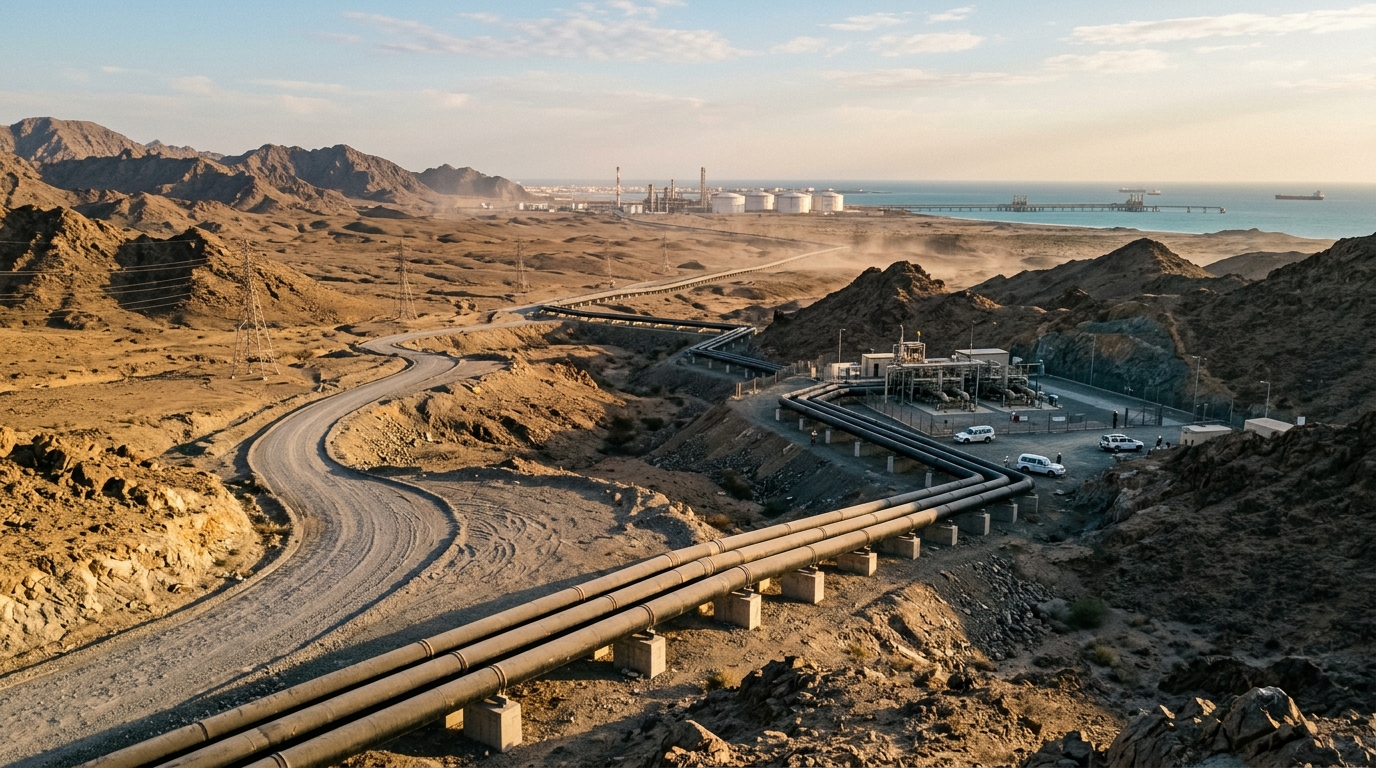
The concentration of global commercial trade through strategic maritime bottlenecks exacerbates systemic fragility across interconnected economic sectors. Chokepoints enhance transport efficiencies under normal conditions but expose mutually dependent utility, energy, and distribution networks to cascading operational failures when geopolitical conflicts emerge. In response to the February 2026 shipping interruptions through the Strait of Hormuz, regional infrastructure operators activated alternative routing mechanisms to bypass the restricted maritime corridor. Saudi Aramco reportedly implemented operational contingency procedures to ramp up throughput across the East-West Pipeline starting on February 28, 2026. By March 4, the overland conduit was reportedly operating near its total operational threshold, transporting approximately seven million barrels of crude oil per day from production fields in the Eastern Province across the Arabian Peninsula to the Red Sea port terminal at Yanbu. This rerouting diverted tankers originally designated for Arabian Gulf loading terminals toward western Red Sea facilities, partially offsetting seaborne export volumes typically transiting the contested strait.
Beyond hydrocarbon transmission, the rerouting of commercial goods extended across intermodal transit systems combining maritime terminals and cross-border highway corridors. Saudi Arabia utilized its geographic position between the Arabian Gulf and the Red Sea to establish extensive land-bridge networks that connect western maritime terminals with neighboring Gulf states, including the United Arab Emirates and Oman. During the initial weeks of the shipping disruptions, official logistics tracking recorded more than 94,000 outbound trucks transiting cross-border overland routes to distribute redirected goods throughout the region. Concurrently, Jeddah Islamic Port emerged as a primary maritime hub along the Red Sea logistics axis, processing approximately 100,000 commercial cargo trucks and more than 90,000 shipping containers in roughly one month. These overland corridors provided critical transit alternatives for essential consumer products, imported foodstuffs, and industrial inputs, illustrating that physical ports, hydrocarbon pipelines, and highway corridors can function collectively to reconfigure regional distribution channels during acute maritime crises.
Despite the successful activation of alternative conduits, the study highlights clear structural limitations governing how much volume secondary infrastructure can absorb. While pipeline networks provide valuable contingency pathways for crude exports, data from the International Energy Agency indicates that existing pipeline capacity capable of bypassing the Strait of Hormuz is limited to between 3.5 million and 5.5 million barrels per day. In contrast, normal seaborne crude trade moving through the Strait of Hormuz reaches approximately twenty million barrels per day. Because pipeline throughput accounts for only a fraction of customary maritime volumes, alternative conduits cannot fully substitute for the complete loss of access to primary shipping corridors. The research cautions that the mere existence of alternative infrastructure pathways must be interpreted as reserve adaptive capacity rather than proof that normal baseline levels of supply, trade throughput, or metropolitan functioning have been completely preserved under sustained external disruption.
The analysis further demonstrates that reconfiguring trade pathways does not extinguish systemic vulnerability, but instead redistributes operational risks toward alternate geographic corridors and administrative jurisdictions. Shifting maritime traffic toward Red Sea gateways relocates logistics flows into an operational theater marked by distinct geopolitical and maritime security hazards. The southern Red Sea and Bab al-Mandab corridor have experienced repeated armed attacks directed against commercial shipping vessels by Houthi forces since late 2023, causing maritime diversions, elevated shipping risks, and steep escalations in marine insurance premiums. When shipping companies circumvent regional hazards altogether by rerouting cargo vessels around the African continent, maritime transit distances increase substantially by 5,000 to approximately 12,000 kilometers. These long-distance diversions add one week or more to maritime transit schedules, imposing severe operational delays, compounding port congestion, elevating inventory holding pressures, and creating substantial cost increases across global supply networks.
These operational shifts generate substantial financial burdens for global ocean carriers and cargo owners, as illustrated by corporate reporting from major shipping lines. International container carrier Maersk estimated that disruptions across Middle Eastern maritime corridors increased its ongoing operational fuel expenditures by approximately 500 million United States dollars per month. Concurrently, multiple ocean carriers suspended selected Gulf services or redirected global liner schedules around southern Africa to mitigate vessel risks. These escalating transport costs, combined with emergency war risk surcharges and higher baseline freight tariffs, demonstrate that route diversification changes the geographic pattern of expenditure and exposure rather than providing an economically seamless or risk-free logistical solution. For urban planners, the resulting economic friction reveals that securing emergency alternative supplies frequently incurs substantial logistical surcharges that cascade into higher procurement costs for essential metropolitan goods and municipal services.
The physical redistribution of freight also generates intense localized operational pressures across recipient logistics nodes and transport facilities. Concentrating cargo intake within western gateways such as Jeddah Islamic Port transfers severe administrative, customs, and vehicle coordination burdens onto local port authorities and terrestrial road infrastructure. Managing tens of thousands of diverted containers and cross-border freight convoys requires continuous inter-agency coordination, expedited customs processing, and expanded fleet capacity across inland highway networks. The study stresses that while route diversification expands regional options, the associated operational strain falls unevenly upon specific urban infrastructures, illustrating how resilience benefits realized at a national strategic level can simultaneously generate acute logistical complications and resource competition for municipal host environments.
Drawing broader conceptual conclusions from the 2026 disruptions, the paper argues that infrastructure governance cannot remain focused solely on economic efficiency and route optimization. Standard planning paradigms historically prioritized consolidated, highly optimized logistics pathways to reduce transit durations and overhead expenses during stable market periods. However, findings from transportation network research demonstrate that network efficiency under steady-state conditions frequently undermines systemic robustness by eliminating operational slack and redundancy. When highly concentrated transit corridors encounter severe operational blockages, tightly coupled distribution networks lack flexible buffers to withstand propagating shocks. The perspective emphasizes that critical infrastructure resilience fundamentally requires structural redundancy, modal diversity, and spatial distributedness across multiple regional lifelines. Planners must view spare capacity and parallel transport connections not as inefficient economic redundancies, but as vital insurance mechanisms required to preserve functional urban continuity when primary supply routes fail.
Ultimately, the study contends that urban resilience frameworks must expand beyond municipal boundaries to encompass the transnational infrastructure webs that sustain contemporary urban life. As an illustrative perspective rather than an exhaustive empirical case study, the paper does not assess the performance of individual municipalities, but instead frames the Strait of Hormuz as an analytical lens for understanding relational infrastructure dependence. Sustaining essential municipal services under geopolitical shock depends on multilateral institutional alignment, multimodal connectivity, and cross-border logistical coordination among national ministries, international shipping entities, and infrastructure operators. Future research must examine the precise institutional conditions under which remote infrastructural adaptations protect municipal welfare rather than simply displacing vulnerabilities onto vulnerable populations, secondary chokepoints, or alternate jurisdictions. Achieving genuine urban resilience therefore requires recognizing that cities endure external disruptions not through self-contained isolation, but through the dynamic, equitable, and coordinated reorganization of interconnected lifelines.
Subject of Research: Infrastructural reconfiguration and urban resilience dynamics during shipping disruptions surrounding the Strait of Hormuz
Article Title: Urban lifelines and resilience beyond the Strait of Hormuz
Article References: Almulhim, A. I. (2026). Urban lifelines and resilience beyond the Strait of Hormuz. Frontiers in Sustainable Cities, 8, Article 1989676. https://doi.org/10.3389/frsc.2026.1989676
Image Credits: AI Generated
DOI: 10.3389/frsc.2026.1989676
Keywords: urban resilience, Strait of Hormuz, infrastructure networks, supply chain reconfiguration, energy lifelines, maritime chokepoints, logistics corridors, adaptive capacity, Urban, lifelines, resilience, beyond
News Source: Denise Maddox. (November 6, 2026). Rerouting Hormuz Infrastructure Lifelines Redistributes Vulnerabilities Across Regional Urban Networks. Scienmag.