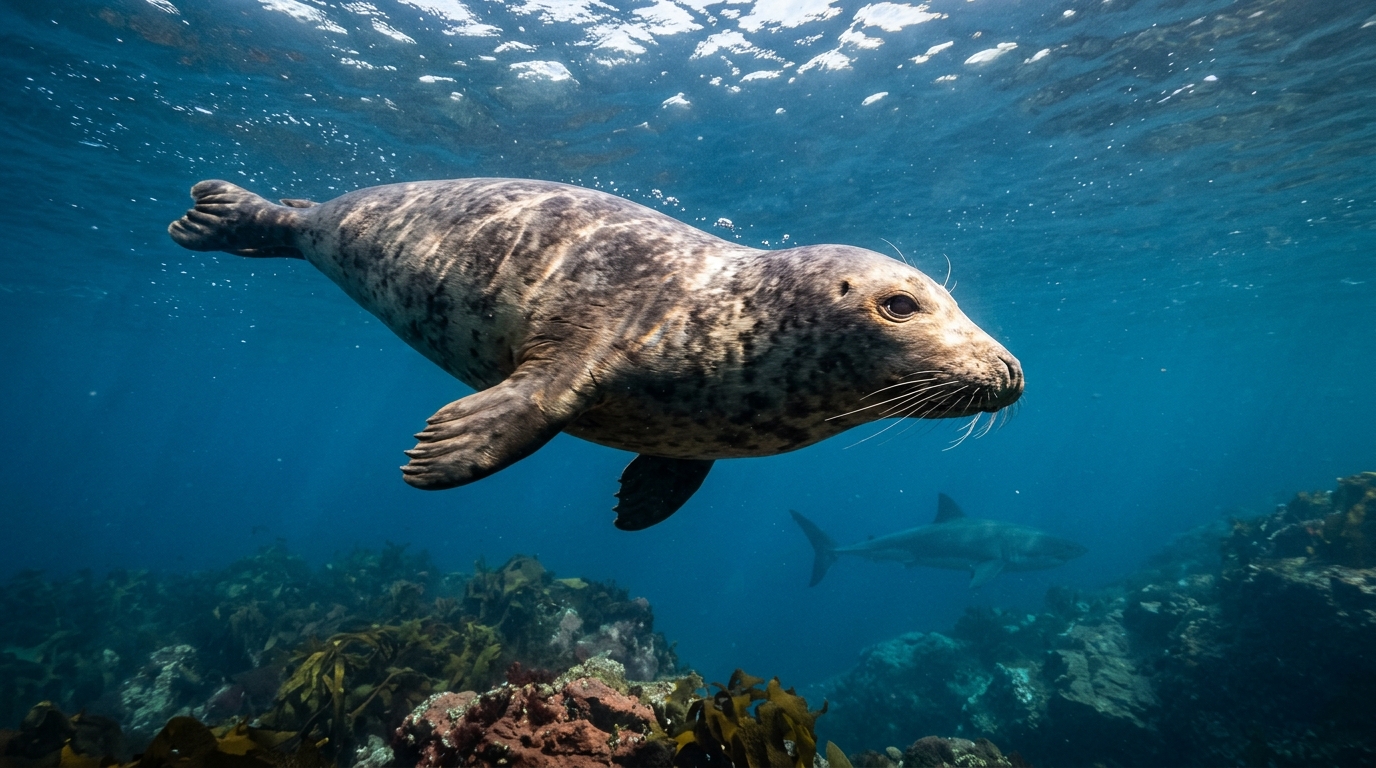
Grey seals and white sharks in Atlantic Canadian waters cross paths far more often around the Magdalen Islands in the Gulf of St. Lawrence than around Sable Island, even though Sable hosts the largest grey seal colony in the region. That is the central finding of a new open-access study in Animal Biotelemetry, which used mobile acoustic telemetry and satellite biologging to map where and when the two species overlap. The work matters because white shark presence in these waters has recently increased, potentially intensifying predation pressure on grey seals, an abundant generalist mesopredator with broad and complex trophic relationships across the ecosystem.
The research team, led by Hassen Allegue and Xavier Bordeleau with colleagues including Cornelia E. den Heyer, Damian C. Lidgard, Megan V. Winton, Gregory B. Skomal, Samuel Mongrain and Heather D. Bowlby, set out to quantify relative probabilities of grey seal and white shark co-occurrence. Their approach compared observed encounters against simulation-based null distributions of random shark movement, a design that accounted for the spatiotemporal distribution of seal acoustic monitoring effort. This control is critical: without it, a shark simply swimming where researchers happened to deploy receivers could look like a meaningful encounter rather than a statistical artifact.
The results reveal a strongly heterogeneous seascape of risk. Co-occurrences were more likely in coastal regions with important grey seal haul-out aggregations in the Gulf of St. Lawrence, such as the Magdalen Islands, than in other coastal regions, offshore areas, and the Sable Island region. In other words, the biggest colony does not generate the most overlap with sharks. Instead, the pattern points to specific coastal aggregation sites as the places where seals and sharks most frequently share the same waters.
Timing proved equally structured. Co-occurrences began in June, increased through September, and then declined through November. This seasonal arc suggests that the window of elevated overlap is concentrated in the late summer and early autumn, with the probability of a seal encountering a shark climbing steadily toward a September peak before tapering off as the year winds down.
The study also examined how encounter probability related to shark characteristics. Seals co-occurred with female and male white sharks with the same probability, although the dataset had limited adult females, a caveat the authors flag explicitly. Co-occurrence probability did not vary with male shark body size, yet it exhibited a weak non-linear relationship with female body size. These sex-specific patterns add a layer of nuance to how predation risk is distributed across the shark population.
Methodologically, the combination of mobile acoustic telemetry and satellite biologging allowed the researchers to track both species in the same analytical frame. Mobile acoustic telemetry detects tagged animals as they pass receivers, while satellite biologging records movements at broader scales. By pairing these data streams with null models of random shark movement that respected the monitoring effort’s own footprint, the team could distinguish genuine spatial and temporal clustering of encounters from patterns that would arise by chance alone.
The ecological stakes are considerable. Depending on the severity of associated lethal and sub-lethal effects, the authors write, this heterogeneous seascape for predation risk and competitive interactions may shape seal behavior, distribution, and demography. Such shifts could in turn cascade through the ecosystem, changing trophic dynamics and community structure in the years to come. Grey seals, as abundant generalist mesopredators, sit at a junction of many food-web pathways, so changes in where they forage or haul out could ripple outward to other species.
It is worth emphasizing what the study does and does not claim. The findings describe relative probabilities of co-occurrence, not direct observations of predation events, and the authors frame the demographic consequences as conditional on the severity of lethal and sub-lethal effects rather than as measured outcomes. The dataset’s limited number of adult female sharks also constrains interpretation of the body-size results for that sex. Ecosystems are networks of organisms connected through biotic and abiotic interactions shaping food-web structures, and these interactions change over time, leading to variable effects on ecosystem functioning, the paper notes in its framing, underscoring that the observed heterogeneity is a snapshot within a dynamic system.
For researchers and managers tracking the recent increase in white shark presence in Atlantic Canadian waters, the study offers a concrete spatial and temporal template: watch the coastal haul-out aggregations of the Gulf of St. Lawrence, especially around the Magdalen Islands, through the June-to-September build-up, and treat the Sable Island region as comparatively lower in encounter probability despite its colony size. The published version is citable and carries a permanent DOI, though the early-release text is subject to further edits and will be replaced by the final Version of Record.
Subject of Research: Spatiotemporal patterns of grey seal and white shark co-occurrence in Atlantic Canadian waters
Article Title: Spatiotemporal patterns of grey seal-white shark co-occurrences in Atlantic Canadian waters
Article References: Allegue, H., Bordeleau, X., den Heyer, C. E., Lidgard, D. C., Winton, M. V., Skomal, G. B., Mongrain, S., & Bowlby, H. D. (2026). Spatiotemporal patterns of grey seal-white shark co-occurrences in Atlantic Canadian waters. Animal Biotelemetry. https://doi.org/10.1186/s40317-026-00493-x
Image Credits: AI Generated
DOI: 10.1186/s40317-026-00493-x
Keywords: grey seal, white shark, acoustic telemetry, satellite biologging, Gulf of St. Lawrence, Magdalen Islands, Sable Island, predation risk, co-occurrence, Atlantic Canada, ecosystem dynamics, animal movement
News Source: Drew Townsend. (November 6, 2026). Grey Seals and White Sharks Meet Most Often Near Magdalen Islands, Not Sable Island. Scienmag.