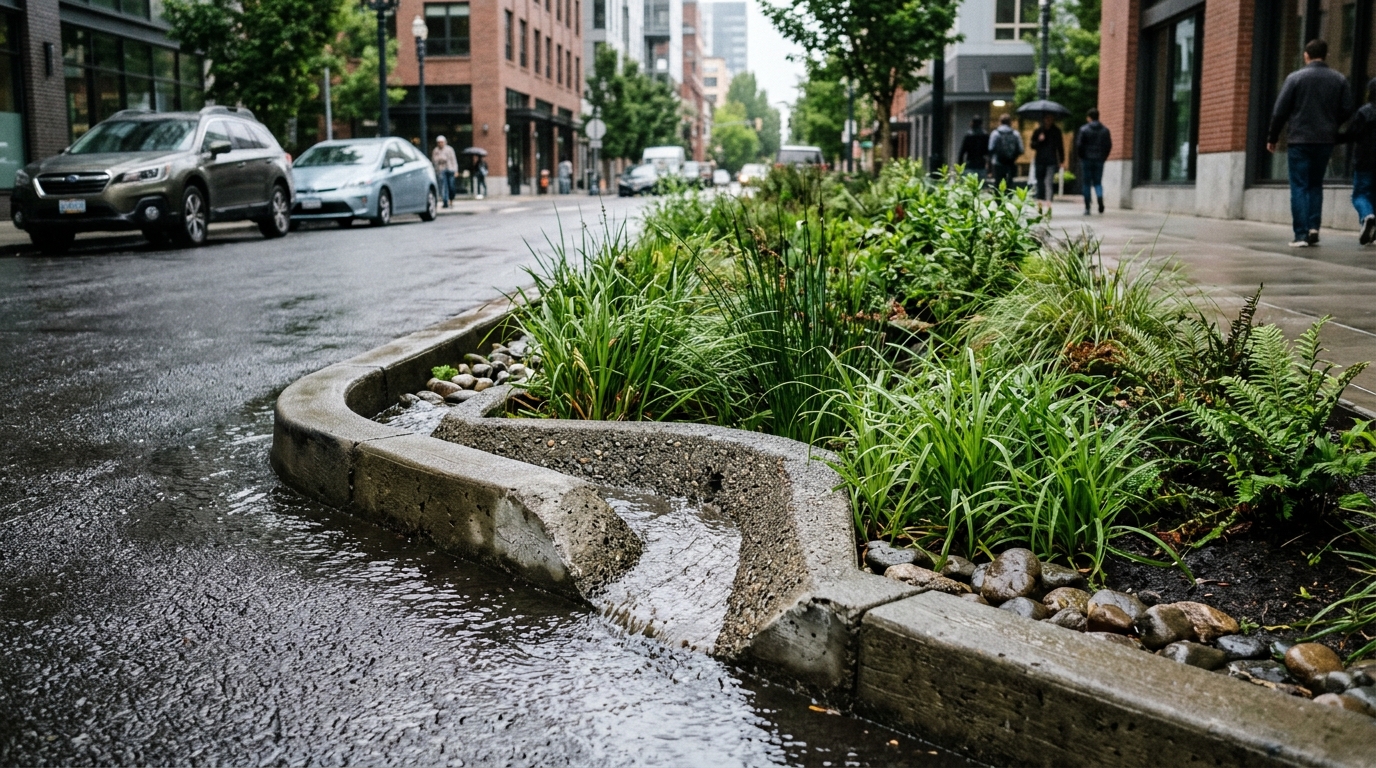
Digital simulations evaluating parametric curb designs on a modeled urban street segment in South Korea demonstrate that modifying curb extrusion height and inclination angle significantly alters rainwater retention volume and directional flow toward roadside green infrastructure. The simulation outcomes revealed that increasing curb extrusion height produced higher rainwater retention capacity, with the tallest tested profiles measuring 210 millimeters in height reaching peak droplet retention counts. However, these tallest configurations also exhibited the greatest performance variability across repeated trials. In contrast, curb profiles with lower extrusion heights of 110 millimeters and 160 millimeters demonstrated moderate retention capacities accompanied by substantially more stable hydraulic behavior. Across all tested extrusion heights, mid-range inclination angles centered around 3 degrees yielded the most consistent retention performance and flow guidance, identifying a passive geometric configuration capable of delivering moisture to street-edge vegetation without requiring active mechanical infrastructure.
The study addresses systemic environmental challenges generated by modern vehicle-dominated street infrastructure, which historically departed from pedestrian-oriented settlement designs originally characterized by transportation researcher John J. Fruin in 1971. As urban population density and vehicular traffic expanded in tandem, motorized transportation intensified localized exhaust emissions, elevated microclimatic temperatures, and accelerated particulate matter accumulation, creating severe public health risks and degrading streetscapes. Among these environmental challenges, the Urban Heat Island phenomenon remains particularly acute in densely developed metropolitan centers such as Seoul. High concentrations of impervious, dark pavement materials with elevated heat storage capacities, combined with anthropogenic heat released by concentrated traffic corridors, intensify thermal stress and compromise urban ecosystems. These dynamics establish a self-reinforcing cycle wherein conventional gray infrastructure development accelerates local ecological degradation and increases energy consumption for cooling.
Urban planners and environmental specialists increasingly advocate for green infrastructure networks, including designated green spaces, vegetated linear corridors, green roofs, and living walls, to mitigate Urban Heat Island effects through canopy shading and vegetative evapotranspiration. Previous studies by researchers such as Balany, Zhou, and Lee have confirmed that canopy geometry, patch perimeter length, and vegetative cooling ranges exert measurable microclimatic benefits in urban neighborhoods. Nonetheless, roadside green infrastructure implementation frequently falls short of its potential due to restricted urban planting space, degraded soil conditions, high maintenance demands, and conflicting spatial priorities. To address these operational constraints without altering established gray infrastructure networks, researchers Joung Been Bae and Gunwon Lee evaluated whether subtle parametric adjustments applied to standard street curbs could passively enhance water delivery to adjacent plantings.
Conventional roadway engineering intentionally crowns pavement surfaces and incorporates curb-gutter sections that channel surface runoff directly into sewer inlets to maintain driver safety and prevent roadway pooling. However, routing stormwater directly into subterranean storm-sewer networks deprives adjacent vegetation of essential moisture, whereas facilitating controlled infiltration into vegetated strips strengthens root systems and mitigates localized flood risks. Prior investigations by Li demonstrated that modifying curb inlet geometries captures greater runoff volume, while Grimm documented that adding structural surface roughness to curb and gutter structures removes up to 95 percent of suspended solids, providing crucial pretreatment that prevents bioretention filter clogging. Building on computational droplet pathing algorithms developed by Park, the current investigation evaluated whether micro-scale curb extrusions could supply moisture to resilient pioneer vegetation, particularly mosses, which Zechmeister, Varela, and Gerdol have identified as effective urban biofilters capable of trapping fine particulate matter and heavy metals across desiccation and rehydration cycles.
To investigate these passive mechanisms, the authors developed a digital simulation framework representing a typical 1,000-millimeter by 1,000-millimeter urban street segment based on documented field footpaths in South Korea. The documented baseline condition comprises a 150-millimeter-wide granite curb band positioned between multi-material pedestrian pavements and an adjacent vegetated green infiltration zone measuring 100 millimeters in width. The digital domain preserved these relative dimensional proportions, allowing sheet flow to organize naturally before contacting the curb edge. Using Rhino 7 and Grasshopper parametric modeling software, the researchers generated sectional meshes for eighteen distinct curb configurations. The geometric variations incorporated three extrusion heights—Design A at 110 millimeters, Design B at 160 millimeters, and Design C at 210 millimeters—each tested across six discrete inclination angles ranging from 0 degrees to 5 degrees, isolated specifically to the square-edge curb interface facing the planter zone.
The hydrological simulation established a standardized, repeatable testing protocol derived from urban climatic statistics recorded by the Korea Meteorological Administration for Seoul. To reflect physical conditions without introducing uncontrolled stochastic variance across trials, raindrop dimensions were standardized to spherical water droplets with a radius of 1.5 millimeters. Applying the mathematical volume formula for a sphere yielded an estimated volume of approximately 1.41 times ten to the negative eighth cubic meters, equivalent to 0.0000141 liters per droplet. Using Seoul’s average July rainfall statistics, active precipitation duration was defined as 10 percent of the total monthly seconds, yielding 259,200 active rain seconds out of 2,592,000 seconds across a standard 30-day month. Converting rainfall intensity over this operational timeframe established a standardized application of 114 droplets per simulation run. Each of the eighteen experimental models underwent 100 repeated simulation iterations, generating an empirical dataset of 1,800 distinct observations.
During the simulation iterations, droplets deposited across the domain contacted the extruded curb surfaces, frequently settling onto horizontal ledges and collecting inside small recesses formed along the down-flow side of each stepped element. These geometric pockets functioned effectively as micro-basins, offering short-term water storage and delaying onward runoff movement so that a measurable fraction of moisture remained trapped within the curb band at the conclusion of each test. Increasing extrusion height expanded the surface area of these ledges and increased cavity depth, thereby lengthening the drainage path toward outlets and raising local spill thresholds. Consequently, taller extrusions retained higher counts of water droplets. In descriptive statistical evaluations, Design A exhibited the lowest retention values, with configuration A1 averaging 21.07 droplets, along with the smallest inter-quartile ranges and fewest outliers, whereas Design C reached peak mean retention of 23.78 droplets in configuration C3.
Statistical evaluation confirmed that curb geometry exerted a highly significant influence on water retention behavior. A one-way analysis of variance conducted across the three primary design series yielded an F-statistic of 14.20 with a p-value of less than 0.001, verifying that physical curb geometry serves as a key determinant of hydraulic response. Correlation analyses revealed moderate internal structural flow consistency within the 160-millimeter B-series, such as a positive correlation coefficient of 0.34 between configurations B2 and B5. Conversely, the 110-millimeter A-series exhibited weaker and occasionally negative correlations, exemplified by a coefficient of negative 0.20 between A1 and A5. Furthermore, linear regression modeling yielded low coefficients of determination, demonstrating that water behavior across differing curb typologies is governed by non-linear interactions rather than uniform global linear trends.
The experimental findings directly verified the study’s three foundational hypotheses regarding micro-scale roadway hydraulics. Hypothesis 1, which posited that increasing curb extrusion height elevates water retention and flow measurements, was supported by significantly higher average retention in 210-millimeter configurations compared to 160-millimeter and 110-millimeter setups. Hypothesis 2 was confirmed because altering curb angles between 0 degrees and 5 degrees produced distinct mean flow values, with central inclinations of 3 degrees and 4 degrees outperforming extreme 0-degree and 5-degree slopes. Shallow angles failed to redirect runoff effectively, while steeper angles caused water to overshoot contact ledges or develop turbulent detachment. Hypothesis 3 was validated as analysis of variance revealed that 3-degree inclination angles produced the smallest performance variance across different extrusion heights, establishing 3 degrees as a robust geometric optimum balancing modular physical adaptability with reliable passive hydraulic retention.
The investigators emphasized several methodological boundaries, noting that the simulation relied on a particle-based droplet approximation using uniform 1.5-millimeter spheres rather than full Navier-Stokes computational fluid dynamic modeling, thereby omitting fluid viscosity, surface tension, and thermal exchange. Furthermore, the dataset reflects isolated July rainfall parameters for Seoul and does not capture variable raindrop size distributions or real-world surface absorption characteristics. Crucially, the tested geometries modify only the secondary curb facing green infrastructure zones, leaving primary street curbs intact so pedestrian circulation widths and roadway safety envelopes remain unaffected. While future field implementation requires compliance with universal accessibility standards, these findings demonstrate that subtle parametric revisions to standard municipal curb components can passively harvest and direct stormwater to support urban vegetation, offering local governments an economical design pathway toward climate resilience without requiring active mechanical retrofits.
Subject of Research: Passive rainwater retention and guidance through parametric street curb geometry
Article Title: Experimental Curb System for Enhancing Urban Sustainability Through Rainwater Guidance and Retention: Simulating Passive Strategies
Article References: Bae, J. B., & Lee, G. (2026). Experimental Curb System for Enhancing Urban Sustainability Through Rainwater Guidance and Retention: Simulating Passive Strategies. Architectural Research, 28(1), Article 6. https://doi.org/10.1007/s44515-026-00005-1
Image Credits: AI Generated
DOI: 10.1007/s44515-026-00005-1
Keywords: Urban Green Infrastructure, Stormwater Management, Parametric Design, Rainwater Retention, Urban Heat Island, Computational Simulation, Roadside Vegetation, Passive Water Harvesting, Experimental, Curb, System, Enhancing
News Source: Denise Maddox. (November 6, 2026). Experimental Street Curb Designs Guide Rainwater Passively Toward Urban Roadside Greenery. Scienmag.