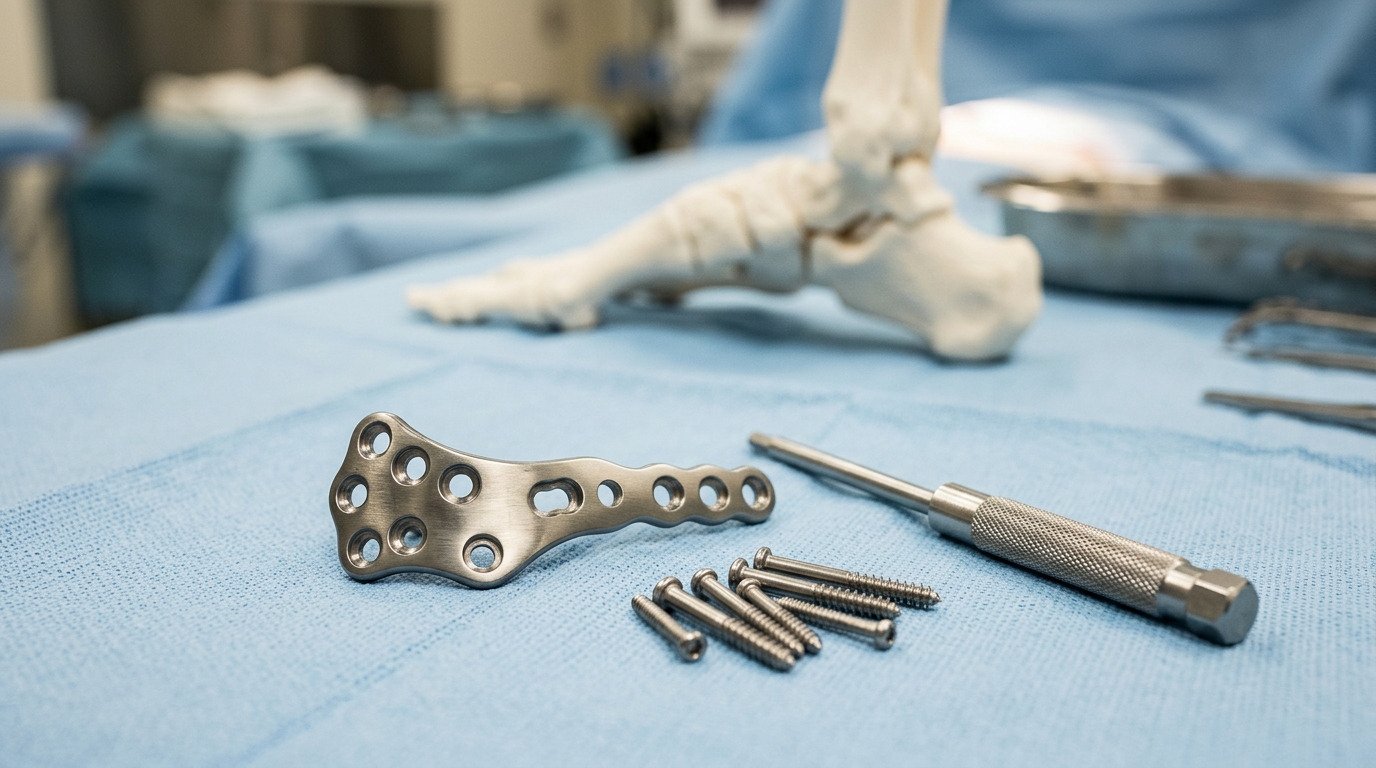
In a retrospective cohort evaluation of patients with closed intra-articular calcaneal fractures, internal fixation using either a Combo plate or a perimeter plate via the sinus tarsi approach demonstrated acceptable and comparable clinical and radiological outcomes at short-term follow-up. Calcaneal width at final follow-up was the only measured parameter that showed a statistically significant difference between the two groups, measuring smaller in patients treated with perimeter plates.
The retrospective study evaluated 38 patients treated between January 2022 and July 2025 who underwent open reduction and internal fixation with either a Combo or perimeter plate. The procedure utilized the sinus tarsi approach, a minimally invasive alternative to the extended lateral approach that allows early operation, reduces wound complications, and permits fixation once sound reduction of the posterior facet and hindfoot alignment is achieved.
During postoperative follow-up spanning 6 to 22 months, clinical and radiographic evaluations revealed no statistically significant differences between the Combo and perimeter groups across the majority of parameters. Recorded outcomes (Combo group vs. perimeter group) included Visual Analogue Scale pain scores of 0.24 ± 0.44 versus 0.32 ± 0.48, American Orthopaedic Foot & Ankle Society Ankle-Hindfoot scores of 94.1 ± 4.0 versus 92.0 ± 5.1, Böhler’s angle of 31.67 ± 3.15° versus 30.05 ± 2.09°, Gissane’s angle of 116.71 ± 6.73° versus 117.16 ± 5.57°, calcaneal length of 86.24 ± 4.58 mm versus 86.34 ± 4.02 mm, and calcaneal height of 87.38 ± 4.07 mm versus 86.86 ± 3.38 mm. Calcaneal width was significantly smaller in the perimeter group at the final follow-up, measuring 38.99 ± 3.33 mm in the Combo group versus 36.01 ± 3.22 mm in the perimeter group. Neither group experienced wound necrosis, infection, or malunion.
The authors concluded that both Combo and perimeter plate fixation via the sinus tarsi approach appear feasible, offering acceptable radiological and clinical outcomes at short-term follow-up. However, they noted that these findings should be interpreted within the limitations of the small sample size and short duration of follow-up, emphasizing that the results do not establish clinical equivalence between the two fixation strategies.
Subject of Research: Fixation strategies for closed intra-articular calcaneal fractures via the sinus tarsi approach
Article Title: Combo or perimeter plate? fixation strategy for intra-articular calcaneal fracture via the sinus tarsi approach: a retrospective cohort study
Article References: Zhao, W., Zhao, Z., Li, X., Assan, I., & Zhao, B. (2026). Combo or perimeter plate? fixation strategy for intra-articular calcaneal fracture via the sinus tarsi approach: a retrospective cohort study. BMC Surgery. https://doi.org/10.1186/s12893-026-04331-y
Image Credits: AI Generated
DOI: 10.1186/s12893-026-04331-y
Keywords: calcaneal fractures, sinus tarsi approach, Combo plate, perimeter plate, internal fixation, retrospective cohort study, Böhler’s angle, AOFAS score, Combo, perimeter, plate, fixation
News Source: Ophelia Keating. (November 6, 2026). Retrospective Study Compares Combo and Perimeter Plates for Calcaneal Fractures. Scienmag.