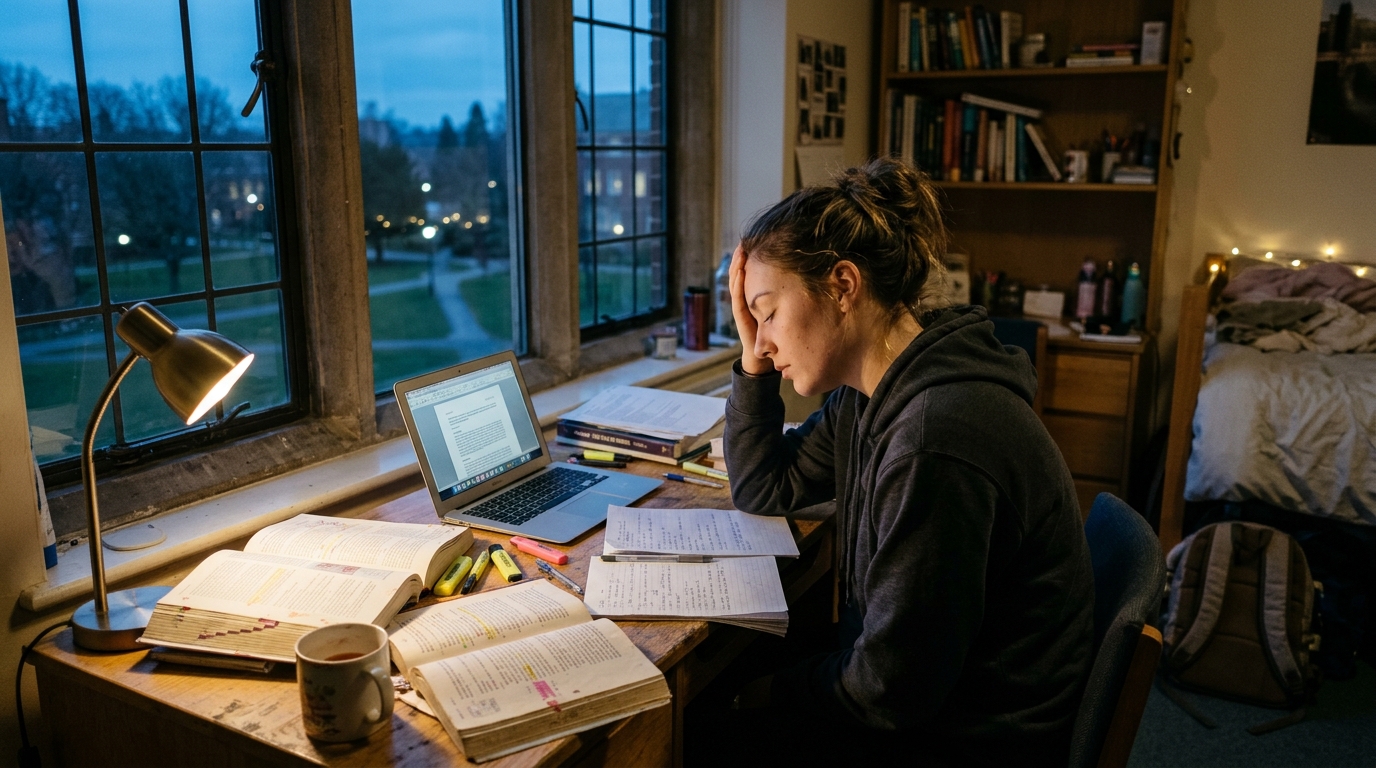
A large cross-national qualitative study has found that college students who live with untreated mental health difficulties do not simply avoid professional care. Instead, they actively manage their distress through a wide repertoire of practices that stretch far beyond bubble baths and meditation apps, reaching into friendships, campus clubs, volunteering, and even limiting their news consumption. The research, published in SSM – Mental Health, analyzed 261 interviews with university students across ten countries and is described by its authors as the first large-scale, cross-national qualitative analysis of psychological self-management among college students.
The study is embedded within the World Health Organization’s World Mental Health International College Student initiative, known as WMH-ICS. Two insights from the initiative’s needs-assessment survey shaped the research. First, college students globally live with high rates of untreated mental health difficulties. Second, students often self-manage through these untreated troubles. Within a group of nearly 14,000 student respondents across eight countries who indicated that they would not seek help for a mental health problem, the leading reason for avoiding help-seeking was a preference to handle the problem on one’s own, cited by 56.4 percent, followed by wanting to talk with friends or relatives instead. The qualitative interview study was designed as a companion to that survey, aiming to understand the lived experiences behind those numbers.
Interviews were conducted between 2022 and 2025 with students in Australia, China/Hong Kong, Canada, Chile, Colombia, Mexico, New Zealand, Romania, Poland, and Qatar. Participants were recruited through the WMH-ICS survey, which includes validated DSM-5 screening questions for conditions including major depressive disorder, generalized anxiety disorder, substance use disorder, and past-year suicidal thoughts and behaviors. The survey logic identified four categories of students, ranging from those who had not recognized their mental health issue and did not intend to seek treatment to those who had recognized it and were already in treatment. The full study dataset contains 498 interviews, but the analysis used a subset of 261 transcripts that had been coded at the time of manuscript preparation. Among the participants represented in that dataset, 88 identified as women, 63 as men, and 10 as other. Both undergraduate and graduate students took part, including domestic and international students enrolled across faculties from social sciences and humanities to engineering and business, at universities with enrollments ranging from roughly 700 to roughly 82,000 students.
To analyze the interviews, the research team applied a Social Ecological Model, a framework that outlines four concentric levels shaping health decision-making: microsystems at the individual level, mesosystems at the interpersonal level, ecosystems at the institutional level, and macrosystems at the societal level. Each transcript was coded by one local coder from the country site where the interviews were conducted and one non-local coder from outside that site, following a qualitative thematic analysis guided by a co-developed codebook. A coding group based at Harvard University met weekly with all coders to discuss cross-cultural considerations and verify consensus. The authors argue that this framework allowed them to transcend simplistic notions of self-management as a merely individualistic practice and to see how health and care are mediated by environmental resources and constraints.
At the individual level, students described hobby-related activities such as music, art, reading, and gaming, which they said helped them manage stress, relieve distress, and distract from ruminations rather than serving purely as leisure. Movement-based practices, including sport, gym workouts, stretching, Pilates, dance, and hiking, provided what students called an embodied sense of relief and release, sometimes alone and sometimes socially. Routines emerged as another pillar: scheduling, keeping a calendar, using checklists, setting limits on phone use, practicing good sleep hygiene, and deliberately setting aside time for oneself. One student even described routines as lifesaving. Everyday necessities also counted, with eating regularly, keeping a clean room, showering, and getting dressed in the morning representing personal accomplishments of wellbeing for some students. Others cited disconnection, such as napping, breaking from responsibilities, or using headphones to muffle surrounding noise, and spiritual practices ranging from mindfulness and breathwork to prayer and worship.
Interpersonal self-management proved equally varied. Students turned to friends, family members, roommates, romantic partners, peers, mentors, and religious congregants for connection, advice, a place to vent, and commiseration. Some provided care to others as a way of supporting their own mental health, describing how supporting family members or encouraging friends sustained rather than depleted their wellbeing. Companion animals figured in as well: one student described a pet as a confidant during emotional difficulty, another said playing with their pet offered stress relief, and yet another said being there for their cat prevented them from acting on suicidal ideation. Boundary setting was also cited, including declining social plans, limiting time with certain individuals, and creating distance from relationships that exacerbated distress, such as one student who minimized contact with a parent whose behavior intensified their symptoms.
Institutional and societal practices rounded out the picture. Some students read psychology books, used mental health apps, tracked cognitive distortions, or accessed mental health literacy websites, reflecting efforts to manage their mental health with psychological knowledge outside traditional therapeutic settings. Others joined campus supports, from emotional management courses to cultural clubs and student associations, or resisted the high-pressure demands of higher education by taking a day off, socializing instead of studying, or organizing a beach day with friends despite endless assignments. At the societal level, students cited volunteerism, community service, mentoring, and collective action such as involvement in a student union to enact social change. Limiting exposure to distressing news also appeared, with one student reporting setting a one-hour daily limit on TikTok and avoiding war updates that caused stress.
The reasons students gave for self-managing were as layered as the practices themselves. Many said self-management simply worked, clearing their minds, relaxing them, and offering calm, balance, refuge, or stability, though several noted it was more reliably effective for lower-grade rather than severe distress. Others valued independence and self-betterment, or pointed to accessibility: professional supports can be inaccessible due to long wait times, unavailability of appropriate services, and bureaucratic complexity, while self-management could be taken up at a moment’s notice and practiced anywhere. Upbringing mattered too, with some students raised in households that encouraged self-sufficiency and others in environments of varying neglect where coping independently became a matter of necessity. Many self-managed to protect loved ones from worry or emotional overload, and some sought support from people who shared their positionality, whether mental health experiences, gender, ethnicity, nationality, or disability status, fostering what the authors call small-scale culturally competent care.
Institutional and societal forces also shaped these decisions. All participating universities offered some degree of mental health support, but campus offerings were often short term and rarely accounted for chronicity, and students cited negative experiences with providers, fear of consequences, and mistrust as reasons to manage independently, though some selectively incorporated therapeutic knowledge into their own repertoires. Academic expectations valorizing productivity and independent resilience reinforced self-management for some and were resisted by others. Financial precarity was salient, with students explaining that paying for mental health supports was not a priority given the costs of tuition, rent, and independent living. A pervasive culture of rugged individualism fashioned professional help-seeking as a last resort, appropriate only when someone is truly at the end of their rope, and stigma, both societal and internalized, led others to manage their wellbeing privately.
The authors caution that their analysis was conducted before all transcripts were coded, with remaining transcripts from additional countries such as Sweden and Kenya to be analyzed in a second phase, and that findings are situated rather than generalizable, neither wholly representative of college cohorts from these countries nor extrapolatable to college students globally. Still, they argue the findings carry practical implications: universities could recognize and resource the informal, relational, and community-based forms of care already occurring on campuses, such as peer support networks, cultural affinity groups, and identity-based student organizations, and could reframe leisure and social activities as valuable means of generating wellbeing. Rather than treatment avoidance, the authors conclude, student accounts suggest self-management is a creative source of community building, a pragmatic response to institutional harms, and a mode of handling inequity, one that deserves recognition as a legitimate form of care rather than dismissal as mere noncompliance.
Subject of Research: Qualitative analysis of how and why college students across ten countries self-manage their mental health
Article Title: A social-ecological analysis of psychological self-management among college students
Article References: Gordon, L., Gillett, J., Li, K., Rankin, O., Castro-Ramirez, F., Andersson, C., Benjet, C., Bosire, E., Bukowska, A., Cichon, E., David, O. A., Dong, D., Eksteins, O., Al-Jayyousi, G. F., Gebbia, K., Hasking, P., Hudec, K., Khakali, L. N., Kiejna, A., … Naslund, J. (2026). A social-ecological analysis of psychological self-management among college students. SSM – Mental Health, 10, Article 100713. https://doi.org/10.1016/j.ssmmh.2026.100713
Image Credits: AI Generated
DOI: 10.1016/j.ssmmh.2026.100713
Keywords: college students, mental health, self-management, qualitative research, social ecological model, WMH-ICS, help-seeking, campus wellbeing, cross-national study, stigma, peer support, social-ecological
News Source: Glenn Wilkins. (November 6, 2026). College Students Manage Mental Health Alone Across Ten Countries, Study Finds. Scienmag.