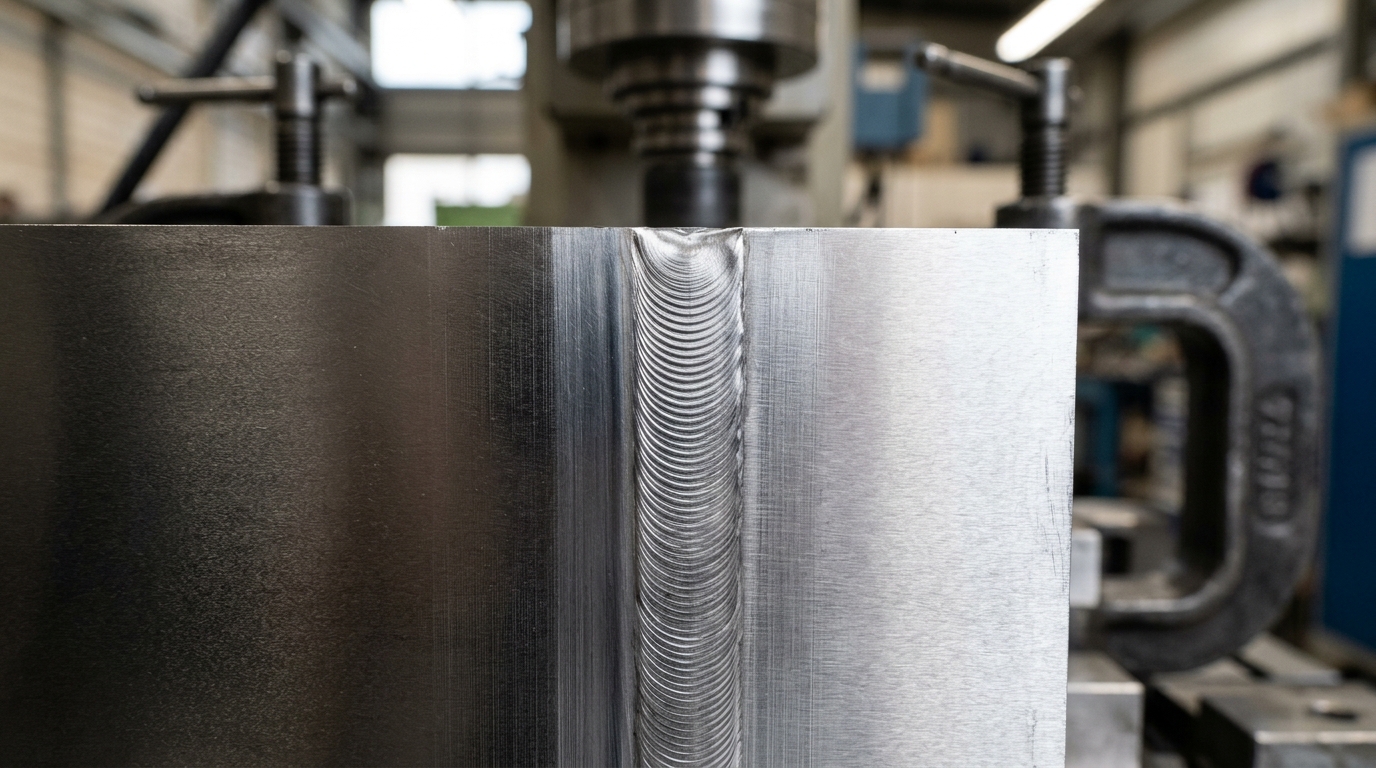
Researchers Brayden Terry and Alvin Strauss have investigated solid-state friction stir welding as an experimental technique for producing dissimilar butt joints between thin sheets of near-equiatomic nickel-titanium shape memory alloy and three primary aerospace aluminum alloys. The investigation, published in Advanced Materials Joining, examined one-millimeter-thick sheets of Nitinol paired individually with AA6061-T6511, AA2024-T351, and AA7075-T651. Joining these dissimilar metal systems could allow aerospace engineers to integrate active shape memory alloys directly into lightweight airframe structures, potentially enabling compact actuation mechanisms, passive vibration damping, and integrated temperature sensing surfaces without relying on heavy or complex mechanical fasteners. However, pronounced disparities in the thermal, chemical, and mechanical properties of nickel-titanium and aluminum alloys make joint formation extraordinarily challenging. Under identical experimental welding conditions, the authors achieved sound, crack-free joints with AA6061, obtained inconsistent results with AA2024, and encountered complete joining failure with AA7075 due to severe post-weld cracking during workpiece cooling.
Aluminum alloys from the 6000, 2000, and 7000 series represent fundamental structural materials in aircraft design due to their high strength-to-weight ratios, low cost, and ease of forming. However, standard fusion welding methods cannot reliably join them because their chemistry promotes hot cracking and stress corrosion. Specifically, 2000 and 7000 series alloys are broadly considered unweldable by fusion techniques, while 6000 series alloys remain weldable but crack-sensitive. Solid-state friction stir welding offers an effective path to join these materials by avoiding molten-state defects. Each alloy system relies on distinct precipitation-strengthening mechanisms that influence weldability. The AA6061 alloy is strengthened primarily by magnesium-silicide precipitates, offering lower initial strength but greater plastic deformation that accommodates the harder Nitinol during welding. Conversely, copper-rich AA2024 strengthens through aluminum-copper-magnesium precipitates, creating higher flow resistance. Finally, AA7075 relies on zinc-magnesium-copper precipitates to achieve the highest strength among the group, making it particularly prone to precipitate disruption, severe strain localization, and cracking during processing.
The shape memory alloy examined was near-equiatomic Nitinol with 55.7 weight percent nickel and an austenitic finish temperature of 20 degrees Celsius. Renowned for its strength, corrosion resistance, superelasticity, and shape memory effect, Nitinol has seen limited bulk structural integration due to fabrication challenges. Earlier research largely explored particulate powder composites rather than joining sheet material. The authors compared their investigation to previous work on dissimilar friction stir welding of aluminum and titanium alloys, such as studies by Chen, Aonuma, Kar, Choi, and Shehabeldeen. Although titanium provides useful conceptual insight regarding chemical differences, it cannot serve as a direct analogue for Nitinol. Those earlier studies demonstrated that joining titanium to aluminum frequently produces brittle intermetallic compounds including TiAl3, TiAl, and Ti3Al that degrade joint strength under elevated heat inputs or excessive tool rotation speeds. By examining bulk sheet Nitinol, this study aimed to determine whether solid-state stir flow could produce viable dissimilar butt joints without creating continuous, embrittling intermetallic layers.
To perform the experimental butt welds, the researchers machined Nitinol and aluminum sheets to dimensions of 25.4 millimeters (1.0 inch) in width, 152.4 millimeters (6.0 inches) in length, and 1.0 millimeter (0.039 inches) in thickness. The welding tool consisted of a tungsten carbide rod with a diameter of 12.7 millimeters (0.5 inches). Notably, the tool featured a completely flat contact face devoid of pins, threads, or scroll features. Existing literature indicates that pinless flat tools provide substantial advantages when friction stir welding thin sheets of one millimeter or less. Conventional threaded pin tools frequently generate severe cross-sectional thinning and root defects in thin materials. However, adopting a flat tool introduces a notable technical compromise: while it minimizes surface tearing and preserves sheet thickness, it delivers reduced through-thickness interaction, concentrating plastic mixing across the upper weld zone while leaving the lower root interface relatively unstirred.
Identical welding parameters were maintained across all joints to facilitate direct performance comparisons. Nitinol was positioned on the advancing side of the seam, following standard dissimilar friction stir welding practice, with aluminum on the retreating side. The flat tool was operated at 1000 revolutions per minute, a traverse speed of 50.8 millimeters per minute (2.0 inches per minute), and a 1.5-degree tilt angle centered over the interface. The initial plunge speed was set to 0.508 millimeters per minute (0.02 inches per minute) to permit frictional heating and plasticization, while plunge depth was maintained at 0.3048 millimeters (0.012 inches). This plunge depth was bounded by tool geometry: tilting a 12.7-millimeter flat tool at 1.5 degrees leaves a leading edge clearance of 0.33 millimeters (0.013 inches). Plunging further causes excessive material pileup and plowing forces, whereas plunging less curtails through-thickness bonding. Three replicate welds were fabricated for each dissimilar and similar alloy combination.
Fabrication trials revealed substantial differences in joining compatibility among the three aluminum alloys. The AA6061-NiTi combination welded cleanly without shrinkage cracking, showing good surface finish and mild flash, which enabled the extraction of ten sound tensile specimens via wire electrical discharge machining. In contrast, AA2024-NiTi welds exhibited mixed, delicate outcomes; joints frequently cracked during cooling, separated when unbolted from the welding anvil, or broke during machining, leaving only five viable tensile specimens. Joining AA7075 to Nitinol failed entirely under tested conditions; although joints appeared intact during tool transit, severe cracking developed along the seam during cooling, fracturing or buckling every workpiece and preventing mechanical testing. The authors attributed this behavior to residual stresses and thermal strain arising from mismatched coefficients of thermal expansion combined with differences in alloy ductility. Because rolled AA7075-T6 exhibits only 8 percent elongation, compared to 12 percent for AA6061-T6 and 10 percent for AA2024-T3, it was unable to accommodate the thermal shrinkage strains.
Tensile testing conducted under ASTM E8 protocols at a crosshead speed of 0.56 millimeters per minute demonstrated significant divergence in mechanical capacity between the surviving weldments. The AA6061-NiTi joints recorded an average ultimate tensile strength of 167.8 ± 12.9 MPa, exceeding similar-material welded 6061 controls (142.41 ± 4.18 MPa) by 18 percent while reaching 37.4 percent of welded base Nitinol strength (450.3 ± 70.7 MPa). Relative to unwelded AA6061-T6 (290 MPa per ASTM B209), this represents a weld efficiency of 57.9 percent, with an average elongation of 3.64 ± 1.14 percent. Conversely, AA2024-NiTi welds suffered severe mechanical degradation, delivering an average tensile strength of 120 ± 33.6 MPa. This achieved just 39.3 percent of welded AA2024 controls (305.2 ± 15.1 MPa) and a weld efficiency of 27.6 percent against unwelded AA2024-T3 (435 MPa). Elongation for AA2024-NiTi averaged only 1.01 ± 0.48 percent, reflecting premature failure before significant plastic strain could develop.
Fracture analysis revealed that tensile performance was primarily controlled by joint interface integrity. Specimens from AA6061-NiTi welds failed via two distinct modes in equal proportions. The first mode was brittle failure along the lower tilted weld interface, where cracking initiated at the poorly stirred bottom root and propagated upward until the thoroughly mixed upper stir zone stretched plastically to final rupture. The second mode was ductile failure located entirely within the retreating-side thermomechanically affected zone of the AA6061 sheet, evidenced by concave and convex profiles. This ductile mode appeared in specimens displaying higher tensile strength and elongation, confirming that sound interfacial bonding shifted failure into the softened aluminum matrix. In contrast, all AA2024-NiTi specimens suffered sudden, brittle fracture propagating directly along the joint interface with minimal deformation. Although upper stir zone flow markings confirmed mechanical mixing, the lower seam acted as an unaccommodated stress riser that dominated joint failure.
Electron microscopy of polished cross-sections using an environmental scanning electron microscope at 15 kilovolts revealed similar microstructural features in both joined systems. Mechanical stirring generated a roughly 1200-micrometer diameter region within the aluminum matrix containing dispersed Nitinol particles. These particles formed when shear forces fragmented the harder Nitinol workpiece, which lost mechanical support as the softer aluminum plasticized at lower temperatures. The dispersed particles exhibited a bimodal size distribution, featuring irregular fragments between 10 and 100 micrometers distributed among smaller, equiaxed particles measuring 1 to 5 micrometers. The authors noted that these finer particles match the scale of primary strengthening precipitates in aluminum alloys. Consequently, the dense field of fine particles likely hindered dislocation motion, producing localized matrix strengthening while reducing tensile ductility. In contrast, the larger irregular particles introduced severe strain incompatibilities and stress concentrations along their edges, acting as crack nucleation sites that limited overall joint elongation.
Energy-dispersive spectroscopy mapping and line scans characterized reaction products within the stir zone. Larger dispersed particles showed aluminum diffusion throughout their bulk, forming lamellar microstructures analogous to Al3Ni intermetallics. Line scans across the particle boundary demonstrated that smaller fragments were not chemically uniform Nitinol; rather, reciprocal variations in nickel and titanium signals indicated separation into nickel-rich and titanium-rich phases consistent with Ni-Al and Ti-Al intermetallics. Crucially, no continuous intermetallic layer formed along the weld interface at the micron scale. The authors explained that dynamic tool traversal repeatedly disrupted the interface, while steep thermal gradients—driven by high aluminum thermal conductivities (167 W/(m·K) for 6061 and 120 W/(m·K) for 2024) dissipating heat rapidly compared to Nitinol (8.5 to 18 W/(m·K))—restricted interfacial diffusion time. Conversely, dispersed particles enveloped in plasticized aluminum experienced sustained multi-sided thermal contact that favored intermetallic growth. The study demonstrates that friction stir welding can successfully produce Al-NiTi butt joints, though performance depends heavily on alloy selection and interface integrity.
Subject of Research: Friction stir butt welding of thin-sheet Nitinol with aerospace aluminum alloys
Article Title: Exploration of friction stir welding butted thin sheet NiTi with AA6061, AA2024, and AA7075
Article References: Terry, B., & Strauss, A. (2026). Exploration of friction stir welding butted thin sheet NiTi with AA6061, AA2024, and AA7075. Advanced Materials Joining, 1(1), Article 20. https://doi.org/10.1007/s44500-026-00026-9
Image Credits: AI Generated
DOI: 10.1007/s44500-026-00026-9
Keywords: friction stir welding, Nitinol, shape memory alloys, aerospace aluminum alloys, dissimilar metal joining, intermetallic compounds, solid-state welding, materials characterization, Exploration, friction, stir, welding
News Source: Denise Maddox. (November 6, 2026). Friction Stir Welding Successfully Joins Nitinol Sheets With Select Aerospace Aluminum Alloys. Scienmag.