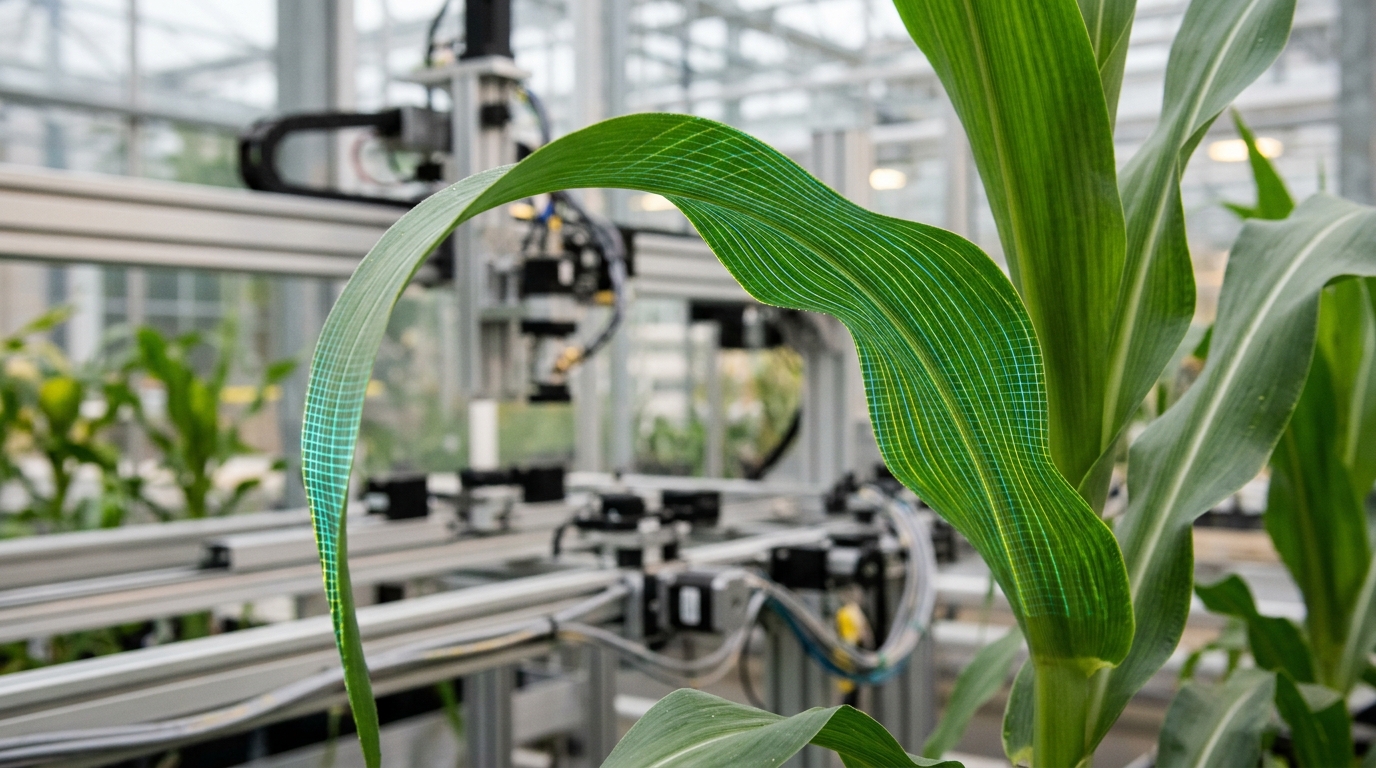
Agricultural researchers have introduced PFL-Net, a specialized deep learning architecture designed to reconstruct missing regions in three-dimensional point clouds of maize leaves, restoring delicate organ-level geometry and supporting high-precision digital plant phenotyping. Within this spatial architecture, individual leaves govern fundamental physiological processes, including photosynthetic efficiency, biomass accumulation, stress tolerance, and ultimate grain yield potential. Digitizing leaf structures into coordinate-based three-dimensional point clouds provides an objective, computational medium to extract these morphological traits. However, acquiring complete point cloud datasets in real-world agricultural environments remains an enduring technical challenge. Raw spatial data regularly suffer from localized gaps, shadowing, and point dropouts caused by mutual occlusion among dense plant organs, high leaf surface reflectivity, variable ambient lighting conditions, and platform sensor limitations. To address this organ-scale information deficit, researchers developed a specialized geometric completion network capable of restoring structural continuity across elongated foliage.
The morphological characteristics of maize leaves present distinct geometric hurdles that differentiate them from typical industrial objects and other plant types evaluated in computational phenotyping. Maize foliage exhibits an elongated, narrow geometry characterized by substantial longitudinal curvature, narrow transverse widths, and intricate, wavy marginal contours. When researchers deploy multi-view camera rigs to reconstruct three-dimensional structures using Structure from Motion, Neural Radiance Fields, or 3D Gaussian Splatting, the resulting point clouds frequently exhibit severe data loss in regions obscured by restricted viewing angles or uneven illumination. Mechanical three-dimensional contact digitizers paired with Loop subdivision algorithms can capture overall mesh geometry, yet they smooth over delicate surface undulations and fail to preserve fine phenotypic features. Stationary terrestrial LiDAR scanners scanning full plant canopies often suffer from mutual canopy shading that occludes mid-tier and lower-canopy foliage. Meanwhile, high-precision robotic scanning arms equipped with handheld laser sensors can capture minute surface geometry, but the physical scanning process is inherently time-consuming, sensitive to mechanical vibrations, and susceptible to ambient environmental noise that introduces localized point cloud fractures.
Point cloud completion has evolved substantially within computer vision, shifting from early geometric interpolation methods toward data-driven deep generative models. Geometric approaches often struggle to maintain robustness when confronted with non-rigid, highly irregular structural topologies. Although recent deep learning architectures have demonstrated high completion accuracy, most models have been engineered for and benchmarked on rigid, highly symmetrical CAD objects such as vehicles, airplanes, and indoor furniture found in public datasets like ShapeNet and ModelNet. These models implicitly rely on planar continuity and bilateral or multilateral symmetry cues to infer occluded surfaces. When applied to botanical subjects, these networks perform reasonably well on round, planar, or palmately lobed leaves, such as cabbage foliage, but degrade severely when processing elongated, ribbon-like leaves. The Point Fractal Network, known as PF-Net, established a generative adversarial baseline that hierarchically predicts missing coordinates using multi-scale combined multi-layer perceptrons. Nevertheless, its reliance on salient feature extraction limits its capacity to reproduce the continuous curvature and intricate borders defining maize leaves, frequently producing localized point clusters and blurry boundary contours.
To overcome the scarcity of specialized training data for non-rigid botanical organs, the research team constructed a comprehensive benchmark dataset comprising 2,073 morphologically intact individual maize leaf point clouds. The underlying samples were captured from maize plants exhibiting uniform growth characteristics across developmental intervals extending from the silking stage to the grain-filling stage. Data acquisition leveraged four distinct sensing modalities to capture broad morphological variability: multi-view two-dimensional imagery collected using the MVS-Pheno platform, three-dimensional digital coordinate meshes recorded with a FastScan contact digitizer, population scans captured using FARO Scan70 and Scan150 terrestrial laser scanners, and close-range scans acquired with a FARO Design ScanArm 2.5C robotic arm. Supplemental intact leaf point clouds were integrated from a publicly available maize dataset. Each isolated leaf sample was derived strictly from a unique, independent plant specimen to prevent data correlation and ensure statistical validity across subsequent evaluations. This varied acquisition strategy provided the structural diversity necessary to train robust neural networks across disparate measurement noise profiles.
Raw data collected across these diverse platforms underwent rigorous modality-specific preprocessing before model ingestion. Multi-view camera captures were reconstructed into calibrated three-dimensional scenes using 3D Gaussian Splatting, segmented into individual plants within CloudCompare, annotated using Label3DMaize, and partitioned into discrete organs with DeepSeg3DMaize before final manual cleaning. Digitizer meshes were processed with MaizeTypeOpt, subjected to four recursive iterations of Loop subdivision to expand mesh face counts by fifteen-fold, and converted to vertices. Terrestrial LiDAR clouds were denoised and segmented in FARO SCENE, while robotic arm laser scans were isolated and filtered using Geometric Studio. To establish geometric uniformity, all segmented leaves were centered at coordinate origin through centroid-based normalization and scaled within a unit sphere by dividing coordinates by maximum radial Euclidean distance. Farthest point sampling standardized each leaf cloud to exactly 2,048 spatial points, with random point duplication applied to scarce samples. Realistic data loss was synthetically modeled through view-based point absence simulation, wherein a random three-dimensional viewpoint was selected and 512 visible points were translated to the coordinate origin, creating paired incomplete inputs and ground-truth missing targets split into training and test partitions at a three-to-one ratio.
The newly formulated PFL-Net framework adopts an adversarial encoder-decoder architecture specifically tailored to capture the multi-scale geometric relationships of elongated foliage. The generator accepts an incomplete 2,048-point cloud and processes it through farthest point sampling to produce three hierarchical resolutions containing 2,048, 1,024, and 512 points. To capture spatial dependencies across the highest-resolution point cloud, the researchers introduced a dedicated Graph Block module inspired by GraphFit. Treating the point cloud as an interconnected topological graph, the Graph Block constructs local neighborhood relationships using k-nearest neighbors across two distinct branches: a large-scale branch evaluating forty nearest neighbors (K equals 40) to encode global curvature and overall contour trajectories, and a small-scale branch evaluating twenty nearest neighbors (K equals 20) to extract localized surface details. Features extracted from both graph branches are concatenated and expanded into a 1,024-dimensional feature vector, providing the network with comprehensive geometric perception spanning macroscopic leaf curvature down to subtle structural margins.
In parallel with the Graph Block, PFL-Net re-engineers the feature aggregation pipeline by replacing standard Combined Multi-Layer Perception with an Average Combined Multi-Layer Perception module, designated as ACMLP. Conventional CMLP blocks utilize max-pooling operations to aggregate extracted spatial features, a mechanism that preserves high-response feature points but systematically suppresses low-response values, discarding fine textural cues critical for reconstructing thin botanical organs. The ACMLP module remedies this by applying average pooling across its final four feature layers, calculating the mean activation within local neighborhoods to retain balanced spatial distribution data. Structurally, the ACMLP processes point clouds reshaped with batch dimensions across six progressive convolutional operations paired with batch normalization and rectified linear unit activations, expanding channel depths from an initial one-by-three kernel to 64, 128, 256, 512, and 1,024 channels. The ACMLP extracts 1,920 features across each downsampled point resolution, which are concatenated, reduced, and merged with the Graph Block output to form a unified 2,944-dimensional representation. The discriminator similarly incorporates an ACMLP block, extracting 448-dimensional features before classification.
Network training and optimization were executed on an Ubuntu 22.04 system with CUDA 12.8 over 101 training epochs with a batch size of 32, using the Adam optimizer initialized with a learning rate of 0.0001, decayed by a factor of 0.2 every 40 epochs. The composite objective function balances an adversarial binary cross-entropy loss with a multi-scale geometric loss based on hierarchical Chamfer distance, weighted with a parameter lambda set to 0.95 to prioritize generator fidelity. Geometric weighting parameters alpha-one and alpha-two were dynamically adjusted across training phases (0.01 and 0.02 for epochs 1 to 30; 0.05 and 0.1 for epochs 30 to 80; 0.1 and 0.2 for epochs 80 to 101) to ensure coarse-to-fine structural consistency. Quantitative evaluation demonstrated that PFL-Net outperformed the PF-Net baseline across all five target metrics: Earth Mover’s Distance fell from 0.030 to 0.017, the F1-score improved from 0.846 to 0.865, Density-aware Chamfer Distance dropped from 0.516 to 0.504, Squared Maximum Mean Discrepancy decreased from 0.014 to 0.008, and Average Hausdorff Distance dropped from 0.032 to 0.029, confirming superior boundary delineation and point distribution uniformity.
To rigorously isolate the specific performance contributions of each architectural modification, the investigators conducted extensive ablation experiments across five model variations alongside the PF-Net baseline. Replacing the initial high-resolution CMLP module with the dual-branch Graph Block in Model A reduced Earth Mover’s Distance to 0.025 and improved F1-score to 0.856, demonstrating that graph convolutions capture high-resolution topological relationships more effectively than purely perceptual layers. Combining the Graph Block with CMLP in Model B further enhanced feature extraction, reducing Earth Mover’s Distance to 0.021 and yielding an F1-score of 0.864. Testing the average pooling mechanism revealed that deploying ACMLP strictly within the generator (Model C) or strictly within the discriminator (Model D) yielded balanced improvements, each achieving an Earth Mover’s Distance of 0.021 or 0.020 and a Squared Maximum Mean Discrepancy of 0.009. However, the fully integrated architecture (Model E, designated as PFL-Net), which deployed ACMLP across both generator and discriminator alongside the Graph Block, secured the highest overall performance, demonstrating the clear synergistic value of combined multi-scale graph reasoning and global average pooling.
The practical utility of PFL-Net was validated in a downstream agricultural phenotyping task focused on non-destructive maize leaf biomass estimation. Morphological leaf traits such as length and surface area directly dictate fresh biomass, rendering regression calculations highly sensitive to point cloud completeness. Evaluating five candidate machine learning models on 273 intact leaves identified a Fully Connected Neural Network as the most stable baseline, delivering a Mean Absolute Percentage Error of 16.83 percent, a Mean Absolute Error of 0.379 grams, and an R-squared of 0.82. When tested on uncompleted point clouds with simulated missing regions, prediction accuracy plummeted to an R-squared of 0.51 with an error of 0.684 grams. Point clouds completed using PF-Net recovered accuracy to an R-squared of 0.81, whereas PFL-Net reconstructions achieved an R-squared of 0.82, a Mean Absolute Error of 0.376 grams, and a Root Mean Square Error of 0.546 grams, matching ground-truth performance within 0.003 grams. Despite these achievements, the authors noted current limitations, including geometric distortions at distant leaf extremities and challenges in upsampling complex textures, underscoring future opportunities to expand training dataset scale and integrate advanced decoders for comprehensive whole-plant phenotypic modeling.
Subject of Research: Deep learning point cloud completion for maize leaf phenotypic reconstruction and biomass estimation
Article Title: PFL-Net: a deep learning network for maize leaf point cloud completion
Article References: Wu, Z., Wen, W., Song, A., Wu, Y., Miao, T., & Guo, X. (2026). PFL-Net: a deep learning network for maize leaf point cloud completion. Smart Agricultural Technology, 15, Article 102667. https://doi.org/10.1016/j.atech.2026.102667
Image Credits: AI Generated
DOI: 10.1016/j.atech.2026.102667
Keywords: deep learning, point cloud completion, maize phenotyping, PFL-Net, plant architecture, computer vision, biomass estimation, agricultural technology, deep, learning, network, maize
News Source: Alan Morgan. (November 6, 2026). Deep Learning Network Reconstructs Missing Geometry in Maize Leaf Point Clouds. Scienmag.