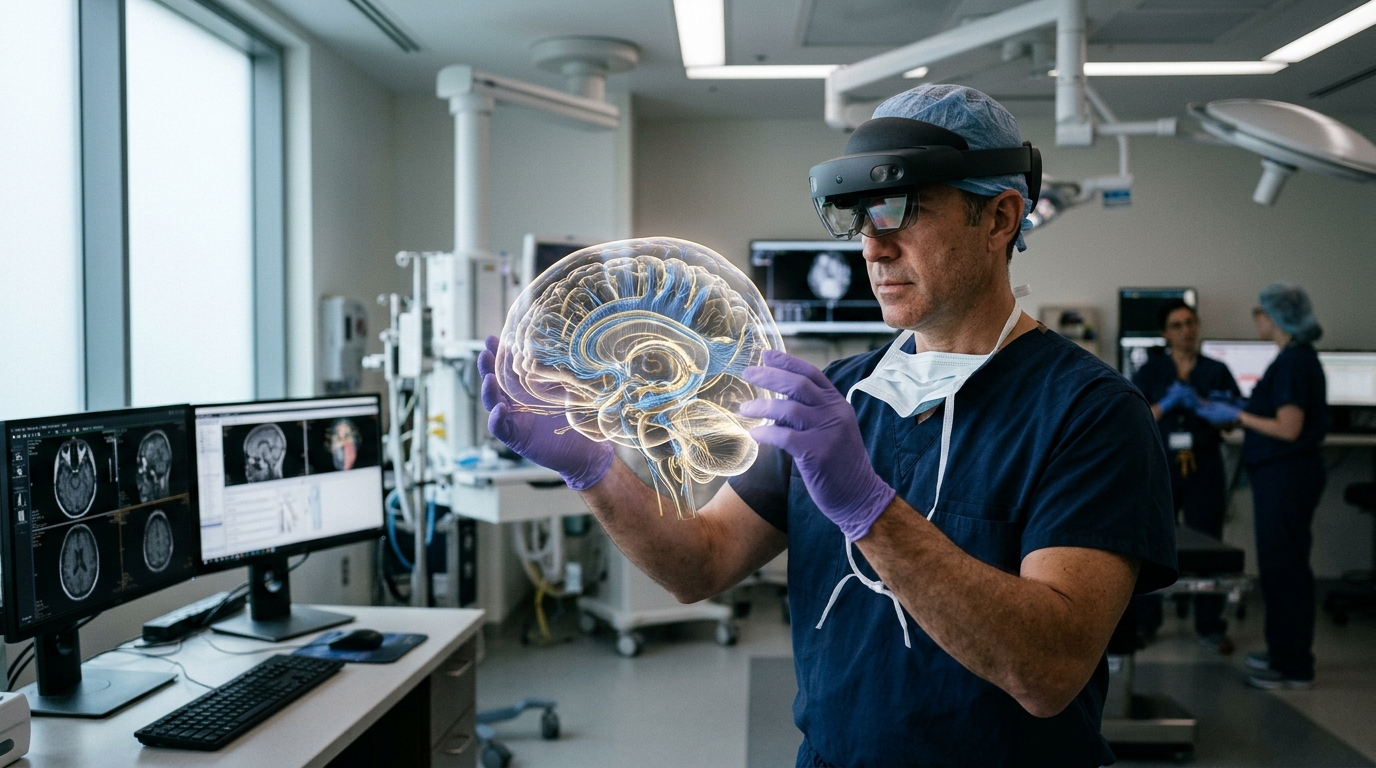
Neurosurgery is one of the most resource-intensive fields in medicine, and an estimated 5 billion people worldwide lack access to essential surgical care. Of the 22.6 million neurosurgical cases requiring intervention each year, less than half of global demand was met in 2019. A new Perspective article published in BMC Global and Public Health argues that four rapidly developing technologies—telemedicine, online collaborative platforms, immersive technology, and clinical artificial intelligence—could help close this gap, particularly in regions that have historically lacked facilities, personnel, expertise, or funding. The authors, led by Jay J. Park and Vivek P. Buch of Stanford University-affiliated institutions, examine both the promise and the practical pitfalls of each tool.
The scale of the shortfall is stark. In 2019, the median density of neurosurgeons across 198 countries was 0.36 per 100,000 population, far below the figures for the Americas at 0.97 and Europe at 1.18 per 100,000. A 2024 cross-sectional study updated the global median to 0.44 neurosurgeons per 100,000 people, but low- and middle-income countries averaged only 0.12. The authors stress that despite this moderate growth, the absolute gap between high-income and low-to-middle income countries persists. Barriers are not confined to poorer nations: within the United States, neurosurgical access correlates significantly with median household income, education level, and population density, with high-access areas more likely to be metropolitan.
Telemedicine emerges as the most mature of the four technologies. The authors report that past studies show it reduces travel time, costs, and wait times for specialised care. One paediatric neurosurgical clinic calculated savings of an average of $48.50 in transportation and work costs, along with 2.5 hours of travel time per visit, for each family. Telehealth has also yielded high patient satisfaction and reported treatment success rates globally. Because neurosurgical subspecialties such as spine, which operate more in outpatient settings, benefit when appointments and imaging are completed in advance, the authors suggest telemedicine may be most effective for consultations, follow-ups, and remote neurological examinations rather than replacing in-person intervention.
The technology is not without technical limits. One study cited in the article found that 30.1% of video consults experienced technical failures, and telemedicine depends on audio and video quality as well as the absence of direct physical evaluation. The authors also flag digital equity as a decisive factor: without investment in mobile clinics, health information systems, and patient education, telemedicine risks exacerbating rather than alleviating disparities. A systematic review by Shakir and colleagues identified telemedicine as a leading strategy in low- and middle-income settings for improving follow-up care delivery for brain tumours, where discontinuous treatment can worsen mortality.
Online collaborative platforms—virtual media enabling remote mass communication outside direct patient care—address a different bottleneck: training and mentorship. Open-access video conferencing tools such as Zoom and YouTube have delivered educational content to thousands of participants across countries, and Zoom has given international medical students exposure to otherwise inaccessible training. Intersurgeon, a website established in 2017 for global surgical collaboration, has facilitated partnerships between individuals and organisations, with 77.8% of these collaborations occurring between high-income and low-to-middle income countries. Social media plays a role too: Neurosurgery Cocktail, an Instagram and Facebook group with over 29,500 members from more than 100 countries, shares educational articles, clinical experiences, and research opportunities.
Immersive technology—virtual, augmented, and mixed reality—targets the immense expertise required to train a neurosurgeon. The authors highlight tele-proctoring, in which an experienced proctor remotely observes and assists a surgeon during a procedure, providing real-time guidance. One of the earliest examples was reported in a 2005 Canadian study using a robotic telecollaboration system for audio communication and neuronavigation data transmission. More recently, resident neurosurgeons in the Philippines observed live annotations from an overseas mentor overlaid onto cadaver anatomy during dissection, using smartphones and Zoom rather than complex robotic systems; the approach improved residents’ reported confidence and allowed evaluation via the Objective Structured Assessment of Technical Skills tool.
Feasibility remains early-stage, however. A 2024 systematic review by Bocanegra-Becerra and colleagues found augmented reality useful in trainee education, with smaller exploratory use in preoperative planning and intraoperative support, but bandwidth-related problems such as audio and video latency and image resolution were commonly reported. Guidelines from the Society of American Gastrointestinal and Endoscopic Surgeons recommend 40 mbps with latency no longer than 450 ms, yet multiple studies in the review relied on 3G internet, which typically falls below that threshold. The authors call for clearer guidelines on sufficient internet speeds before augmented reality can be considered a reliable intraoperative tool.
Artificial intelligence offers a third pathway: reducing reliance on scarce human resources while augmenting clinical decision-making. Convolutional neural networks have been used in neuroradiology to detect and segment neuropathologies, improving the efficacy and accuracy of MRI and CT analyses. By analysing surgical videos and quantifying tool-handling motion metrics, these models have accurately differentiated surgeon skill levels, offering a systematic alternative to direct expert observation in training. Large language models such as ChatGPT have been used to analyse medical records, generate administrative reports, aid diagnostics, translate documents, and explain medical jargon. The authors caution, however, that biases in training data from underrepresented groups can degrade output quality for the very populations that need care most.
Regulation is a recurring theme. The World Health Organization and the International Telecommunication Union jointly published a global standard for telehealth accessibility in 2022. In the United States, the FDA’s Digital Health Center for Excellence launched the Technology-Enabled Meaningful Patient Outcomes pilot in April 2026 to promote access to digital health while protecting patient safety. The FDA has approved over 1,000 AI and machine learning tools as of May 2025 since first approving PAPNET in 1995, and maintains a public list of over 100 approved medical devices featuring augmented and virtual reality. In the European Union, commercial medical devices require CE marking; TytoCare, a handheld device for remote examination, received its mark in 2018.
The authors conclude that no single technology can substitute for in-person care, and each carries limitations including inability to replace physical examination, regulatory gaps, limited access, high upfront costs, and implementation challenges. Cultural acceptance within clinical settings remains a perhaps overlooked barrier, and algorithms trained on non-representative datasets may underperform in underrepresented populations. They call for diverse training datasets, transparent and explainable models, and regulatory frameworks safeguarding data privacy. Considerations such as internet access, maintenance costs, and user acceptability are critical for successful adoption in resource-constrained settings, but the authors argue these continually evolving tools present significant opportunities to expand and improve neurosurgical care worldwide.
Subject of Research: Technological innovations to overcome barriers to global neurosurgical care access
Article Title: Overcoming barriers to neurosurgical care with technology and innovation
Article References: Park, J. J., Lee, M., Wong, E., Bhanot, P., Limb, A. H., Ceesay, O., Sakamoto, A., Lin, A., & Buch, V. P. (2026). Overcoming barriers to neurosurgical care with technology and innovation. BMC Global and Public Health, 4(1), Article 86. https://doi.org/10.1186/s44263-026-00310-w
Image Credits: AI Generated
DOI: 10.1186/s44263-026-00310-w
Keywords: neurosurgery, global health, telemedicine, artificial intelligence, virtual reality, augmented reality, health equity, surgical training, LMICs, digital health, online collaboration, workforce shortage
News Source: Ophelia Keating. (November 6, 2026). Telemedicine, AI and virtual reality could widen access to neurosurgical care. Scienmag.