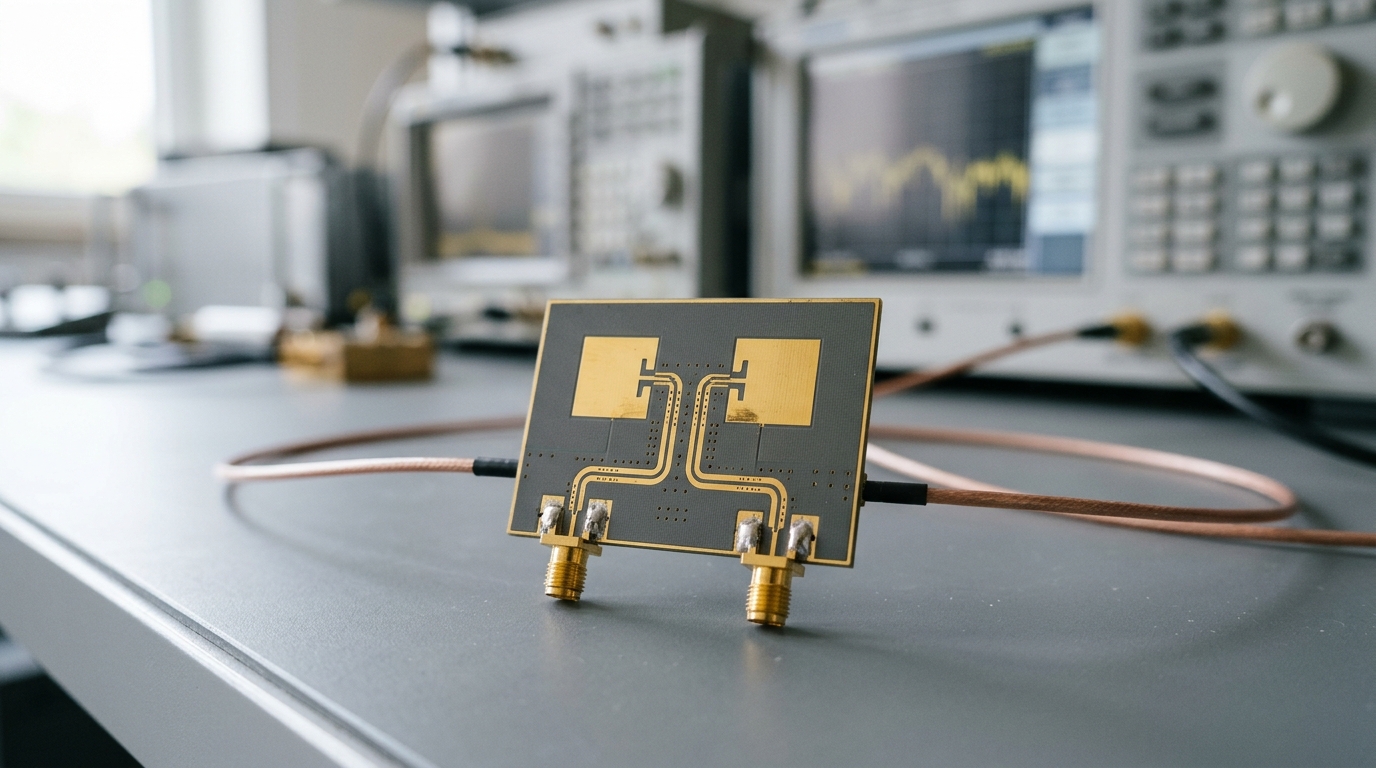
Engineers have unveiled a miniaturized two-port MIMO antenna designed to operate across the 26.3 to 32 GHz millimeter-wave band for future-generation 5G wireless communications. The design, described in Discover Applied Sciences, is fabricated on a RO3210 substrate and consists of two identical stepped-slot loaded radiators placed symmetrically. A key feature is that the antenna achieves its isolation performance without any additional decoupling network, relying instead on the intrinsic behavior of its feed structure.
The distinctive element of the design is a non-uniform feed line. According to the authors, this feed geometry ensures a controlled transition of impedance and phase, which simultaneously realizes broadband impedance matching and suppresses mutual coupling between the two ports. In conventional multi-antenna layouts, decoupling often demands extra structures that enlarge the footprint; here, that function is built into the feed itself, allowing the whole system to remain compact.
Measurements confirm the wideband behavior. The antenna attains a measured impedance bandwidth from 26.3 to 32 GHz with −10 dB return losses, covering the targeted millimeter-wave range for 5G user equipment. Isolation between the ports stays under −15 dB throughout the operating band, and even drops to between −25 dB and −30 dB at the resonance frequencies, indicating that the two radiators can transmit and receive with minimal interference from one another.
Radiation performance is equally central to the reported results. Broadside radiation patterns were observed, together with a measured realized gain of 7.5 to 8.5 dBi and a simulated directivity of 11 to 12 dBi. The authors attribute these high directivity values to constructive interference at millimeter-wave frequencies, where the closely spaced radiating elements reinforce each other’s fields in the preferred direction.
Because MIMO systems depend on multiple antennas working together, the diversity metrics matter as much as the raw gain. The diversity performance study reveals that the envelope correlation coefficient is below 0.01 when calculated from S-parameters and below 0.02 when derived from far-field patterns. Low correlation means the two ports experience sufficiently different channel characteristics, a prerequisite for the multiplexing and reliability gains that MIMO technology promises.
Further diversity indicators support the design’s suitability. Diversity gain is approximately 10 dB, the channel capacity loss stays below 0.35 bps/Hz, and the mean effective gain is well balanced, lying within −3.5 dB and −4.2 dB. A balanced mean effective gain suggests neither port is systematically disadvantaged, while the low capacity loss indicates the antenna pair preserves most of the theoretical channel capacity benefit that multiple antennas can offer in rich scattering environments.
The physical dimensions are a headline achievement in themselves. The complete MIMO antenna measures just 10.9 × 13 mm², a footprint small enough for integration in compact 5G millimeter-wave user equipment and multi-antenna communication devices. At millimeter-wave frequencies, where wavelengths shrink to a few millimeters, miniaturization is essential because handsets must accommodate multiple antennas alongside batteries, displays and other components.
The operating band, 26.3 to 32 GHz, sits within the millimeter-wave spectrum that next-generation 5G systems are expected to exploit for high data-rate, short-range links. Millimeter-wave bands offer wide contiguous bandwidths that lower-frequency cellular bands cannot match, but they bring challenges: signals attenuate rapidly, components must be precisely matched, and antenna arrays must maintain low coupling despite tight spacing. The reported design addresses the matching and coupling challenges through its stepped-slot radiators and non-uniform feed, achieving −10 dB return loss across the full band.
The work, published as an open access research article on 3 November 2026, is presented as an early release of peer-reviewed, accepted research that is citable and carries a permanent DOI, with a final version of record to follow. For the antenna community, the study demonstrates that feed-based decoupling can deliver port isolation below −15 dB, correlation coefficients below 0.01 from S-parameters, and a 10.9 × 13 mm² footprint in a single integrated structure, a combination the authors consider suitable for compact 5G millimeter-wave user equipment and multi-antenna communication devices.
Subject of Research: Design and measured performance of a compact wideband two-port MIMO antenna with feed-based decoupling for 26–32 GHz 5G millimeter-wave applications
Article Title: A compact wideband two-port MIMO antenna with intrinsic feed-based decoupling for 26–32 GHz 5G millimeter-wave applications
Article References: D, R. K., Dhananjeyan, R., Parameswari, S., Sathiyapriya, T., Sathiyavathi, S., & Pattanayak, S. S. (2026). A compact wideband two-port MIMO antenna with intrinsic feed-based decoupling for 26–32 GHz 5G millimeter-wave applications. Discover Applied Sciences. https://doi.org/10.1007/s42452-026-09765-w
Image Credits: AI Generated
DOI: 10.1007/s42452-026-09765-w
Keywords: MIMO antenna, millimeter-wave, 5G, 26–32 GHz, mutual coupling, impedance bandwidth, envelope correlation coefficient, channel capacity loss, RO3210 substrate, user equipment, compact, wideband
News Source: Denise Maddox. (November 6, 2026). Compact two-port MIMO antenna targets 26–32 GHz 5G millimeter-wave bands. Scienmag.