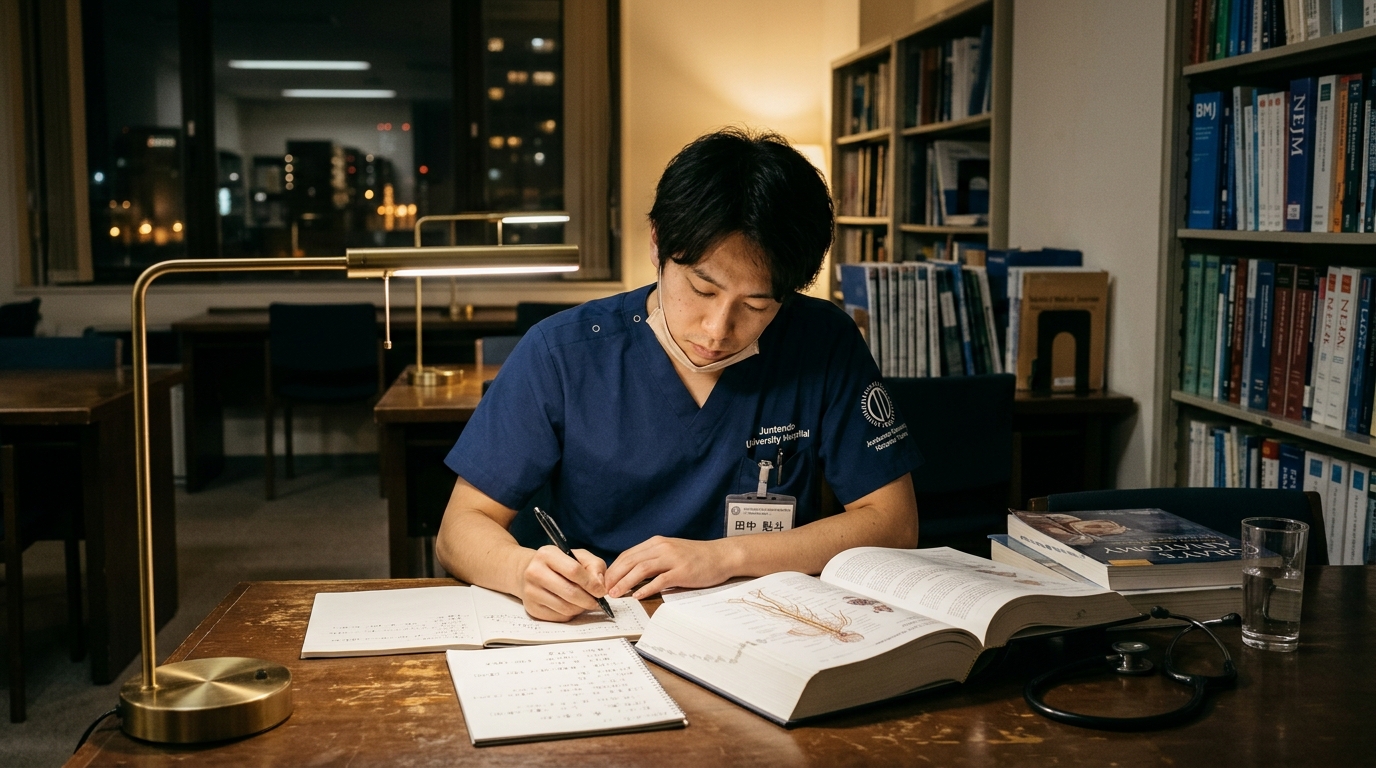
Higher grit scores among Japanese medical residents are significantly associated with higher scores on the General Medicine In-Training Examination as well as longer daily self-study duration, according to a nationwide cross-sectional study published in the Journal of General Internal Medicine. Conducted by researchers including Toshinori Nishizawa and colleagues, the investigation evaluated whether non-cognitive traits are associated with academic performance during residency training, while exploring how self-directed study habits intersect with this relationship.
The study was designed to examine the association between grit, General Medicine In-Training Examination (GM-ITE) performance, and self-study duration among resident physicians in Japan. As outlined in the study, grit may influence academic performance through self-regulated learning and self-directed study, but empirical evidence on its association with in-training examination performance during residency has been limited, and the specific role of residents’ self-study time has remained unclear.
To assess these connections, the nationwide cross-sectional study linked GM-ITE examination data with an anonymous post-examination survey administered between January and March 2025. The study participants were postgraduate year 1 and 2 residents who completed the examination. Out of 9,179 eligible residents across Japan, the final analysis included 2,939 participants, representing a participation rate of 32.1 percent across 553 residency hospitals.
Resident grit was measured using the Japanese Short Grit Scale (Grit-S), which assesses traits on a scale ranging from 1 to 5 and includes subscales for perseverance of effort and consistency of interest. The primary outcome was performance on the GM-ITE, while average daily self-study time—categorized as none, 0–30 minutes, 31–60 minutes, 61–90 minutes, or 91 minutes and greater—served as the secondary outcome. The researchers fitted multilevel linear regression models with a random intercept for residency hospitals. An initial model adjusted for postgraduate year and previous academic performance, specifically repeating a school year or failing the medical licensing examination, while a second model additionally adjusted for daily self-study time. Multilevel proportional odds models evaluated the association between grit and self-study duration.
In the primary multilevel model adjusting for training year and prior academic difficulties, each 1-point increase in total Grit-S score was associated with a 1.03-point higher score on the GM-ITE (95% confidence interval, 0.61 to 1.44). Following additional adjustment for self-study duration, the association was attenuated but remained statistically significant at 0.73 points (95% CI, 0.31 to 1.15). When evaluating individual subscales, perseverance of effort was associated with GM-ITE scores, whereas consistency of interest was not. In addition, higher grit was associated with longer daily self-study time, yielding an adjusted odds ratio of 1.98 (95% CI, 1.76 to 2.23). The authors concluded that higher grit was associated with better examination performance and longer self-study time among Japanese medical residents, highlighting the importance of non-cognitive traits and learning behaviors in postgraduate training.
Subject of Research: Association of grit with medical residency examination performance and self-study duration
Article Title: Association Between Grit and In-Training Examination Scores Among Japanese Medical Residents: A Nationwide Study
Article References: Nishizawa, T., Nagasaki, K., Nishizaki, Y., Nawa, N., Akaishi, Y., Fujiwara, T., Yamawaki, M., Shimizu, T., Yamamoto, Y., Shikino, K., Kobayashi, H., & Tokuda, Y. (2026). Association Between Grit and In-Training Examination Scores Among Japanese Medical Residents: A Nationwide Study. Journal of General Internal Medicine. https://doi.org/10.1007/s11606-026-10970-x
Image Credits: AI Generated
DOI: 10.1007/s11606-026-10970-x
Keywords: medical education, grit, in-training examination, Japanese medical residents, self-directed study, academic performance, postgraduate training, perseverance of effort, Association, Between, In-Training, Examination
News Source: Ophelia Keating. (November 6, 2026). Higher Grit Linked to Better Exam Scores Among Japanese Medical Residents. Scienmag.