A redesigned iridium oxide tip metallization for Utah electrode arrays has passed an accelerated stimulation stress test that broke roughly half of the electrodes made with the current commercial process, according to a new study in Bioelectronic Medicine. In the study, electrodes built with the standard Blackrock metallization were pulsed with 1 million high-current biphasic pulses, and approximately 50 percent of them failed electrically during that run. Electrodes carrying the research metallization, developed by the same team, received the same treatment and then kept going: the researchers extended the test to 4 million pulses and still recorded no electrical failures. The result, reported by Taylor Stump, Brian Baker, Ryan Caldwell, Rohit Sharma, Sandeep Negi and Loren Rieth, does not mean the new coating is ready for patients tomorrow, but it does show how much of a difference the hidden metal stack at the tip of each silicon needle can make to how long a neural interface survives.
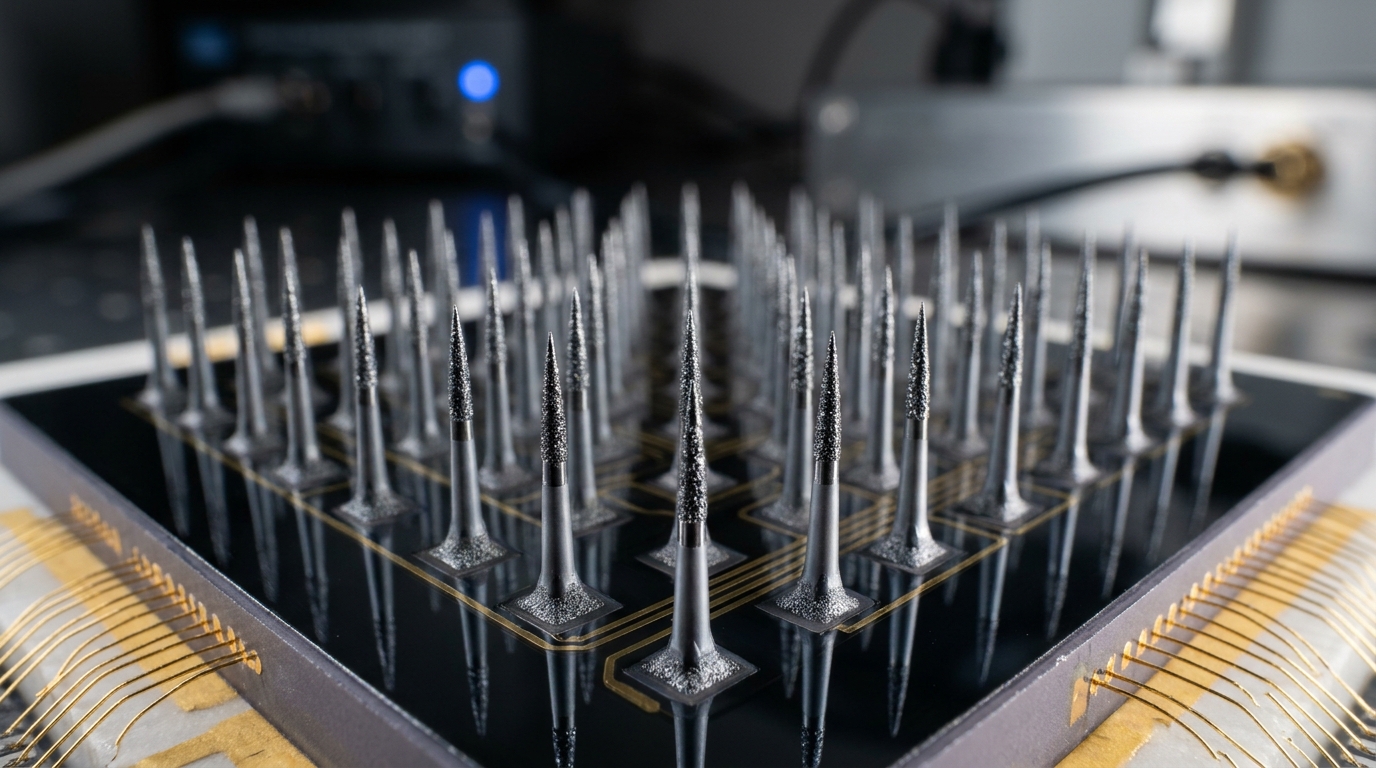
Utah electrode arrays are dense beds of silicon microelectrodes that can both record neural signals and deliver electrical stimulation. They underpin research aimed at partially restoring sensory and motor function after spinal cord injury, addressing sensory loss such as hearing loss, and improving daily living for people after amputations, by interfacing with the central and peripheral nervous systems. The difficulty with stimulation is geometric: because each electrode tip is tiny, the current densities needed to drive useful charge through it are far higher than those of macro-scale electrodes such as electrocorticography grids or nerve cuffs. Even though sensory percepts can be evoked with currents on the scale of tens of microamperes, the charge pushed through such a small surface area stresses the electrode materials hard. That is why the amount of charge an electrode can deliver without degrading is a central measure of stimulation stability, and why the team behind the new work set out to improve the charge injection capacity, impedance and stimulation lifetime of the iridium oxide tip metallization.
The study compared two fabrication recipes on otherwise matched hardware. The researchers fabricated four 4-by-4 Utah electrode arrays: two using the Blackrock standard practice metallization, the current practice around 2019, and two using their research metallization. The standard process starts with a co-sputtered 50-nanometer platinum silicide film as the primary layer making electrical contact with the silicon shank, while the research process uses a pure 25-nanometer platinum layer instead. Both stacks then receive similar sputtered layers of iridium and iridium oxide that form the actual electrode surface, giving stacks of platinum silicide, iridium and iridium oxide at thicknesses of 50, 200 and 350 nanometers for the standard process, and 25, 200 and 350 nanometers for the research version. The annealing steps differ too. The Blackrock metallization was briefly annealed, for less than a minute, in a tube furnace at 475 degrees Celsius in an uncontrolled ambient, a step designed to aid electrical contact formation and film adhesion. The research metallization was annealed at the same temperature but in pure oxygen for 40 minutes, a treatment intended to drive the metallurgical reaction at the interface to form platinum silicide for contact formation and adhesion. Both processes run in oxygen-containing ambients to prevent reduction of the iridium oxide layer.
To judge survival, the team used a stimulation-stability protocol, abbreviated Stim-Stab, that pushes electrodes far beyond physiological conditions on purpose. The arrays were stimulated at 2,100 microamperes per phase, delivering 420 nanocoulombs per phase through cathodic-leading biphasic pulses of 200 microseconds per phase with a 100-microsecond intrapulse interval, at a rate of 300 pulses per second. That current is 21 times the maximum safe chronic stimulation level of 100 microamperes, or 20 nanocoulombs per phase, used physiologically for Utah arrays, a level that earlier non-human primate studies found did not increase tissue response and that formed the basis of clinical intracortical microstimulation investigations. The researchers chose 2,100 microamperes, the upper limit of their stimulator and measurement equipment, as a quick, practical and quantitative worst-case method to accelerate degradation mechanisms and evaluate improvements in the metallization. They are explicit about the trade-off: this heavy acceleration significantly exceeds the water window of safe electrochemical potentials and might activate failure modes that would never occur under physiological use, but it remains a useful comparison because of the large stability differences it reveals.
In total, 58 electrodes were stimulated, since six electrodes from one research array were not tested, with two stimulator channels ganged together to reach the high current. The standard practice electrodes were pulsed for 1 million pulses. The research samples were also pulsed initially for 1 million pulses, but because the longitudinal voltage transient data showed no failures, the test was extended to 4 million pulses. Voltage transients were recorded with a research-grade analog-to-digital converter, one transient out of every 1,000 pulses, yielding 1,000 measurements for the standard arrays and 4,000 for the research arrays. From each recorded waveform the team calculated two quantities: the access potential, which reflects the voltage drop across the spreading impedance of the electrolyte, and the maximum cathodic potential at the electrode interface, which can show electrode polarization. Large, abrupt and sustained increases in voltage were defined as the electrical failure point, and the pulse count at which that happened was recorded as the electrode’s lifetime.
The failure statistics were stark. Roughly 50 percent of the Blackrock standard practice electrodes were categorized as failed by 1 million pulses, while no electrical failures appeared in the voltage transient plots for the research metallization arrays at 1 million pulses, and none appeared after 4 million pulses either. A log-rank statistical analysis found a highly significant difference between the two metallization groups, with no significant differences within each cohort. Backscattered scanning electron microscopy, whose contrast is sensitive to atomic number and can therefore distinguish iridium oxide, silicon and Parylene-C, told a more nuanced story. Every electrode that failed electrically during testing had complete loss of its metallization. But even among electrodes that passed the electrical test, damage was common: 80 percent of the standard practice electrodes and 50 percent of the research metallization electrodes that did not show voltage-transient failures had notable metallization degradation visible in the electron micrographs, placing them in a mixed category between survived and failed.
The electrochemical measurements added texture to those outcomes. Impedance spectra were collected before and after stimulation in phosphate-buffered saline at physiological osmolality and pH 7.4, using a three-electrode configuration with a macro-scale platinum counter and silver-silver chloride reference electrode. For electrodes in the survived and mixed categories, impedance often decreased at frequencies below 1 kilohertz, which the authors attribute to electrochemical activation of the iridium oxide; the research devices even included three sites whose initially high impedances dropped after stimulation. Failed electrodes showed the opposite: dramatic increases in impedance magnitude across the spectrum, consistent with complete loss of tip metallization and a changed electrochemical interface. Cyclic voltammetry showed that cathodal charge storage capacity, which ranged from about 8 to nearly 30 millicoulombs per square centimeter on an estimated tip area of 3.5 by 10 to the minus 5 square centimeters, increased after stimulation for all measured electrodes. Notably, all maximum cathodic potentials measured during the high-current stimulation exceeded the water window, reaching cathodic values in the 3-to-4-volt range, and some research electrodes nonetheless tolerated those potentials, hinting at resilience under conditions usually considered damaging, though the two-electrode measurement configuration means counter-electrode polarization could have inflated those values.
The authors are careful about what the study does and does not establish. The comparison was designed to isolate the effect of stimulation current stress by modulating only the current amplitude, rather than using other accelerated aging approaches such as elevated temperature or mechanical loading, and the tip deinsulation measurements showed the standard practice arrays had comparable or slightly larger electrode surface areas, a potential advantage to the older process rather than a handicap. Yet the work does not identify the mechanisms behind the different lifetimes. Pitting observed in electron micrographs of silicon exposed by lost tip metal is consistent with electrochemical degradation and dissolution of silicon, and silicon degradation has been seen in long-term implants in human subjects, where it was proposed as one mechanism for electrode metal loss. The team also notes that the character of the metal-semiconductor contacts was not measured, because no viable method exists for the shank geometry, and that the interface between the tip metallization and the silicon shank may be pivotal for reducing delamination. The research metallization’s better outcomes, they conclude, represent important steps toward improving electrode metallization lifetime for Utah arrays, while the Stim-Stab method itself provides valuable engineering feedback for designing improved metallizations.
The broader context makes the result meaningful. The team’s earlier role on the DARPA HAPTIX program was to maximize the stimulation lifetime of the iridium oxide tip metallization used for Utah slanted electrode arrays, so that reliable long-term stimulation, beyond one year, in peripheral nerves of human subjects could be achieved; those studies delivered up to 19 millicoulombs of charge for some electrodes over nearly a year and a half in-dwelling, a large amount for Utah arrays in peripheral nerves but still far below the charge delivered by clinical devices such as cochlear implants. The new accelerated test offers a way to screen metallization improvements on an engineering timescale instead of waiting years, and it produces graded lifetime data rather than simple pass-or-fail endpoints, which enables sharper statistical comparisons between fabrication processes. Future work, the authors write, should elucidate the degradation mechanisms and how stimulation conditions affect them, optimize the electrode surface, deposition conditions and heat treatments, adopt more precise three-electrode measurements of potentials during stimulation, and possibly use artificial intelligence to classify electron micrographs and pinpoint failure modes such as delamination, cracking and electrochemical void formation. For now, the message is concrete: changing what lies beneath the iridium oxide at the tip of each silicon needle, from a platinum silicide contact layer to a pure platinum one annealed in oxygen, multiplied the number of high-current pulses the electrodes could endure fourfold in this test, with zero electrical failures where the standard process lost about half its electrodes.
Subject of Research: Stimulation stability testing of a research iridium oxide tip metallization for Utah electrode arrays compared with the standard Blackrock metallization
Article Title: Improved electrode stimulation stability of Utah arrays*
Article References: Stump, T., Baker, B., Caldwell, R., Sharma, R., Negi, S., & Rieth, L. (2025). Improved electrode stimulation stability of Utah arrays*. Bioelectronic Medicine, 11(1), Article 30. https://doi.org/10.1186/s42234-025-00190-9
Image Credits: AI Generated
DOI: 10.1186/s42234-025-00190-9
Keywords: Utah electrode array, iridium oxide, neural stimulation, microelectrodes, brain-computer interface, neural prosthetics, electrode metallization, accelerated aging, charge injection capacity, voltage transients, electrochemical impedance, Bioelectronic Medicine
News Source: Cassandra Pierce. (November 6, 2026). New iridium oxide metallization quadruples stimulation lifetime of Utah electrode arrays in accelerated stress test. Scienmag.