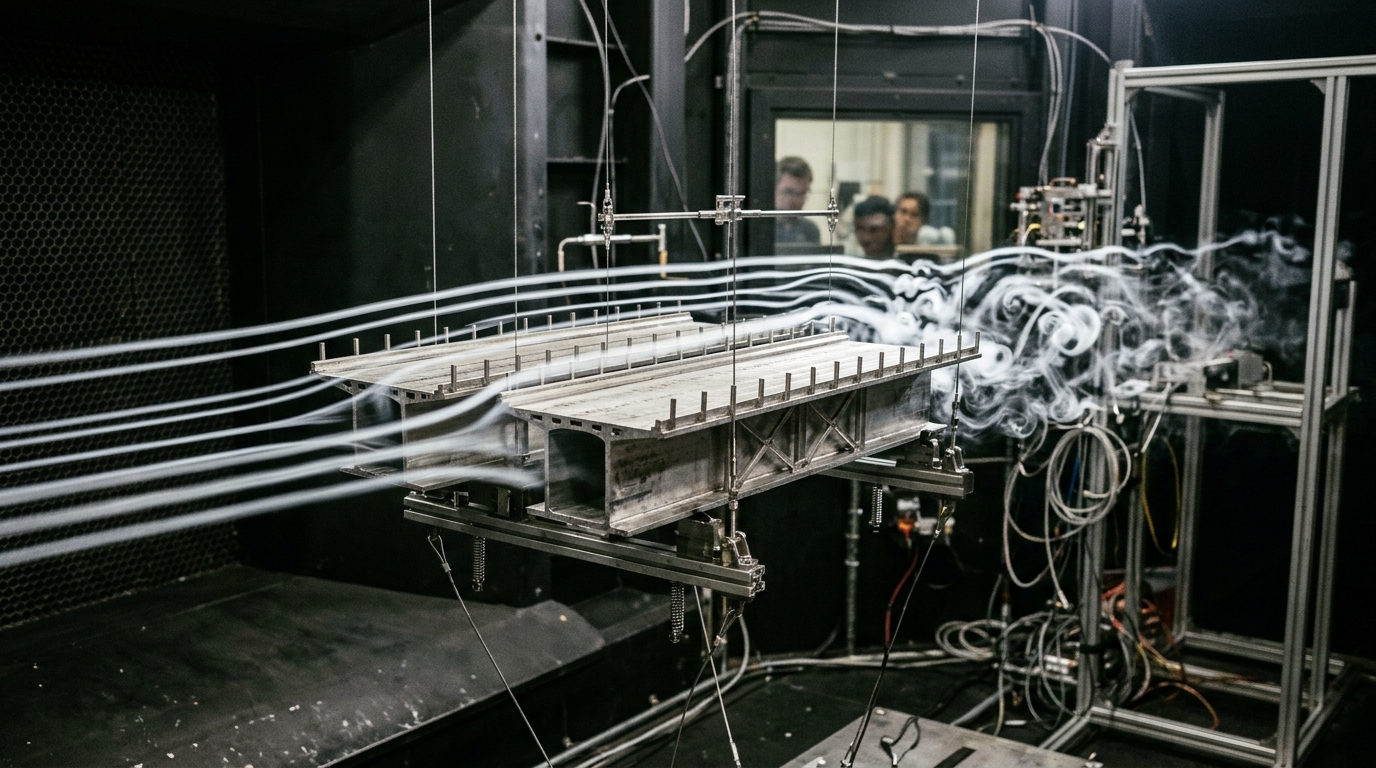
Wind flowing across a bridge deck can peel off alternating vortices, and when the shedding frequency approaches one of the bridge’s natural frequencies, the structure can resonate in what engineers call vortex-induced vibration, or VIV. While this limit-cycle oscillation rarely causes immediate structural failure, it can compromise driving stability and safety, accelerate fatigue-related deterioration of components, and impose significant social and economic costs. Long-span girder bridges are especially vulnerable because they combine low weight, high flexibility, blunt geometry, and low damping, and documented cases show the scale of the problem: the Jindo Bridge in South Korea experienced large VIVs with a maximum amplitude of 10 centimeters at wind speeds of 9.8 to 11.5 meters per second, the Volga River Bridge in Russia saw amplitudes of 40 centimeters at 11.6 to 15.6 meters per second, the Xihoumen Bridge has repeatedly vibrated vertically at 6 to 10 meters per second with reported amplitudes exceeding 20 centimeters, and the Great Belt East Bridge in Denmark recorded vertical VIVs of up to 32 centimeters at 4.8 to 9 meters per second. Notably, no torsional VIV cases have been reported for this bridge type, so torsional response was excluded from the new study.
A research team led by Bo Wang, Fuyou Xu, Mingjie Zhang, and Miaomin Wang has now published an experimental investigation of the vortex-induced vibration characteristics of a long-span twin continuous steel box girder bridge, appearing in the journal Advances in Bridge Engineering. The work, released as an open access Original Innovation article on 30 April 2026, targets a bridge class that is the preferred choice for crossing high mountains and deep valleys. Twin-girder decks are favored by designers for their wide visual effect and excellent traffic conditions, but the aerodynamic interference between the two parallel girders makes their wind-resistant performance considerably more complex than that of a single deck. Under strong wind, the upstream girder of a long-span twin-girder bridge with high piers may generate significant VIV that can either enhance or suppress the response of the downstream girder, and the flow in the gap between the two girders is the key factor governing these behaviors.
To build a systematic experimental dataset, the researchers conducted sectional model wind tunnel tests at a scale ratio of 1:40 in the DUT-1 boundary layer wind tunnel at Dalian University of Technology in China. The closed-circuit tunnel has a work section 18.0 meters long, 3.1 meters wide, and 2.5 meters high, with wind velocity continuously adjustable between 1 and 50 meters per second, velocity inhomogeneity below 1 percent, and turbulence intensity below 0.5 percent at wind speeds above 4 meters per second. The target bridge features a span arrangement of 70 plus 110 plus 110 plus 70 meters, with twin girders transversely connected only at the piers and no lateral connections elsewhere. Three cross-sections at different heights along the main girder were tested: the mid-span section, the quarter-span section, and the pier-top section, with model heights of 78, 108, and 137 millimeters respectively. A single girder model was 325 millimeters wide, the twin-girder arrangement spanned 662.5 millimeters, and the total model length was 3000 millimeters, nearly filling the tunnel width to minimize three-dimensional flow effects.
The spring-suspended sectional models were standardized to a mass of 6.677 kilograms per meter by adding counterweights, including one-third of the spring mass, ensuring identical vibration frequencies across the models. Eight coil springs with a total stiffness of 35413 newtons per meter supported each deck model, and three piezoelectric acceleration sensors per model collected vibration data at a sampling frequency of 100 hertz. During each test the wind speed increased in steps of 0.2 meters per second from 2 to 11 meters per second, producing Reynolds numbers ranging from roughly 8.6 times 10 to the third to 7.55 times 10 to the fourth depending on the section, and vibration data were recorded for 30 seconds after conditions stabilized. The mechanical damping ratio in still air was identified as approximately 4.1 per thousand using free decay tests at small amplitudes, and damping was standardized between the upstream and downstream girders by wrapping double-sided tape around the suspension springs. Displacement amplitudes in the lock-in region were calculated from filtered vertical acceleration and the monotonic vibration frequency of the signal.
The experiments varied four parameters: wind angles of attack from minus 5 to plus 5 degrees, Scruton numbers, girder heights, and layout forms including the twin-girder arrangement, a single girder, and a twin-girder fixed configuration in which the two girders were bolted together to simulate an extreme retrofit scenario with lateral connections. All tests ran in a uniform flow field. The results confirm that the VIV response of the twin-box bridge is highly complex and shows no clear trend with changes in girder height or wind angle of attack. For the shallowest section at 78 millimeters, both girders reached their strongest VIV at a positive 5 degree angle of attack, with the upstream girder achieving a maximum dimensionless amplitude of 0.06 at a reduced wind velocity of 15.0 and the downstream girder reaching a markedly larger 0.177 at the same reduced velocity. For the 108 and 137 millimeter sections, maximum vibration occurred at minus 5 degrees, and the downstream girder showed higher amplitude except for a slight upstream advantage in the 108 millimeter model, where the upstream girder reached 0.0334 and the downstream 0.03.
Across all three heights, the leeward girder proved more susceptible to aerodynamic interference. The researchers attribute this to vortex shedding from the upstream girder impinging on the leading edge of the downstream girder, inducing local flow separation and enhancing pressure fluctuations, while the gap flow state determines how strongly the downstream girder is affected by the wake of its neighbor. Girder height itself altered the gap flow and shear layer development in ways that modulated vortex shedding intensity differently at different attack angles: when the angle was negative, the tallest 137 millimeter section vibrated most strongly, with downstream maximum dimensionless amplitudes of 0.094 and 0.093 at minus 5 and minus 3 degrees, whereas at zero and positive angles the shallowest 78 millimeter section responded most, with downstream maxima of 0.058, 0.153, and 0.177 at 0, plus 3, and plus 5 degrees. The intermediate 108 millimeter height consistently showed lower amplitudes under most attack angles, suggesting better VIV resistance among the three depths tested, though the authors emphasize that no unified trend can be identified and that the response is nonlinear and uncertain.
One of the most striking findings concerns the coupling between the two girders. Within the lock-in region of the shallowest section at plus 5 degrees, the phase difference between the upstream and downstream vibrations was minimal at the onset, approximately 48 degrees at a reduced wind velocity of 4.82. As wind speed and amplitude increased, the phase difference grew to a peak of about 177 degrees, approaching a fully anti-phase vibration state, before gradually decreasing again in a first-increase-then-decrease pattern. A similar trend appeared at plus 3 degrees, where the phase difference started near 45 degrees and peaked around 167 degrees, occurring before the amplitude reached its maximum. The vibration frequencies of the two girders remained consistent at the same reduced wind velocity, staying close to the natural frequency throughout lock-in, and both girders exhibited steady, single-frequency vibration with self-limiting amplitudes, confirming typical vertical bending VIV in both decks.
Damping proved to be a powerful lever for suppression. As the Scruton number, which combines mass and damping, increased, the VIV response of the twin-girder model was significantly suppressed, with the lock-in region shortening and maximum amplitudes falling. Raising the Scruton number from 11.39 to 22.52 left the lock-in region relatively stable with only a slight amplitude decrease, but at values of 29.19 and 34.47 the lock-in region shortened dramatically, with VIV occurring only in the later stage of the original range, and at 51.43 the model showed almost no observable VIV. Between Scruton numbers of 11.39 and 29.19, the maximum dimensionless amplitude of the upstream model dropped by approximately 86 percent while the downstream model dropped by about 65 percent, an apparent exponential attenuation. The authors conclude that increasing structural damping is an effective strategy for improving the VIV resistance of twin-girder bridges and recommend that damping be reasonably controlled in practical design.
Layout form also mattered, though again without a simple rule. At plus 3 degrees, the downstream girder of the twin arrangement produced the largest response at 0.153, the single girder reached a moderate 0.106, and the bolted twin-girder fixed model only 0.016, with the twin model maintaining the widest lock-in range from 11.53 to 19.48. At 0 degrees the single girder slightly exceeded the twin model at 0.072 versus 0.058, while the fixed configuration showed the smallest amplitude at 0.012 with its lock-in range shifted to higher wind speeds. At minus 3 degrees the pattern inverted: the twin-girder fixed model jumped to 0.065, surpassing both alternatives and suggesting it may induce structural resonance at specific angles of attack. Summarizing across configurations, the largest amplitudes occurred in the twin, single, and twin-girder fixed models at plus 3, 0, and minus 3 degrees respectively, and the authors stress that the VIV response is highly sensitive to section details, so results for the studied section may differ from those of other sections. They advise designers to consider the coupled effects of wind angle and layout form to avoid inducing strong resonance under specific conditions, to select girder height according to the bridge’s specific wind environment, and to enhance structural damping to achieve effective VIV suppression.
Subject of Research: Vortex-induced vibration characteristics of long-span twin continuous steel box girder bridges tested with sectional model wind tunnel experiments
Article Title: Experimental investigation on the vortex-induced vibration characteristics of long-span twin continuous steel box girder bridge
Article References: Wang, B., Xu, F., Zhang, M., & Wang, M. (2026). Experimental investigation on the vortex-induced vibration characteristics of long-span twin continuous steel box girder bridge. Advances in Bridge Engineering, 7(1), Article 18. https://doi.org/10.1186/s43251-026-00207-6
Image Credits: AI Generated
DOI: 10.1186/s43251-026-00207-6
Keywords: vortex-induced vibration, twin box girder bridge, wind tunnel test, aerodynamic interference, Scruton number, lock-in region, steel box girder, bridge engineering, wind angle of attack, sectional model, structural damping, phase difference
News Source: Denise Maddox. (November 6, 2026). Wind Tunnel Tests Reveal Complex Vortex Vibrations in Twin Steel Box Girder Bridges. Scienmag.