• HOME
  • NEWS
  • EXPLORE
    • CAREER
      • Companies
      • Jobs
    • EVENTS
    • iGEM
      • News
      • Team
    • PHOTOS
    • VIDEO
    • WIKI
  • BLOG
  • COMMUNITY
    • FACEBOOK
    • INSTAGRAM
    • TWITTER
Friday, November 6, 2026
BIOENGINEER.ORG
No Result
View All Result
  • Login
  • HOME
  • NEWS
  • EXPLORE
    • CAREER
      • Companies
      • Jobs
        • Lecturer
        • PhD Studentship
        • Postdoc
        • Research Assistant
    • EVENTS
    • iGEM
      • News
      • Team
    • PHOTOS
    • VIDEO
    • WIKI
  • BLOG
  • COMMUNITY
    • FACEBOOK
    • INSTAGRAM
    • TWITTER
No Result
View All Result
Bioengineer.org
No Result
View All Result
Home NEWS Science News Cancer

MRI Features Differentiate Confluent Hepatic Fibrosis From Infiltrative Cholangiocarcinoma

by
November 6, 2026
in Cancer, Health
Reading Time: 2 mins read
0
MRI Features Differentiate Confluent Hepatic Fibrosis From Infiltrative Cholangiocarcinoma

MRI Features Differentiate Confluent Hepatic Fibrosis From Infiltrative Cholangiocarcinoma

Share on FacebookShare on TwitterShare on LinkedinShare on RedditShare on Telegram

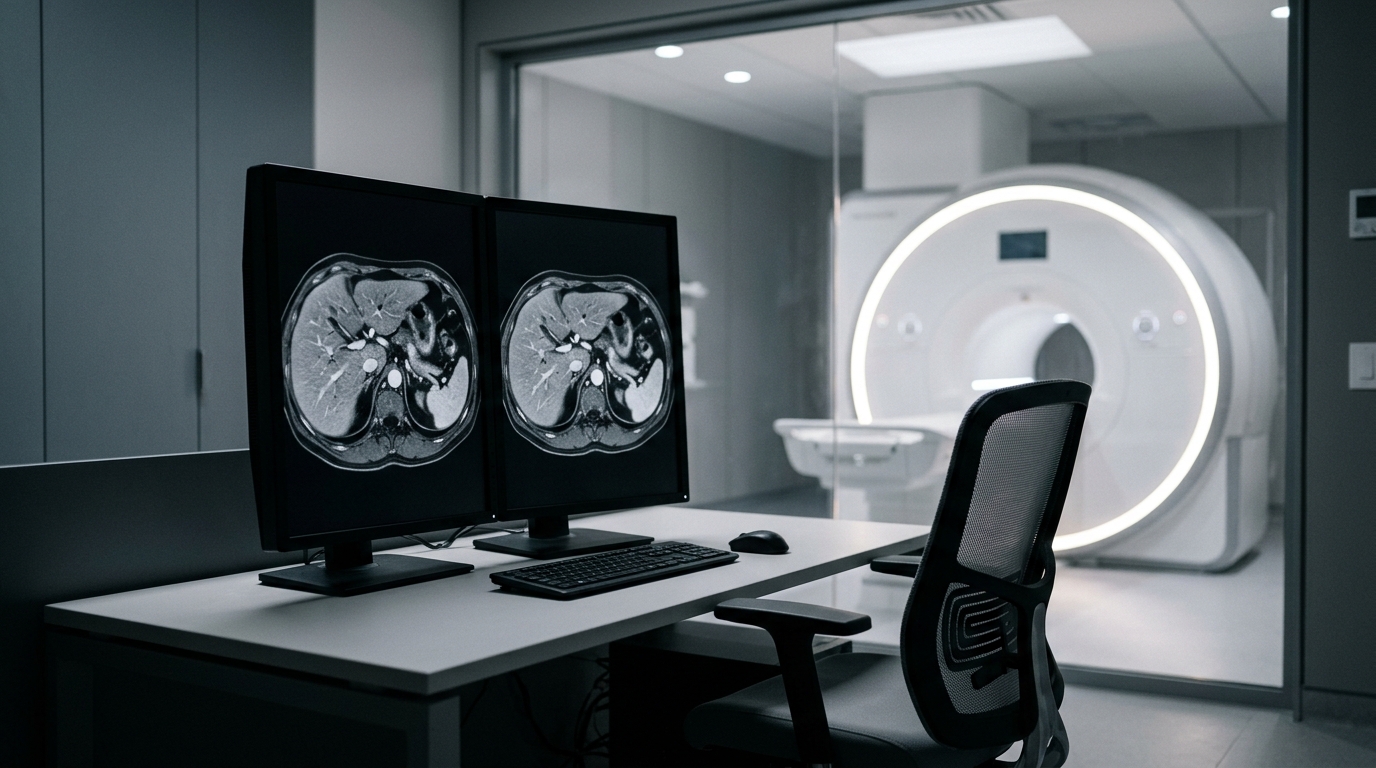
In a retrospective study published in Cancer Imaging, researchers identified magnetic resonance imaging (MRI) features that can differentiate confluent fibrosis (CF) from mass-forming intrahepatic cholangiocarcinoma with an infiltrative tumor margin (mICCITM), demonstrating that combining arterial phase non-enhancement or non-rim enhancement with delayed phase signal homogeneity achieved a diagnostic accuracy of 97.3% (72/74) for CF, with an area under the curve (AUC) of 0.972 (95% CI: 0.904–0.996).

The retrospective analysis evaluated 44 CF patients and 30 mICCITM patients who underwent upper abdomen MRI scans to assess lesion imaging features and measure apparent diffusion coefficient (ADC) values, noting that imaging features of CF may mimic intrahepatic cholangiocarcinoma. Hepatic capsular retraction at the site of the lesion, hepatic volume loss, the “nodular surround sign,” and liver cirrhosis were observed more frequently in CF patients than in mICCITM patients (all P < 0.005). When evaluated individually, superior diagnostic accuracy was shown by hepatic capsular retraction at 75.7% (56/74), arterial phase non-enhancement or non-rim enhancement at 79.7% (59/74), and delayed phase signal homogeneity at 94.6% (70/74).

Diagnostic performance varied across feature combinations. A sensitivity of 100.0% (44/44) for CF diagnosis was achieved when hepatic capsular retraction, arterial phase non-enhancement or non-rim enhancement, or delayed phase signal homogeneity was present. A specificity of 96.7% (29/30) was reached when hepatic capsular retraction and delayed phase signal homogeneity were present, when arterial non-enhancement or non-rim enhancement and delayed phase signal homogeneity were present, or when all three features were positive. In addition to 97.3% accuracy, the combination of arterial non-enhancement or non-rim enhancement and delayed phase signal homogeneity yielded 97.7% (43/44) sensitivity and 96.7% (29/30) specificity, whereas no significant difference was observed in lesion ADC values between CF and mICCITM (P = 0.511).

Based on these findings, the authors concluded that the combination of non-enhancement or non-rim enhancement in the arterial phase and delayed phase signal homogeneity represents potential MRI features for differentiating CF from mICCITM.

Subject of Research: MRI differentiation of confluent hepatic fibrosis and intrahepatic cholangiocarcinoma

Article Title: Differentiation of confluent hepatic fibrosis and mass forming intrahepatic cholangiocarcinoma with infltrative tumor margin (mICCITM) on MR imaging

Article References: Liu, J.-J., Sun, Z.-Q., Duan, M.-J., Chu, Q.-Q., Huang, M.-Y., Che, Y.-Y., Wang, M.-Z., Li, K.-X., & Zhang, Y. (2026). Differentiation of confluent hepatic fibrosis and mass forming intrahepatic cholangiocarcinoma with infltrative tumor margin (mICCITM) on MR imaging. Cancer Imaging. https://doi.org/10.1186/s40644-026-01147-0

Image Credits: AI Generated

DOI: 10.1186/s40644-026-01147-0

Keywords: magnetic resonance imaging, confluent hepatic fibrosis, intrahepatic cholangiocarcinoma, apparent diffusion coefficient, diagnostic accuracy, hepatic capsular retraction, delayed phase signal homogeneity, Differentiation, confluent, hepatic, fibrosis, mass

News Source: Ophelia Keating. (November 6, 2026). MRI Features Differentiate Confluent Hepatic Fibrosis From Infiltrative Cholangiocarcinoma. Scienmag.

Tags: apparent diffusion coefficientconfluentconfluent hepatic fibrosisdelayed phase signal homogeneitydiagnostic accuracydifferentiationFibrosishepatichepatic capsular retractionintrahepatic cholangiocarcinomamagnetic resonance imagingmass
Share12Tweet7Share2ShareShareShare1

Related Posts

Canadian Allergy Journal Shows Rising Women Authorship Alongside Persistent Leadership Gaps

Canadian Allergy Journal Shows Rising Women Authorship Alongside Persistent Leadership Gaps

November 6, 2026
Gilteritinib Yields Five-Year Remission in Relapsed Acute Myeloid Leukemia Case

Gilteritinib Yields Five-Year Remission in Relapsed Acute Myeloid Leukemia Case

November 6, 2026

Cerebral Hemangioma Causes Sudden Seizures in a Five-Month-Old Dog

November 6, 2026

Medicaid claims data offers a smarter way to find and recruit providers for qualitative research

November 6, 2026

POPULAR NEWS

  • Crotonylation Boost Keeps Aging Stem Cells Fighting Gut Inflammation

    Crotonylation Boost Keeps Aging Stem Cells Fighting Gut Inflammation

    29 shares
    Share 12 Tweet 7
  • Lightweight Edge Computing Model Dynamically Segments Citrus Flowers and Developing Fruitlets

    29 shares
    Share 12 Tweet 7
  • Dual Constrained Neural Network Accelerates Robot Path Planning on Grid Maps

    29 shares
    Share 12 Tweet 7
  • Canadian Allergy Journal Shows Rising Women Authorship Alongside Persistent Leadership Gaps

    29 shares
    Share 12 Tweet 7

About

We bring you the latest biotechnology news from best research centers and universities around the world. Check our website.

Follow us

Recent News

Crotonylation Boost Keeps Aging Stem Cells Fighting Gut Inflammation

Lightweight Edge Computing Model Dynamically Segments Citrus Flowers and Developing Fruitlets

Dual Constrained Neural Network Accelerates Robot Path Planning on Grid Maps

Subscribe to Blog via Email

Enter your email address to subscribe to this blog and receive notifications of new posts by email.

Join 86 other subscribers
  • Contact Us

Bioengineer.org © Copyright 2023 All Rights Reserved.

Welcome Back!

Login to your account below

Forgotten Password?

Retrieve your password

Please enter your username or email address to reset your password.

Log In
No Result
View All Result
  • Homepages
    • Home Page 1
    • Home Page 2
  • News
  • National
  • Business
  • Health
  • Lifestyle
  • Science

Bioengineer.org © Copyright 2023 All Rights Reserved.