• HOME
  • NEWS
  • EXPLORE
    • CAREER
      • Companies
      • Jobs
    • EVENTS
    • iGEM
      • News
      • Team
    • PHOTOS
    • VIDEO
    • WIKI
  • BLOG
  • COMMUNITY
    • FACEBOOK
    • INSTAGRAM
    • TWITTER
Monday, November 16, 2026
BIOENGINEER.ORG
No Result
View All Result
  • Login
  • HOME
  • NEWS
  • EXPLORE
    • CAREER
      • Companies
      • Jobs
        • Lecturer
        • PhD Studentship
        • Postdoc
        • Research Assistant
    • EVENTS
    • iGEM
      • News
      • Team
    • PHOTOS
    • VIDEO
    • WIKI
  • BLOG
  • COMMUNITY
    • FACEBOOK
    • INSTAGRAM
    • TWITTER
No Result
View All Result
Bioengineer.org
No Result
View All Result
Home NEWS Science News Health

Finite Element Study Evaluates Crossed Wire Fixation Angles for Supracondylar Fractures

by
November 6, 2026
in Health
Reading Time: 2 mins read
0
Finite Element Study Evaluates Crossed Wire Fixation Angles for Supracondylar Fractures

Finite Element Study Evaluates Crossed Wire Fixation Angles for Supracondylar Fractures

Share on FacebookShare on TwitterShare on LinkedinShare on RedditShare on Telegram

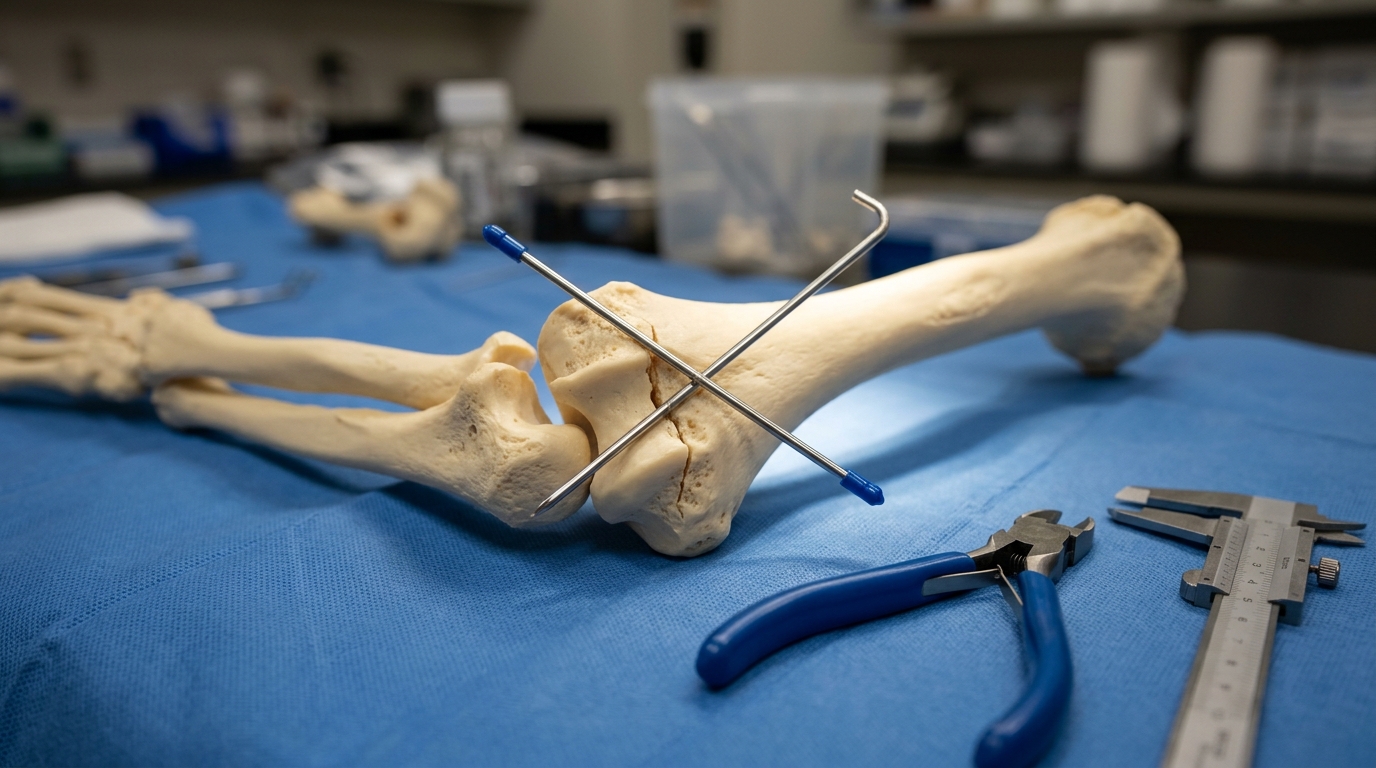
Finite element analysis has demonstrated that the biomechanical stability of crossed Kirschner wire (K-wire) fixation in supracondylar humerus fractures depends directly on the fracture level. In a computational investigation evaluating wire configurations across different fracture heights, researchers identified distinct mechanical stability profiles, establishing a biomechanical basis for personalized surgical planning in pediatric elbow fractures.

To assess stability characteristics, the researchers constructed 27 types of finite element models displaying various insertion angles of crossed K-wires across low, middle, and high fracture levels of supracondylar humerus fractures. Across these simulated configurations, the computational analysis evaluated equivalent (von Mises) stress, equivalent elastic strain, and total construct deformation.

The finite element analysis demonstrated distinct biomechanical characteristics across the different fracture levels. For low fractures, smaller insertion angles for the crossed K-wires provided more favorable biomechanical performance. For middle fractures, a configuration combining a larger lateral insertion angle with a smaller medial insertion angle appeared to offer superior mechanical stability. For high fractures, crossed fixation using large insertion angles on both sides showed more favorable biomechanical characteristics.

The study established a biomechanical relationship between fracture level and the optimal configuration of crossed K-wire fixation in supracondylar humerus fractures. The authors noted that these findings can serve as a reference for optimizing fixation techniques and pin configurations according to fracture height.

Subject of Research: Biomechanical finite element analysis of crossed Kirschner wire fixation for supracondylar humerus fractures

Article Title: Biomechanical comparison of crossed Kirschner wires fixation for supracondylar humerus fractures at different fracture lines: finite element analysis and exploration of the optimal fixed angle

Article References: Deng, Y., Guo, Y., Wang, Y., Bi, Y., Cao, Y., Huang, M., & Guo, Z. (2026). Biomechanical comparison of crossed Kirschner wires fixation for supracondylar humerus fractures at different fracture lines: finite element analysis and exploration of the optimal fixed angle. BMC Musculoskeletal Disorders. https://doi.org/10.1186/s12891-026-10719-x

Image Credits: AI Generated

DOI: 10.1186/s12891-026-10719-x

Keywords: supracondylar humerus fractures, Kirschner wires, finite element analysis, biomechanics, orthopedic surgery, fracture fixation, pediatric fractures, von Mises stress, Biomechanical, comparison, crossed, Kirschner

News Source: Ophelia Keating. (November 6, 2026). Finite Element Study Evaluates Crossed Wire Fixation Angles for Supracondylar Fractures. Scienmag.


Tags: biomechanicalBiomechanicscomparisoncrossedfinite element analysisfracture fixationKirschnerKirschner wiresorthopedic surgerypediatric fracturessupracondylar humerus fracturesvon Mises stress
Share12Tweet7Share2ShareShareShare1

Related Posts

Information-Based Prescription Review Systems Evolve from Manual Screening to Intelligent Interception

Information-Based Prescription Review Systems Evolve from Manual Screening to Intelligent Interception

November 16, 2026
Study Reveals Incidence of Rare Pediatric Hip Disorders in Japanese Children

Study Reveals Incidence of Rare Pediatric Hip Disorders in Japanese Children

November 16, 2026

Children With Nephrotic Syndrome Exhibit Severe Disruption Across Gut Microbial Kingdoms

November 16, 2026

Low-Molecular-Weight Heparin Linked to Lower Clot Odds in Blunt Trauma

November 16, 2026

POPULAR NEWS

  • Information-Based Prescription Review Systems Evolve from Manual Screening to Intelligent Interception

    Information-Based Prescription Review Systems Evolve from Manual Screening to Intelligent Interception

    29 shares
    Share 12 Tweet 7
  • Study Reveals Incidence of Rare Pediatric Hip Disorders in Japanese Children

    29 shares
    Share 12 Tweet 7
  • Children With Nephrotic Syndrome Exhibit Severe Disruption Across Gut Microbial Kingdoms

    29 shares
    Share 12 Tweet 7
  • Automated Platform Maps Genomic Hotspots in CHO Cells for Antibody Production

    29 shares
    Share 12 Tweet 7

About

We bring you the latest biotechnology news from best research centers and universities around the world. Check our website.

Follow us

Recent News

Phenazine Mediators Enable Selective Hydrogenation of Nitro Compounds at Biphasic Interfaces

Information-Based Prescription Review Systems Evolve from Manual Screening to Intelligent Interception

Study Reveals Incidence of Rare Pediatric Hip Disorders in Japanese Children

Subscribe to Blog via Email

Enter your email address to subscribe to this blog and receive notifications of new posts by email.

Join 88 other subscribers
  • Contact Us

Bioengineer.org © Copyright 2023 All Rights Reserved.

Welcome Back!

Login to your account below

Forgotten Password?

Retrieve your password

Please enter your username or email address to reset your password.

Log In
No Result
View All Result
  • Homepages
    • Home Page 1
    • Home Page 2
  • News
  • National
  • Business
  • Health
  • Lifestyle
  • Science

Bioengineer.org © Copyright 2023 All Rights Reserved.