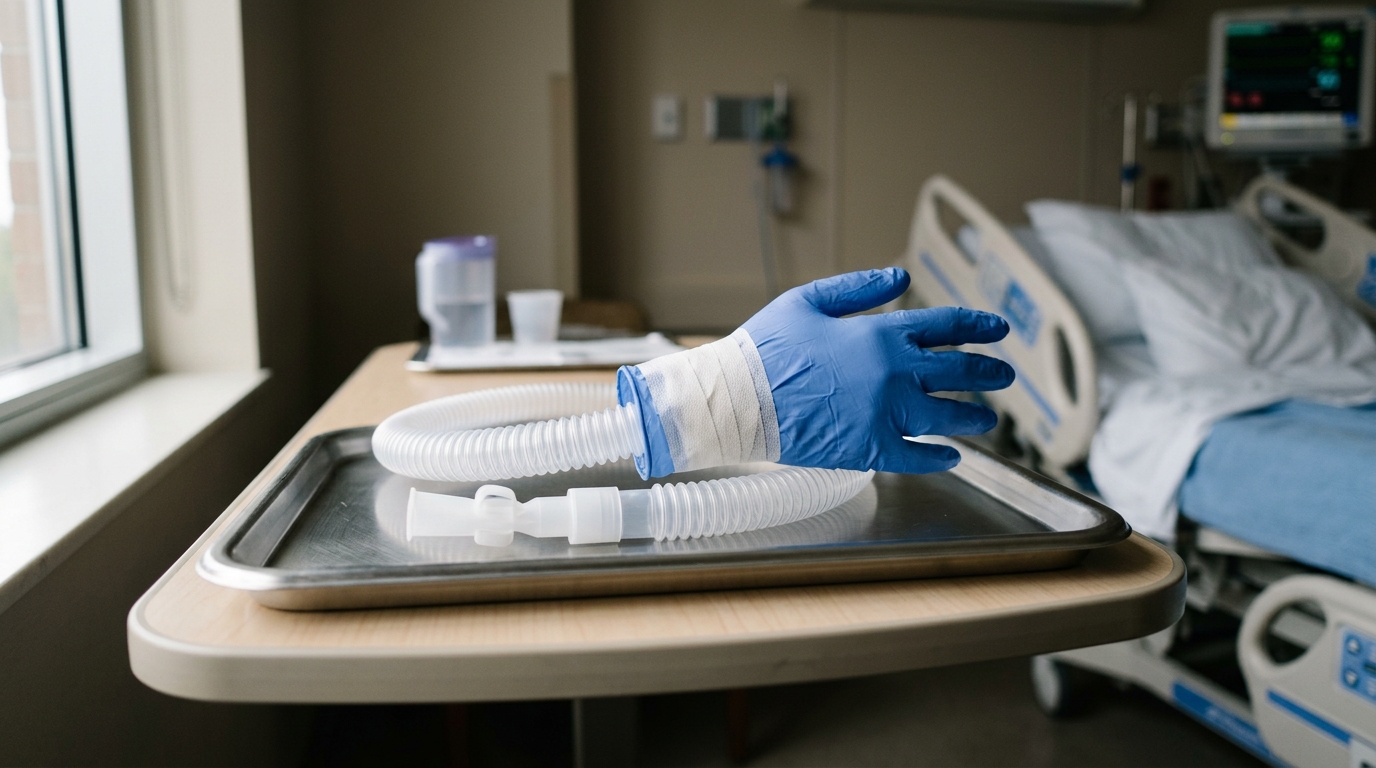
Physiotherapists in low-resource hospitals have long handed patients a homemade breathing device assembled from a powdered surgical latex glove, a 5-mL syringe barrel and adhesive plaster, trusting that it delivers the same therapeutic pressure as commercial equipment. A new quasi-experimental study from a Nigerian tertiary hospital now offers the first direct clinical comparison of that improvised latex-glove device against the Acapella, a validated oscillating positive expiratory pressure device, in patients recovering from upper abdominal surgery. The verdict: the cheap, locally sourced alternative performed comparably to the commercial device across the key lung function measures over ten days of therapy.
The study, published in the Bulletin of Faculty of Physical Therapy, enrolled 46 patients scheduled for upper abdominal surgery at the Obafemi Awolowo University Teaching Hospitals Complex in Ile-Ife, Nigeria. Upper abdominal surgery is a well-established independent risk factor for postoperative pulmonary complications, with reported incidences ranging from 6% to over 40%. The surgical incision and associated pain trigger predictable physiological changes, including diaphragmatic dysfunction, reduced vital capacity and functional residual capacity, and a restrictive breathing pattern that predisposes patients to atelectasis, the most common postoperative pulmonary complication and a precursor to pneumonia.
Positive expiratory pressure devices work by creating back-pressure during expiration, which prevents premature airway collapse, facilitates collateral ventilation and helps mobilize secretions. Oscillating devices such as the Acapella add high-frequency oscillations to that positive pressure. But in sub-Saharan Africa, the relatively high cost and limited availability of commercial devices hinder routine clinical use, which is why Nigerian physiotherapists have relied for years on the modified latex-glove and syringe setup. Until now, that practice had never been verified through objective research in surgical patients.
The researchers used a pretest–posttest quasi-experimental design with purposive sampling. Based on a sample size calculation targeting 20 participants per group with allowance for 10% attrition, 50 patients were recruited and 46 completed follow-up. An independent research assistant allocated participants into two groups: one receiving therapy with the improvised latex-glove device, the other with the Acapella device set at a fixed resistance. Excluded were patients with a positive history of pulmonary disease or hypertension, and elite athletes. The trial was registered with the Pan African Clinical Registry (PACTR202210515878180) and approved by the Health Research Ethics Committee of the Institute of Public Health, Obafemi Awolowo University.
The treatment protocol was deliberately identical across both arms. Participants sat in a supported position, inhaled deeply, held their breath for 2–3 seconds, and then exhaled actively but not forcefully through their allocated device. Rest periods of about two minutes followed every 2–3 repetitions, and each 20-minute session comprised ten expiratory breaths. Sessions were administered three times daily for the first ten postoperative days, following a standardized schedule after waking in the morning, after an afternoon nap, and before bedtime. All participants also received routine postoperative medical care and early mobilization according to their clinical status.
Lung function was assessed with a portable spirometer at five time points: one day preoperatively, a few hours after recovery from anaesthesia, and on postoperative days 4, 8 and 10. Recovery from anaesthesia was confirmed using the Modified Post-Anaesthetic Discharge Scoring System, which evaluates activity, vital signs, nausea and vomiting, surgical bleeding and pain. The outcome measures were forced vital capacity (FVC), forced expiratory volume in one second (FEV₁), the percentage of forced expiratory volume in one second (FEV₁%) and peak expiratory flow rate (PEFR).
The baseline damage from surgery was clear. Comparing pre-surgery with immediate post-surgery values across participants, FVC fell significantly from 0.92 ± 0.44 to 0.58 ± 0.40 (t = 5.482, p = 0.001), and PEFR dropped from 85.02 ± 47.62 to 58.48 ± 30.44 (t = 3.766, p = 0.001). FEV₁ declined from 0.58 ± 0.48 to 0.46 ± 0.26 without reaching statistical significance (p = 0.070), and FEV₁% showed no significant change (57.00 ± 36.08 vs. 65.65 ± 31.66; t = −1.089, p = 0.282). The authors attribute the preserved FEV₁ measures to effective postoperative analgesia, which mitigates pain-related restriction of deep breathing and coughing.
Within-group repeated-measures ANOVA showed significant improvement in FVC, FEV₁ and PEFR across baseline and postoperative days 4, 8 and 10 in both device groups (p = 0.001 for the Acapella group; p = 0.01 for the latex-glove group). In the Acapella group, significant within-group differences appeared in FVC at day 10, FEV₁ at day 8, FEV₁% at baseline and day 8, and PEFR at days 8 and 10. In the improvised latex-glove group, significant differences emerged in FVC at days 4, 8 and 10, FEV₁ at days 8 and 10, FEV₁% at day 4, and PEFR at days 4, 8 and 10.
Between-group comparisons revealed a nuanced picture. The latex-glove group showed significantly better FVC at day 4 (t = 4.110, p < 0.001) and day 8 (t = 2.230, p = 0.031), significantly better FEV₁% at day 4 (t = 2.801, p = 0.008) and day 10 (t = 2.573, p = 0.014), and significantly better PEFR at day 4 (t = 3.409, p = 0.001). However, no significant mean changes were observed for FEV₁ at days 4, 8 and 10 (p > 0.05). The authors conclude that positive expiratory pressure therapy using the Acapella device is not superior to the improvised latex-glove device for lung function rehabilitation of patients who underwent upper abdominal surgery.
The findings carry practical weight for low- and middle-income countries, where the cost of commercial PEP devices limits access to essential postoperative respiratory care. Experimental evidence cited by the authors shows that powdered latex gloves can generate PEP values within the recommended therapeutic range of 10–20 cmH₂O, producing physiological effects comparable to standard devices. A key limitation, acknowledged by the researchers, is the lack of objective measurement of the pressure actually delivered during therapy, which prevented verification and standardization of the therapeutic dose; pressure variability, influenced largely by patient expiratory effort, affects commercial devices as well. The authors recommend standardized clinical protocols governing the construction, application and quality assurance of improvised PEP devices, and further evaluation across diverse populations, including thoracic surgery patients and those with chronic obstructive pulmonary disease or cystic fibrosis.
Subject of Research: Comparison of an improvised latex-glove positive expiratory pressure device with the commercial Acapella device on lung function after upper abdominal surgery
Article Title: Comparative study of improvised latex-glove and acapella positive expiratory pressure devices on lung function following upper abdominal surgery
Article References: Igwe, C. F., Adedoyin, R., Ademoyegun, A. B., Erhabor, G., Nlewedim, I. P., Igwe, A. O., Okonji, A. M., & Mbada, C. E. (2026). Comparative study of improvised latex-glove and acapella positive expiratory pressure devices on lung function following upper abdominal surgery. Bulletin of Faculty of Physical Therapy, 31(1), Article 25. https://doi.org/10.1186/s43161-026-00358-7
Image Credits: AI Generated
DOI: 10.1186/s43161-026-00358-7
Keywords: positive expiratory pressure, Acapella device, improvised latex-glove device, upper abdominal surgery, lung function, spirometry, postoperative pulmonary complications, chest physiotherapy, low-resource settings, Nigeria, quasi-experimental study, pulmonary rehabilitation
News Source: Ophelia Keating. (November 6, 2026). Improvised latex-glove breathing device matches Acapella for lung recovery after upper abdominal surgery. Scienmag.