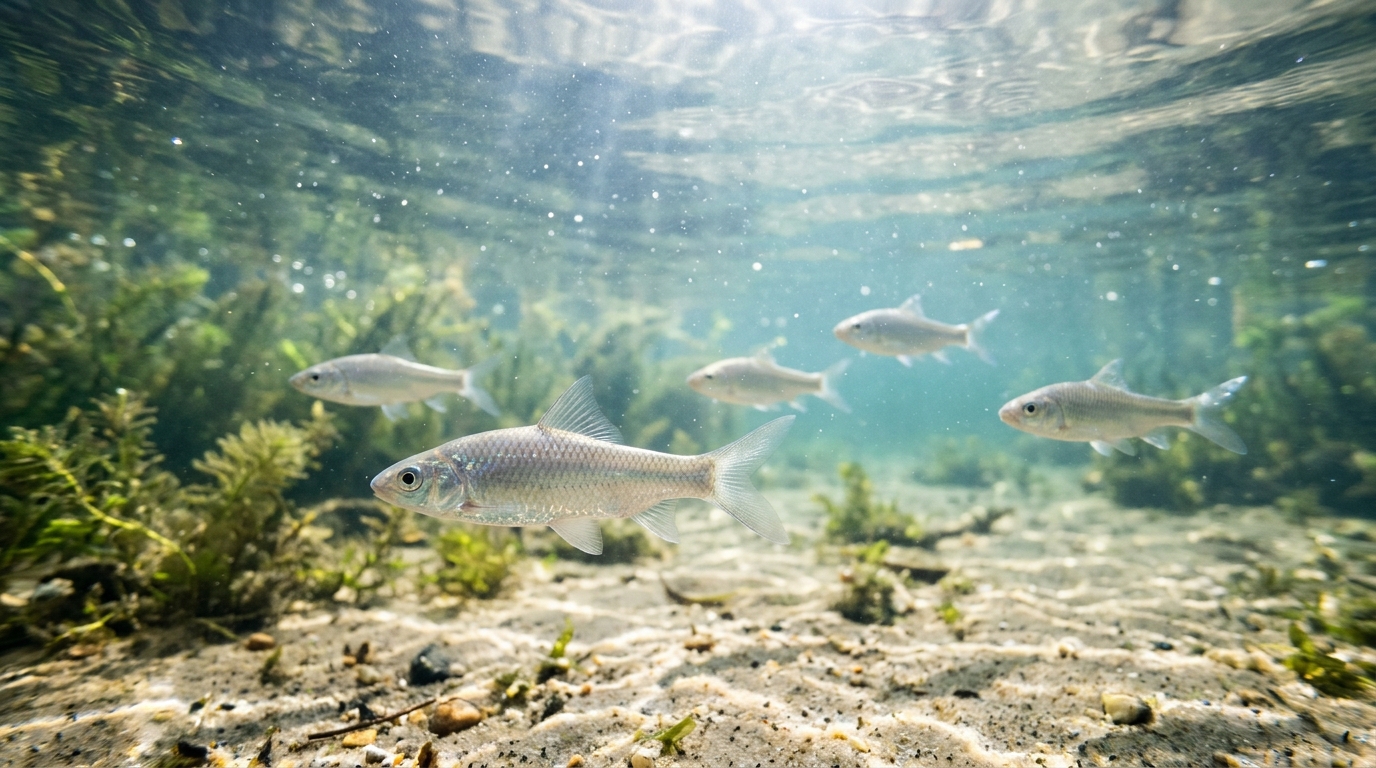
A 45-day tank trial in Tripura, India, has found that fingerlings of the minor carp Cirrhinus reba, known locally as reba, grew fastest, converted feed most efficiently and showed the lowest signs of physiological stress when stocked at ten fish per cubic metre, the lowest of three densities tested. At that density the fish reached a mean final length of 9.02 centimetres and a mean final weight of 6.62 grams, with a specific growth rate of 5.38 percent per day and a survival rate of 88.33 percent.
Reba is a small cyprinid distributed across the Indian subcontinent and prized in northern and northeastern India, where it is consumed whole and commands a market price of 200 to 250 rupees per kilogram thanks to its oily, tasty flesh, attractive flavour, high nutritional value and comparatively few spines. The authors describe it as an eco-friendly species and a suitable candidate for diversifying traditional Indian aquaculture, which is dominated by carps that together account for roughly 85 percent of total production. Yet the wild population is reported to be declining rapidly because of overfishing and anthropogenic activities that destroy the natural spawning and nursery habitats the species depends on. Production of reba under semi-intensive culture has not been established at a commercial level, which the researchers say makes density optimisation a practical prerequisite for any serious rearing protocol.
The experiment was carried out at the College of Fisheries, Lembucherra, under the Central Agricultural University in Tripura, with ethical oversight from the institute’s animal ethics committee. Nine outdoor cemented tanks, each measuring five by four by one metre and holding twenty cubic metres of water with an eight-centimetre soil bed, were arranged in a completely randomized design. Fifteen-day-old reba stock, averaging 3.81 centimetres in length and 0.59 grams in weight, were assigned to three treatments in triplicate: ten fish per cubic metre, twenty per cubic metre and thirty per cubic metre.
Tank preparation followed standard carp husbandry. The tanks were limed at 300 kilograms per hectare, equivalent to 100 grams of calcium oxide per tank, filled with groundwater to a 90-centimetre depth and fertilised a week later with two split doses of soaked mustard oil cake at 750 grams per tank. Fish were fed a pelleted, isonitrogenous diet containing 30 percent crude protein, initially at 6 percent of body weight twice daily and later adjusted to 4 percent, with the pellet size reduced to 0.6 millimetres to suit the small mouths of the young fish. Nylon netting covered the tanks to keep birds out.
Growth and feed-use results separated the treatments cleanly. Fish at the lowest density posted a mean daily weight gain of 13.40 percent, an apparent feed conversion ratio of 1.05 and an apparent protein efficiency ratio of 1.92, all significantly better than the values recorded at twenty and thirty fish per cubic metre. The condition factor, hepatosomatic index and relative fatness, by contrast, showed no significant differences across densities, suggesting that gross body shape and liver size were less sensitive to crowding than growth rate itself.
Digestive enzyme activity told a parallel story. Intestinal protease activity was significantly highest in the low-density group at 1.43 units per milligram of protein per minute and fell to 0.91 units in the highest-density group. Lipase activity was significantly lower only at the highest density, while amylase activity did not differ significantly among treatments at all. Earlier work cited in the study likewise found that higher stocking densities depress the specific activity of digestive enzymes in fish, so the reba data add a minor carp species to that emerging consensus.
The haematological picture was notably different. Haemoglobin concentration, red blood cell count, haematocrit, white blood cell count and the derived indices of mean cell volume, mean cell haemoglobin and mean cell haemoglobin concentration all remained within normal ranges and showed no statistically significant differences among the three densities. The authors interpret this as evidence that, over a 45-day window, stocking density in this range did not measurably disturb the cellular composition of the blood, and they note that a similar absence of haematological response has been reported by other workers.
Those stress markers moved in a clear dose-dependent fashion. Blood glucose averaged 46.96 milligrams per decilitre at ten fish per cubic metre, 50.20 at twenty and 56.68 at thirty, while serum cortisol measured 310.93 nanograms per decilitre, 348.24 and 381.34 respectively, with both parameters significantly elevated as density increased. The authors frame this through the hypothalamus-pituitary-interrenal axis: crowding acts as a stressor that stimulates catecholamine and corticosteroid release, cortisol constituting the primary stress response and the resulting hyperglycaemia the secondary one. Comparable density-driven rises in glucose and cortisol have been documented in other carp species and in tilapia.
The practical upshot is a density recommendation rather than a universal law. The authors conclude that, within the weight range studied, ten fish per cubic metre is optimal for improving growth performance and digestive enzyme activity while reducing crowding stress in reba fingerlings, and that densities above that threshold retard growth and amplify stress. They are careful to scope the claim: the trial covered a single 45-day window in outdoor cemented tanks at one site, with fish starting at roughly 0.59 grams, and the authors themselves flag that rearing practices for this species still require considerable research at different temperatures and in different culture systems, particularly earthen ponds, where the present results are offered as a baseline rather than a final prescription. The study also builds on the team’s earlier work, which had optimised density for three-day-old spawn of about 0.002 grams nursed for fifteen days, so the new data extend the density optimisation from the spawn stage into the fingerling stage.
For aquaculture planners the findings carry a broader economic message. Stocking density directly determines the viability of a fish culture system because it governs growth, survival and net yield, and high densities are routinely imposed in commercial operations to maximise output per unit volume.
Subject of Research: Effects of stocking density on growth, digestive enzymes, blood parameters and stress responses of reba carp fingerlings
Article Title: Evaluation of different stocking densities on growth parameters, digestive enzymes, hemato-immunological and stress responses of Cirrhinus reba (Hamilton, 1822)
Article References: Keer, N. R., Datta, M. K., Kumar, M., Patel, A. B., Mandal, S. C., Dar, S. A., Meena, D. K., & Singh, J. (2026). Evaluation of different stocking densities on growth parameters, digestive enzymes, hemato-immunological and stress responses of Cirrhinus reba (Hamilton, 1822). Aquaculture Science and Management, 3(1), Article 1. https://doi.org/10.1186/s44365-026-00031-z
Image Credits: AI Generated
DOI: 10.1186/s44365-026-00031-z
Keywords: Cirrhinus reba, stocking density, aquaculture, fish growth, digestive enzymes, cortisol, blood glucose, fingerlings, stress response, minor carp, India, semi-intensive culture
News Source: Alan Morgan. (November 5, 2026). Low Stocking Density Boosts Growth and Lowers Stress in Reba Carp Fingerlings. Scienmag.