Credit: Stacey D. Finley, Ph.D.
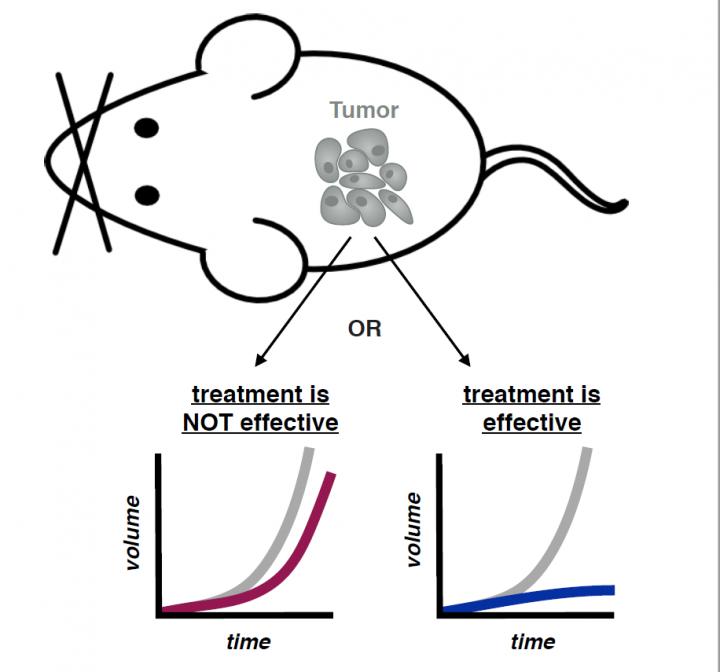
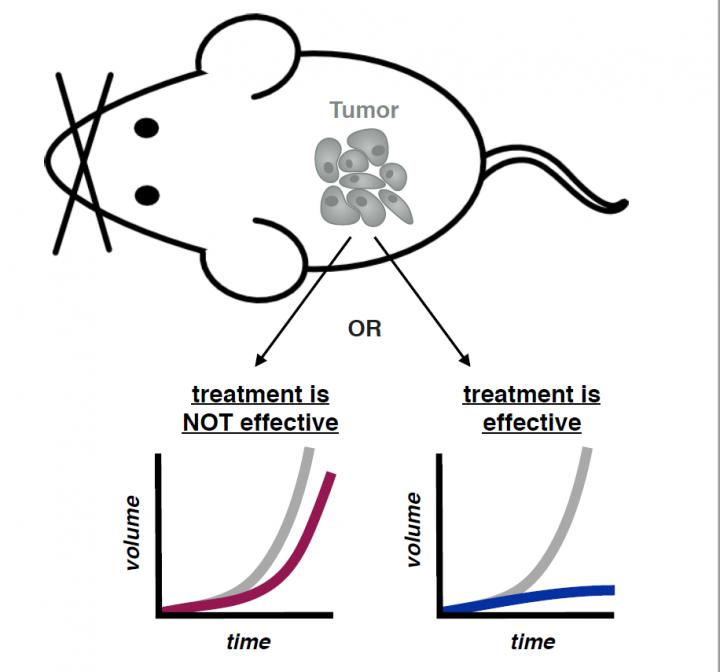
Using a mathematical modeling approach, scientists have found that certain parameters of tumor growth in mice can predict the effectiveness of drugs that block formation of tumor-nourishing blood vessels. The findings are published in PLOS Computational Biology.
Even within the same cancer type, different tumors can respond differently to cancer drugs, and some tumors do not respond at all. Therefore, it is useful to identify tumor features that can serve as "predictive biomarkers" to forecast how a person's tumor might respond to a particular treatment. However, before drugs are tested in humans in a clinical setting, they are usually explored in mice.
In efforts to enhance pre-clinical drug testing, Thomas Gaddy of the University of Southern California, Los Angeles, and colleagues in the research group of Professor Stacey Finley investigated a potential predictive biomarker for a type of cancer drug known as anti-angiogenic therapy. This treatment inhibits the formation of new blood vessels that can help a tumor grow.
The researchers had previously built a mathematical model that simulates the activity of a blood-vessel-growth-promoting protein called VEGF in a mouse tumor. For the new study, they added a component to the model that simulates the tumor's response to drugs that target VEGF and inhibit its activity. They trained and validated the model using real-world data on tumor growth in mice.
Using their new model, the researchers found that certain parameters about the way a tumor grows could successfully and accurately predict its response to anti-angiogenic treatment that targets VEGF activity. Using those characteristics, they were able to predict how effective the treatment would be (i.e., whether tumor growth would slow), even before the start of treatment.
If these results are confirmed in live mouse studies, they could eventually lead to new strategies to predict tumor response to anti-angiogenic therapy in people. Meanwhile, the research team is using their model to simulate such a study.
"In our virtual mouse study, we will simulate tumor growth with and without treatment and determine if the growth parameters can indeed be used to distinguish between mice whose tumors will respond to therapy or not," Finley says. "We are also scouring published literature to find more experimental data to further validate our model predictions."
###
In your coverage please use this URL to provide access to the freely available article in PLOS Computational Biology: http://journals.plos.org/ploscompbiol/article?id=10.1371/journal.pcbi.1005874
Citation: Gaddy TD, Wu Q, Arnheim AD, Finley SD (2017) Mechanistic modeling quantifies the influence of tumor growth kinetics on the response to anti angiogenic treatment. PLoS Comput Biol 13 (12): e1005874. https://doi.org/10.1371/journal.pcbi.1005874
Funding: SDF acknowledges the support of the US National Science Foundation (1552065) http://nsf.gov/. TDG acknowledges the support of the USC Provost's Office, Undergraduate Research Fellowship http://undergrad.usc.edu/experience/research/undergrad_research/. The funders had no role in study design, data collection and analysis, decision to publish, or preparation of the manuscript.
Competing Interests: The authors have declared that no competing interests exist.
Media Contact
Stacey D. Finley
[email protected]
Related Journal Article
http://dx.doi.org/10.1371/journal.pcbi.1005874