• HOME
  • NEWS
  • EXPLORE
    • CAREER
      • Companies
      • Jobs
    • EVENTS
    • iGEM
      • News
      • Team
    • PHOTOS
    • VIDEO
    • WIKI
  • BLOG
  • COMMUNITY
    • FACEBOOK
    • INSTAGRAM
    • TWITTER
Tuesday, September 1, 2026
BIOENGINEER.ORG
No Result
View All Result
  • Login
  • HOME
  • NEWS
  • EXPLORE
    • CAREER
      • Companies
      • Jobs
        • Lecturer
        • PhD Studentship
        • Postdoc
        • Research Assistant
    • EVENTS
    • iGEM
      • News
      • Team
    • PHOTOS
    • VIDEO
    • WIKI
  • BLOG
  • COMMUNITY
    • FACEBOOK
    • INSTAGRAM
    • TWITTER
  • HOME
  • NEWS
  • EXPLORE
    • CAREER
      • Companies
      • Jobs
        • Lecturer
        • PhD Studentship
        • Postdoc
        • Research Assistant
    • EVENTS
    • iGEM
      • News
      • Team
    • PHOTOS
    • VIDEO
    • WIKI
  • BLOG
  • COMMUNITY
    • FACEBOOK
    • INSTAGRAM
    • TWITTER
No Result
View All Result
Bioengineer.org
No Result
View All Result
Home NEWS Science News

UTHealth, UT Health San Antonio gain $6 million to refine cancer-fighting antibody

Bioengineer by Bioengineer
December 21, 2017
in Science News
Reading Time: 2 mins read
0
Share on FacebookShare on TwitterShare on LinkedinShare on RedditShare on Telegram
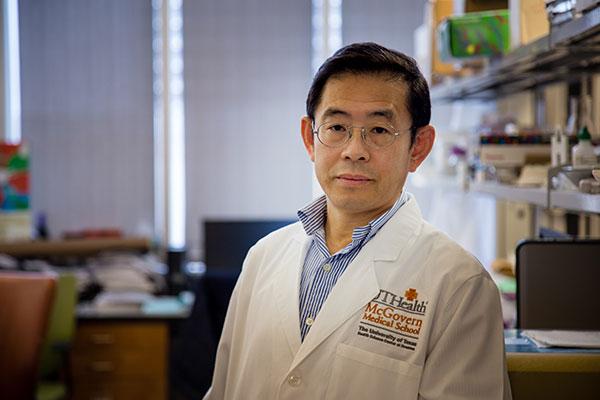
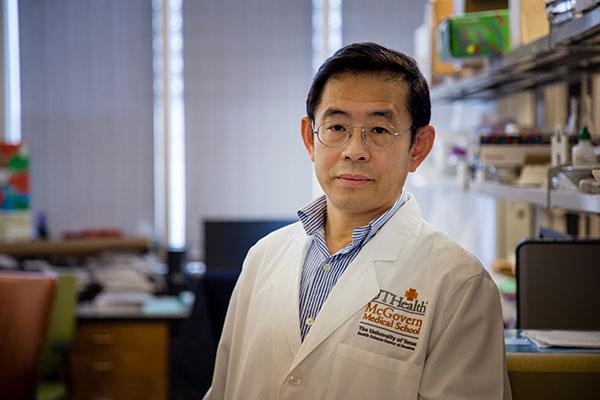
IMAGE

Credit: Maricruz Kwon, UTHealth

Scientists at The University of Texas Health Science Center at Houston (UTHealth) and The University of Texas Health Science Center at San Antonio (UT Health San Antonio) received $6 million in grants from the U.S. Department of Defense to expand studies of a therapeutic antibody, the two UT health institutions announced today.

The scientists are developing an innovative antibody-based drug to stem the spread of breast cancer to bone. This spread, called metastasis, is linked to a dramatic reduction in survival rates.

Zhiqiang An, Ph.D., professor and the Robert A. Welch Distinguished University Chair in Chemistry at McGovern Medical School at UTHealth, is collaborating on the project with lead principal investigator Jean Jiang, Ph.D., the Ashbel Smith Professor at UT Health San Antonio and the associate director of the Joint Biomedical Engineering Graduate Program of UT Health San Antonio and The University of Texas at San Antonio.

McGovern Medical School received $2.8 million for drug development. "Current treatment options are limited for breast cancer bone metastasis," An said. "There is thus an urgent need to develop new and specific therapies with improved therapeutic efficacies and fewer side effects."

"Antibodies are part of the body's natural defenses and can be optimized to perform specific tasks," Jiang said. "In this case, an antibody activates the connexin channels in bone cells, which protects skeletal tissue from breast cancer colonization and invasion."

UT Health San Antonio received $3.2 million for preclinical testing in the joint project. "Research from my laboratory shows the functional role of these channels in suppressing breast cancer invasion and bone metastases. This provides a potential therapeutic target for drug development in breast cancer," Jiang said.

An said the antibody drug discovery expertise in the Texas Therapeutics Institute helped advance the basic discovery from the Jiang laboratory to preclinical drug development. Founded in 2010, the Texas Therapeutics Institute is an academic drug discovery center housed in the Brown Foundation Institute of Molecular Medicine for the Prevention of Human Diseases at UTHealth.

The goal of An and Jiang is to develop a less toxic treatment and reduce deaths tied to the spread of breast cancer to the bone. At the end of the study, the researchers hope to have a drug that can advance to clinical trials.

"With 1.3 million soldiers deployed around the world, the DOD supports research designed to increase the health of its employees and citizens of United States," Jiang said. "Dr. An and I appreciate the DOD's commitment to translational drug discovery."

Not counting some kinds of skin cancer, breast cancer in the United States is the most common cancer in women. In 2014, 236,968 women and 2,141 men in the U.S. were diagnosed with breast cancer and 41,211 women and 465 men died from the disease.

###

Media Contact

Rob Cahill
[email protected]
713-500-3030

http://www.uthouston.edu

Share14Tweet8Share2ShareShareShare2

Related Posts

β-Sitosterol from Ipomoea carnea Jacq. As a promising anti-inflammatory agent: Evidence from in silico modeling and in vitro validation

β-Sitosterol from Ipomoea carnea Jacq. As a promising anti-inflammatory agent: Evidence from in silico modeling and in vitro validation

August 31, 2026
Design, fabrication and characterization of a wearable Fiber Bragg grating sensor for cardiorespiratory monitoring using finger plethysmography

Design, fabrication and characterization of a wearable Fiber Bragg grating sensor for cardiorespiratory monitoring using finger plethysmography

August 31, 2026

KAIST opens the era of industrial-scale microbial foods, proposing growth strategies for the next-generation protein market

August 31, 2026

Virologist awarded $2 million NIH grant to investigate how virus-infected cells live and die

August 31, 2026
Please login to join discussion

POPULAR NEWS

  • β-Sitosterol from Ipomoea carnea Jacq. As a promising anti-inflammatory agent: Evidence from in silico modeling and in vitro validation

    29 shares
    Share 12 Tweet 7
  • Design, fabrication and characterization of a wearable Fiber Bragg grating sensor for cardiorespiratory monitoring using finger plethysmography

    29 shares
    Share 12 Tweet 7
  • KAIST opens the era of industrial-scale microbial foods, proposing growth strategies for the next-generation protein market

    29 shares
    Share 12 Tweet 7
  • Virologist awarded $2 million NIH grant to investigate how virus-infected cells live and die

    29 shares
    Share 12 Tweet 7

About

We bring you the latest biotechnology news from best research centers and universities around the world. Check our website.

Follow us

Recent News

β-Sitosterol from Ipomoea carnea Jacq. As a promising anti-inflammatory agent: Evidence from in silico modeling and in vitro validation

Design, fabrication and characterization of a wearable Fiber Bragg grating sensor for cardiorespiratory monitoring using finger plethysmography

KAIST opens the era of industrial-scale microbial foods, proposing growth strategies for the next-generation protein market

Subscribe to Blog via Email

Enter your email address to subscribe to this blog and receive notifications of new posts by email.

Join 85 other subscribers
  • Contact Us

Bioengineer.org © Copyright 2023 All Rights Reserved.

Welcome Back!

Login to your account below

Forgotten Password?

Retrieve your password

Please enter your username or email address to reset your password.

Log In
No Result
View All Result
  • Homepages
    • Home Page 1
    • Home Page 2
  • News
  • National
  • Business
  • Health
  • Lifestyle
  • Science

Bioengineer.org © Copyright 2023 All Rights Reserved.