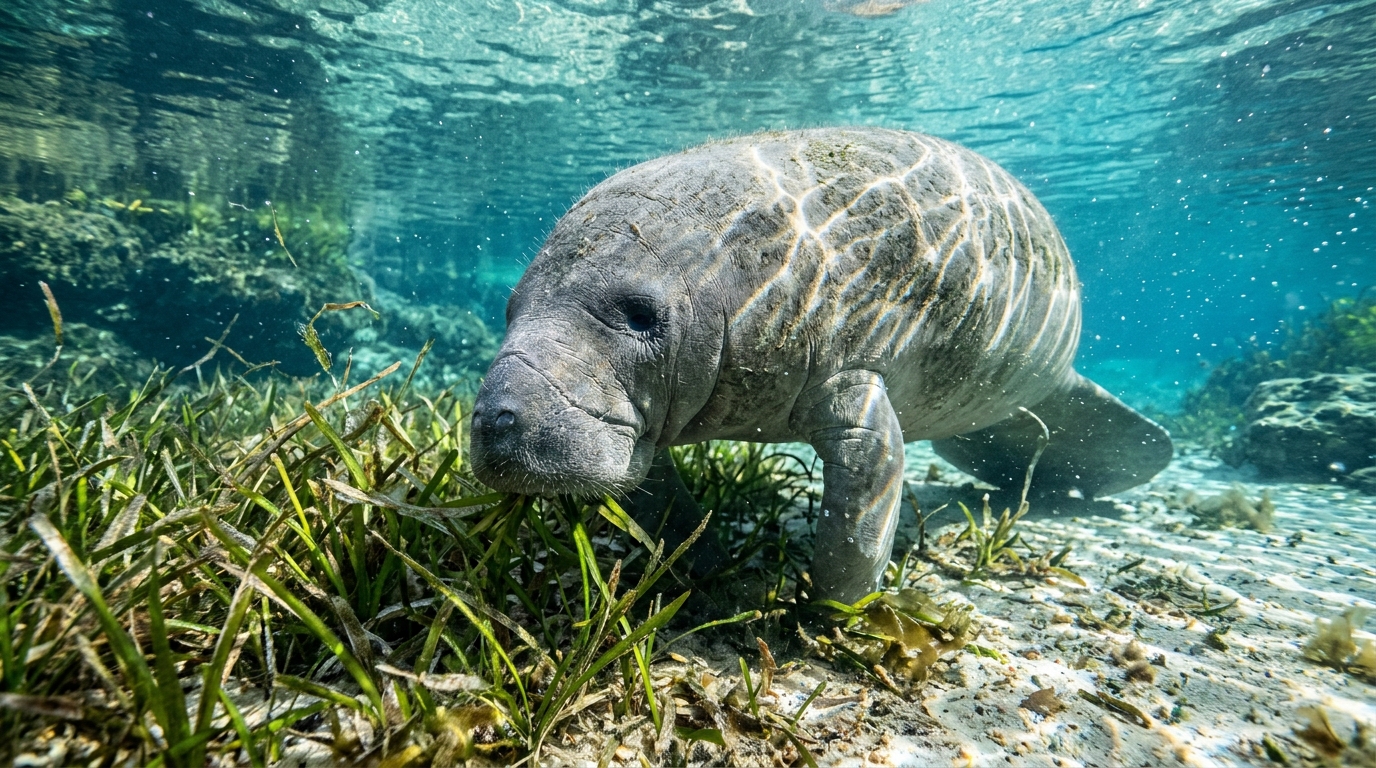
Manatees are the only living mammals that have committed themselves entirely to a life of eating plants underwater, and the microbes in their intestines appear to have evolved an unusually elaborate toolkit to help them do it. A genomic survey of 47 freshwater and marine manatees housed at two Brazilian conservation institutions has produced one of the deepest catalogues yet of any mammalian gut microbiome, identifying 1,215 non-redundant prokaryotic genomes alongside 863 viral genomes. The analysis, published in Nature Microbiology, shows that these animals carry a multilayered enzymatic system for breaking down plant cell walls, one that combines free enzymes, cell-based scaffolds called cellulosomes and carbohydrate-loaded outer membrane vesicles in a way that more closely resembles the digestive strategy of cattle and other foregut fermenters than that of other hindgut-fermenting herbivores.
The research team, led by scientists at Brazilian institutions including the Brazilian Institute for Amazonian Research and the Aquasis marine conservation centre, collected faecal samples from 37 Amazonian manatees and 11 marine manatees spanning calves, juveniles, adults and older individuals. Sequencing the samples with a hybrid approach that combined 16S ribosomal RNA amplicons, short reads and long reads generated roughly 1.5 terabases of raw data. From this material the researchers assembled 6,145 prokaryotic metagenome-assembled genomes, which they consolidated into 1,215 species-level clusters meeting strict quality thresholds of at least 80 percent completeness and no more than 10 percent contamination. More than three-quarters of these genomes met the criteria for near-complete reference quality, and the continuity of the assembly was high enough to reconstruct over 100 bacterial chromosomes as complete, circularized molecules.
The viral component of the community proved equally distinctive. Most of the recovered phages belong to the class Caudoviricetes and predominantly infect Bacillota, the bacterial phylum that dominates manatee gut fermentation. Most are temperate, meaning they integrate into their host genomes rather than immediately killing the cell, a lifestyle associated with bacterial gene regulation and community structuring. The researchers also identified a subset of jumbo phages with genomes exceeding 200 kilobase pairs that carry expanded repertoires of DNA replication and processing genes, suggesting reduced dependence on their hosts’ own replication machinery. Only about 10 percent of prokaryotic genomes and roughly 4 percent of viral genomes were shared between the freshwater and marine manatee species, indicating that each host carries a largely distinct microbial community despite broad conservation at the phylum level.
Approximately half of the bacterial taxa and around 80 percent of the viral taxa recovered from these animals lack close representatives in existing reference databases, positioning the manatee gut as a reservoir of deeply divergent microbial diversity. Bacillota accounted for more than 70 percent of the 3,263 biosynthetic gene clusters identified across the prokaryotic genomes, with over 85 percent of these clusters lacking close homologues in the MIBiG and BGC Atlas reference databases. The researchers suggest this degree of biosynthetic divergence exceeds what has been reported for other vertebrate gut microbiomes and points to an untapped reservoir of microbiome-encoded chemical diversity, including ranthipeptides and cyclic lactone autoinducer systems that may mediate quorum-sensing regulation of secondary metabolism.
The enzymatic machinery dedicated to plant cell wall deconstruction is primarily encoded by Bacillota, Bacteroidota and Verrucomicrobiota in both manatee species, indicating high functional convergence despite pronounced taxonomic divergence between hosts. The catalogue contains over 91,000 genes distributed across 368 carbohydrate-active enzyme families, many predicted to target cellulose, beta-1,3-glucans, heteromannans, heteroxylans, mixed-linkage glucans and polysaccharide decorations. Cellulose breakdown is supported by three complementary mechanisms: secreted free cellulases from glycoside hydrolase families GH5, GH8, GH9 and GH48; cellulosomes encoded by Ruminococcaceae genomes that organize catalytic modules on scaffoldin proteins; and outer membrane vesicle systems associated with Fibrobacter lineages. The coexistence of all three strategies within a single gut community distinguishes the manatee microbiome from those of the capybara and the elephant, in which only subsets of these cellulolytic mechanisms have been described, and aligns with the high apparent cellulose digestibility of 80 to 86 percent previously reported for manatees.
Hemicellulose deconstruction follows a similarly layered architecture. Predicted xylan- and xyloglucan-active systems are primarily organized as polysaccharide utilization loci within Bacteroidota lineages, including a conserved GH43–GH5–GH2–GH3–GH31 core coupled to SusC/D transporters. A broad repertoire of heteromannan-degrading systems was identified in both Bacillota and Bacteroidota genomes, enriched in GH26, GH5, GH2 and GH130 functions. Additional gene clusters target beta-glucans, laminarin and sulfated polysaccharides such as carrageenan- and agar-like substrates, consistent with the marine diet’s contribution of sulfated galactans from seagrasses and algal polysaccharides from a minor macroalgal fraction.
Beyond polysaccharide depolymerization, the manatee gut microbiota encodes an extensive repertoire of pathways for utilizing plant-derived aromatic compounds, potentially expanding carbon recovery from lignocellulosic biomass. The researchers identified complete gene signatures for anaerobic O-demethylation of methoxylated aromatics converging on benzoyl-CoA-like intermediates, along with central modules for anaerobic benzoyl-CoA metabolism in fermentative Bacillota. These aromatic catabolic routes converge on central fermentative metabolism, linking lignocellulose-derived aromatics to acetyl-CoA generation and short-chain fatty acid production. The coexistence of aerobic and anaerobic metabolic routes is consistent with the partially anoxic and spatially heterogeneous conditions of the manatee gut, suggesting a versatile metabolic potential capable of operating under fluctuating oxygen availability.
The most striking discovery, however, concerns a single uncultured Bacillota species the researchers named Candidatus Epilactovorans intestinalis. This bacterium carries a gene cluster encoding one GH116 enzyme and three GH26 enzymes, each sharing low sequence identity with previously catalogued family members. The three GH26 enzymes adopt wide cleft-like active sites with extra room for accommodating branched polysaccharide side chains, and two of four beta-sandwich domains on the extracellular GH26b enzyme bind preferentially to decorated heteromannans. Mutating surface-exposed aromatic residues in these domains reduced binding affinity, confirming their role in substrate recognition. The GH26 enzymes showed no detectable activity against commercial mannans, suggesting they probably target complex, substituted heteromannans absent from conventional substrate libraries.
The GH116 enzyme, which the researchers term epilactase, displays an unprecedented preference for the disaccharide epilactose, Gal-beta(1,4)-Man, hydrolysing it into galactose and mannose. When the reducing-end residue was fixed as mannose, varying the non-reducing residue produced roughly tenfold higher activity towards the galactose-containing substrate relative to the glucose-containing one. Conversely, when the non-reducing end was fixed as galactose, substituting the reducing-end residue yielded approximately 100-fold higher activity towards mannose compared with glucose. This dual-epimer regioselectivity, governed primarily by the reducing-end sugar rather than the non-reducing-end subsite as in classical glycoside hydrolases, defines an enzymatic activity not previously described in nature. Cryo-electron microscopy structures of both the manatee enzyme and a closely related orthologue from the gut microbiota of Tanzanian Hadza hunter-gatherers, solved at global resolutions of 2.2 and 2.7 angstroms respectively, revealed a homodimeric arrangement built on an (alpha/alpha)6 barrel scaffold, a structural architecture distinct from the (alpha/beta)8 scaffolds that underpin most previously described beta-galactosidases.
The same gene cluster was found to be conserved in the gut microbiota of Hadza hunter-gatherers and in at least 11 additional metagenome-assembled genomes recovered from geographically diverse human gut samples, indicating that this enzymatic system is not restricted to aquatic herbivores. The researchers propose that epilactose serves as a private carbohydrate reserve that is non-edible to most members of the gut microbiota, creating a nutrient niche partitioning in a highly competitive environment. Genomic analysis of Candidatus Epilactovorans intestinalis also revealed a lactose transporter, a disaccharide 2-epimerase that can convert lactose into epilactose, and key metabolic enzymes for mannose and galactose primary metabolism, suggesting an alternative lactose-dependent route that converges with the GH26-dependent pathway through the same epilactase-catalysed hydrolytic step. Together, these findings expand the known biochemical landscape of mammalian gut microbiomes and introduce epilactose utilization via epilactase activity as a previously unrecognized nutrient acquisition pathway that spans divergent hosts and dietary regimes.
Subject of Research: Genomic and biochemical characterization of the manatee gut microbiome and its specialized epilactose utilization pathway
Article Title: Metabolic specialization in the gut microbiome of aquatic mammalian herbivores
Article References: Persinoti, G. F., Martins, M. P., Silva, C. B. C., Streit, R. S. A., Paixão, D. A. A., Martins, G. H., Higasi, P. M. R., Braatz, G. M., Silva, M. K. P., Morão, L. G., Martins-Junior, J., Stoffel, F., Ciol, H., Noske, G. D., Miyamoto, R. Y., Oliveira, G. M., Martim, D. B., Oliveira, C. H. M., Almeida, O. A. C., … Murakami, M. T. (2026). Metabolic specialization in the gut microbiome of aquatic mammalian herbivores. Nature Microbiology. https://doi.org/10.1038/s41564-026-02520-2
Image Credits: AI Generated
DOI: 10.1038/s41564-026-02520-2
Keywords: manatee, gut microbiome, metagenome-assembled genomes, Bacillota, epilactase, epilactose, plant cell wall deconstruction, cellulosomes, outer membrane vesicles, CAZymes, niche partitioning, sirenians
News Source: Drew Townsend. (November 5, 2026). Manatee gut microbes reveal a hidden pathway for digesting tough aquatic plants. Scienmag.