Huangjing Jiangzhi granules, a traditional Chinese herbal formulation, appear to fight nonalcoholic fatty liver disease through a newly mapped molecular route: they boost the transcription factor FOXA1, which in turn switches on the ER quality-control gene DERL1, easing endoplasmic reticulum stress, curbing hepatocyte death, and reducing fat buildup in the liver. That is the central claim of a study published in Biological Procedures Online, which combined a mouse model of diet-induced fatty liver disease with oleic acid-treated human HepG2 liver cells to trace the mechanism in detail.
Nonalcoholic fatty liver disease, or NAFLD, spans a spectrum from simple hepatic steatosis to nonalcoholic steatohepatitis, cirrhosis and, in some cases, hepatocellular carcinoma, and it currently affects roughly 30 percent of the global population according to background cited in the paper. A key pathological link is endoplasmic reticulum stress. When excess nutrients persistently overload the ER, its protein-folding homeostasis collapses and the unfolded protein response kicks in. One major branch of that response, the PERK-eIF2α-CHOP pathway, becomes activated and drives inflammatory signaling that favors apoptosis, feeding a vicious cycle of liver damage. DERL1, a component of ER-associated degradation, or ERAD, participates in this stress response by retrotranslocating misfolded proteins from the ER into the cytosol for disposal.
The research team, led by Dongyu Xie, Yunqing Wu and colleagues with Haina Xie among the senior authors, set out to uncover how the granules work at the molecular level, because the mechanisms of traditional Chinese herbal formulations against complex metabolic disorders had remained largely unexplored in this context. The FOXA family of forkhead transcription factors—FOXA1, FOXA2 and FOXA3—critically regulates metabolism in pancreatic, adipose and hepatic tissue, and FOXA1 had previously been found downregulated in animal models of NAFLD and in human nonalcoholic fatty livers. What remained unknown was whether FOXA members regulate ER stress and apoptosis in NAFLD and whether they participate in the anti-steatosis effect of HJJZ granules.
Experimentally, the group worked with six-week-old male C57BL/6 mice divided into six groups of six animals each. One group ate standard chow throughout. The others received a high-fat diet to induce NAFLD pathology, and after an initial six weeks of HFD feeding that established hepatic steatosis, four intervention groups began concurrent treatment: low, medium and high doses of HJJZ granules delivered by gavage at 0.634, 1.268 and 2.536 grams per kilogram per day, plus an atorvastatin positive-control arm at 20 milligrams per kilogram per day. Interventions then continued for a further six weeks alongside the respective diets, a design intended to test dose-dependent therapeutic effects on established steatosis, liver injury, apoptosis and associated molecular pathways. All animal protocols were approved by the Medical Ethics Committee of the Zhenjiang Hospital of Traditional Chinese Medicine and followed ARRIVE 2.0 guidelines.
The results were striking. H&E staining revealed pronounced macrovesicular steatosis in hepatocytes of HFD-fed mice, which was markedly attenuated in a dose-dependent manner after granule treatment, and Oil Red O staining of lipid droplets told the same story when quantified by steatosis scores and optical density. High-fat feeding raised serum alanine aminotransferase and aspartate aminotransferase, standard markers of liver injury, and dual treatment significantly lowered both enzymes alongside the granule doses. Triglyceride and cholesterol levels in serum and in liver tissue, both elevated by the HFD, were relieved dose-dependently, and the high granule dose achieved an effect comparable to atorvastatin. The authors conclude these data suggest HJJZ granules can effectively counteract the deleterious effects of a high-fat diet on lipids and liver injury.
Deeper analysis focused on cell death and ER stress signaling. TUNEL staining of liver sections showed significantly reduced apoptotic cell counts after granule supplementation, especially at the high dose. Western blotting revealed that HFD treatment significantly upregulated DERL1 and CHOP expression and increased the ratios of phosphorylated PERK to total PERK and phosphorylated eIF2α to total eIF2α, indicating activation of the PERK branch of the unfolded protein response. HJJZ granules interrupted this trend, decreasing DERL1 and CHOP levels dose-dependently and ameliorating the phosphorylation changes. In parallel work with HepG2 cells exposed to 0.5 millimolar oleic acid for 48 hours alongside granule concentrations of 4, 8 or 16 milligrams per milliliter, cotreatment reversed the OA-induced drop in cell viability, lowered the percentage of apoptotic cells measured by flow cytometry, suppressed DERL1, CHOP and PERK-pathway phosphorylation, reduced lipid droplet accumulation, and inhibited elevated ALT and AST activities in the culture supernatant as well as intracellular triglyceride and cholesterol levels.
The pivotal discovery came when the team profiled the FOXA transcription factors. In livers of HFD-fed mice, mRNA of FOXA1 and FOXA2 was reduced compared with controls, while FOXA3 was significantly increased; treatment with the granules selectively restored FOXA1 mRNA in a dose-dependent manner without touching FOXA2 or FOXA3. That selectivity carried through to protein: HFD-induced reductions in FOXA1 protein were rapidly restored by HJJZ treatment, and in OA-treated HepG2 cells the granules likewise upregulated FOXA1 dose-dependently. To test whether FOXA1 was merely a bystander or a genuine mediator, the researchers silenced it in HepG2 cells using three independent short hairpin RNAs cloned into a lentiviral vector, confirming effective knockdown at both mRNA and protein levels.
The knockdown experiment delivered a clear verdict. In cells carrying the nontargeting control, granule treatment at 16 milligrams per milliliter counteracted OA-induced cytotoxicity, improved viability in the CCK-8 assay, reduced apoptosis, blunted the OA-driven upregulation of DERL1 and CHOP, and prevented PERK and eIF2α phosphorylation, while also cutting lipid droplet accumulation, ALT and AST release, and intracellular triglyceride and cholesterol. In FOXA1-deficient cells, all of those benefits vanished: viability fell, apoptosis rose, the ER stress pathway stayed activated, and lipid and injury markers remained elevated. The authors state that FOXA1 knockdown completely negates the capacity of HJJZ granules to improve viability, reduce apoptosis, suppress ER stress and ameliorate lipid accumulation, establishing FOXA1 as a required mediator of the protective effects.
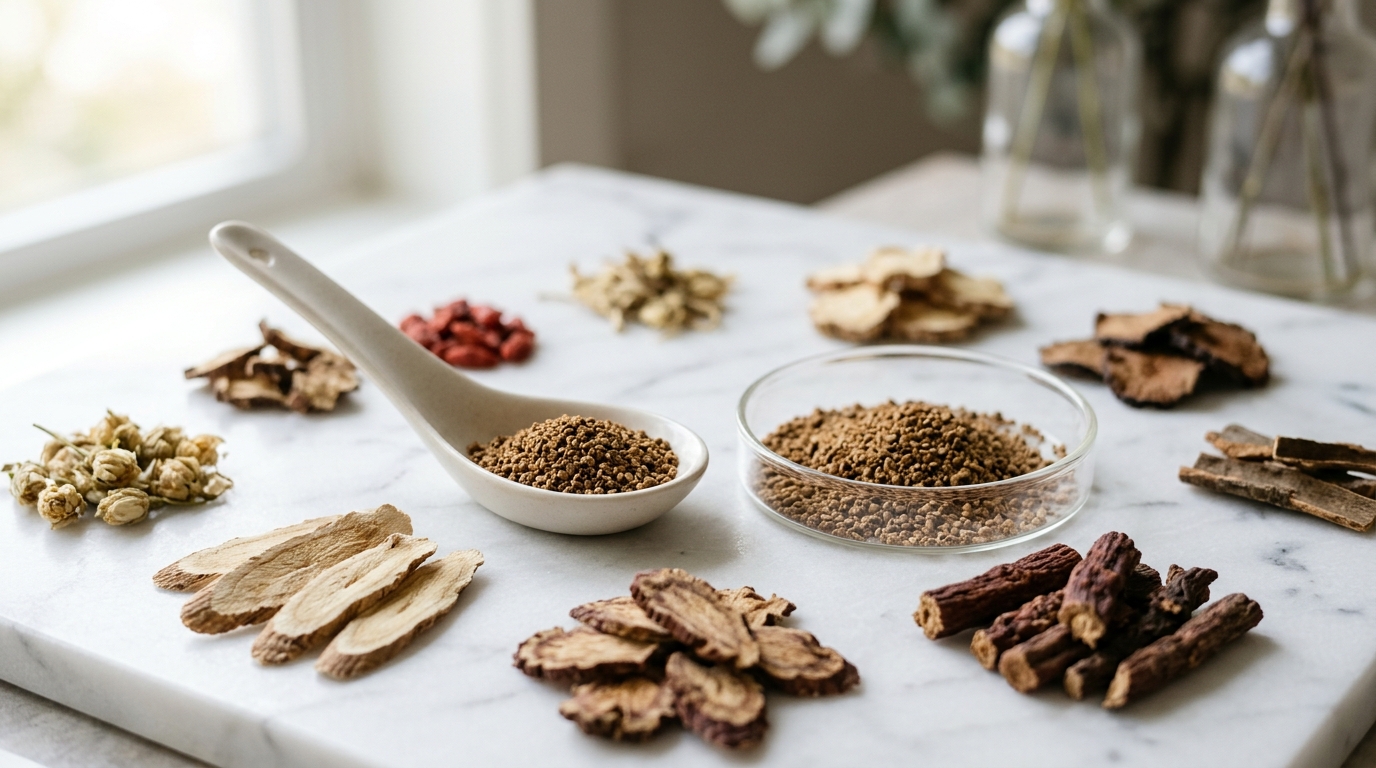
Mechanistically, chromatin immunoprecipitation showed significant enrichment of FOXA1 on the DERL1 promoter region in HepG2 cells, and dual-luciferase reporter plus qRT-PCR assays demonstrated that oleic acid suppressed while HJJZ granules restored DERL1 promoter activity and mRNA expression in a FOXA1-dependent manner. A rescue experiment sealed the logic: overexpressing DERL1 in FOXA1-knockdown cells restored cell viability, diminished apoptosis, inhibited the upregulated ER stress markers CHOP, p-PERK and p-eIF2α, and attenuated lipid droplet accumulation, ALT and AST release, and intracellular triglyceride and cholesterol, comparable to control levels. In the authors’ summary, elevated DERL1 is necessary and sufficient to relieve ER stress, thereby decreasing apoptosis and relieving hepatic steatosis. Notably, the granule formulation itself is a ten-herb mixture including processed Heshouwu, Shanzha, Danshen, Yujin, Huzhanggen, Zexie, Chenpi, processed Banxia, Fuling, Huangjing and Fenbixie, and database screening identified 574 active ingredients meeting absorption and drug-likeness criteria, among which compounds such as coumarin, curcumin, quercetin and resveratrol have been reported to regulate FOXA1 expression and function.
The study’s limitations deserve equal weight. The authors acknowledge that using HepG2 cells, a hepatocellular carcinoma line, rather than primary hepatocytes may partly account for discrepancies between in vitro and in vivo findings, and they call for future work in primary cells. The research relies entirely on animal models and in vitro experiments, so clinical validation of the efficacy and safety of HJJZ granules in patients remains necessary, and the specific active ingredients responsible for inducing FOXA1 have not yet been pinpointed. Within those bounds, the paper proposes a coherent mechanistic chain—granule treatment upregulates FOXA1, FOXA1 transcriptionally activates DERL1, increased DERL1 bolsters ERAD-mediated protein quality control, ER stress falls, and hepatocyte apoptosis and excessive lipid accumulation decline—identifying the FOXA1-DERL1 axis as a potential target for future NAFLD therapy while leaving translation to patients an open question for clinical trials.
Subject of Research: Mechanism of Huangjing Jiangzhi granules against nonalcoholic fatty liver disease via the FOXA1-DERL1 regulatory axis
Article Title: Huangjing Jiangzhi Granules Ameliorate Nonalcoholic Fatty Liver Disease by Activating the FOXA1-DERL1 Regulatory Axis to Suppress Lipid Accumulation, Endoplasmic Reticulum Stress, and Apoptosis
Article References: Xie, D., Wu, Y., Jiang, J., Xu, L., Sun, X., Ouyang, J., Xi, B., Zhang, D., & Xie, H. (2026). Huangjing Jiangzhi Granules Ameliorate Nonalcoholic Fatty Liver Disease by Activating the FOXA1-DERL1 Regulatory Axis to Suppress Lipid Accumulation, Endoplasmic Reticulum Stress, and Apoptosis. Biological Procedures Online, 28(1), Article 40. https://doi.org/10.1186/s12575-026-00356-y
Image Credits: AI Generated
DOI: 10.1186/s12575-026-00356-y
Keywords: nonalcoholic fatty liver disease, Huangjing Jiangzhi granules, FOXA1, DERL1, endoplasmic reticulum stress, PERK-eIF2α-CHOP pathway, hepatocyte apoptosis, ER-associated degradation, HepG2 cells, high-fat diet mice, traditional Chinese medicine, lipid accumulation
News Source: Gregory Coleman. (November 5, 2026). Traditional Chinese Medicine Granules Ease Fatty Liver Disease via a Newly Mapped FOXA1-DERL1 Pathway. Scienmag.