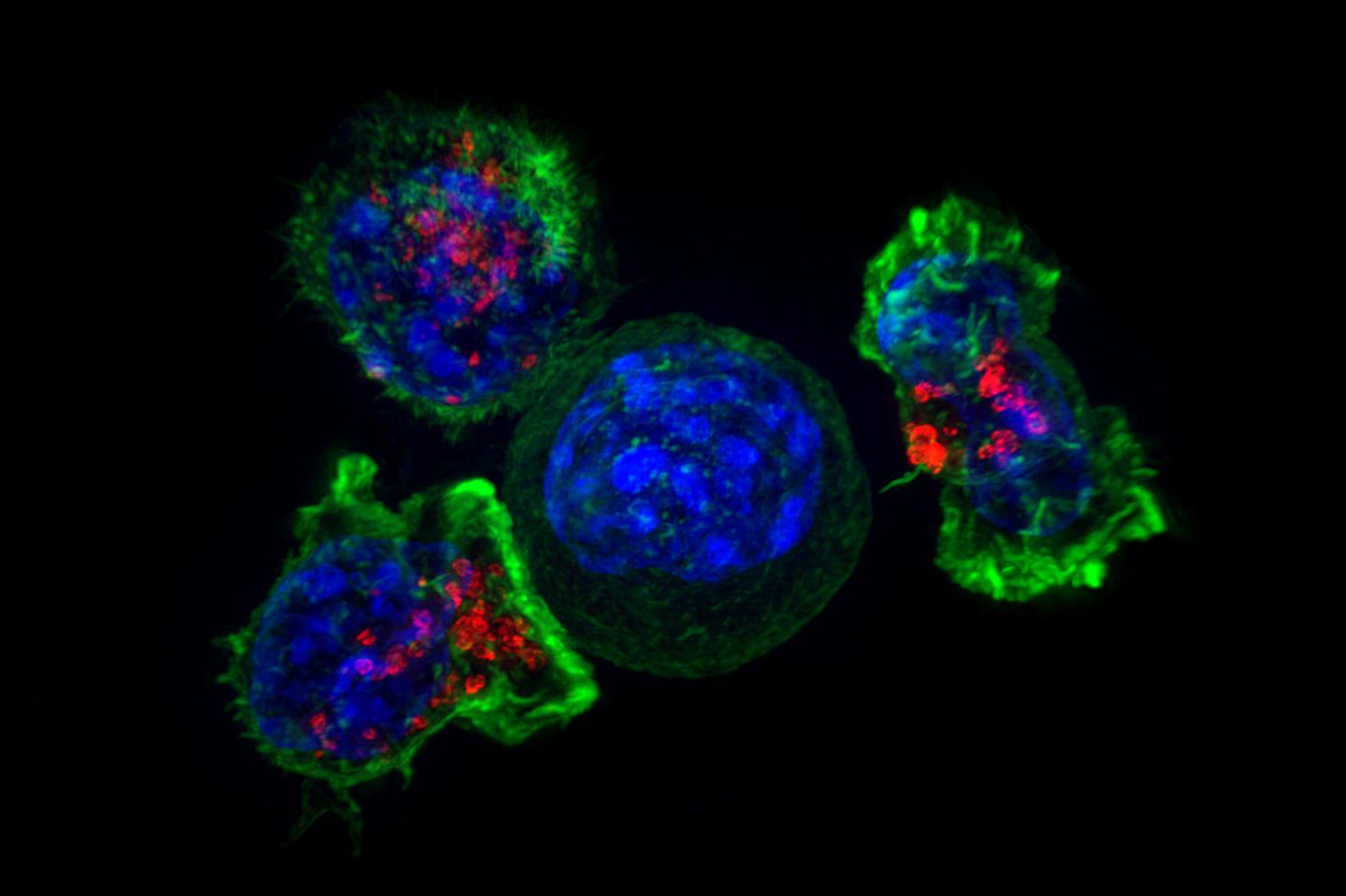
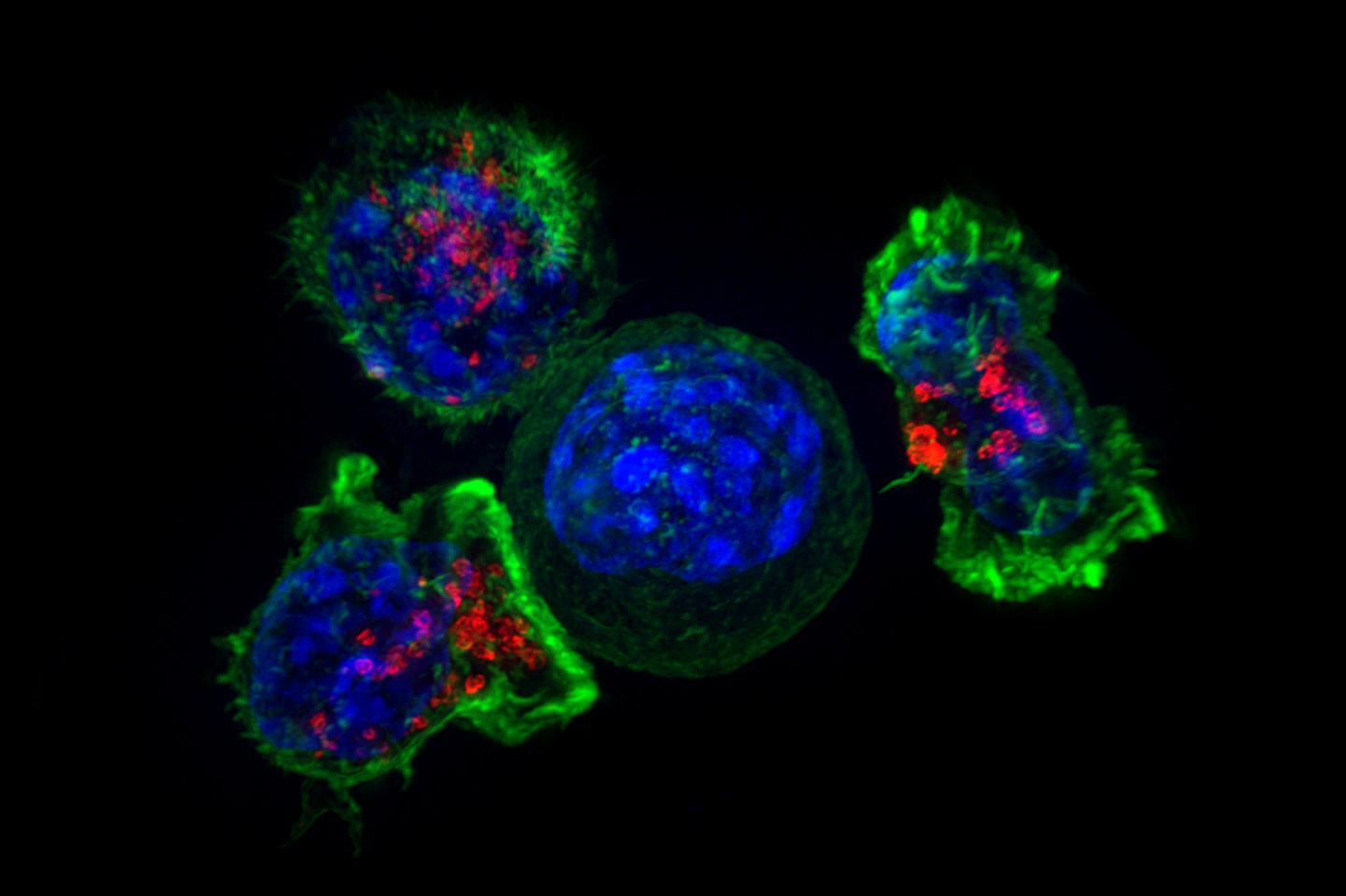
Credit: National Institutes of Health
Cancer cells arise when DNA is mutated, and these cells should be recognized as "foreign" by the immune system. However, cancer cells have found ways to evade detection by the immune system.
New drugs called immune checkpoint inhibitors can restore the immune system's recognition of cancer cells and have led to dramatic responses in a number of cancer types.
But not everyone responds. Investigators at Columbia University's Herbert Irving Comprehensive Cancer Center and Memorial Sloan Kettering Cancer Center-led by Naiyer Rizvi, MD, and Timothy Chan, MD, PhD-have been trying to understand why and have recently found how an individual's own genes can play a role in the response to the immunotherapy drugs. The complete findings were published Dec. 7 in Science.
The genes involved belong to the human leukocyte antigen (HLA) system, a gene complex encoding proteins that the immune system uses to recognize which cells belong in the body and which do not. HLA genes have many possible variations, allowing each person's immune system to react to a wide range of foreign invaders. The HLA system brings fragments of a virus or tumor to the surface of the cell so that the cell can be destroyed by the immune system.
"Some HLA genes have hundreds of different versions; however there previously was little understanding of the relationship between an individual's HLA composition and response to checkpoint inhibitors," says Dr. Rizvi, the Price Family Professor of Medicine at Columbia University Irving Medical Center and director of thoracic oncology and of immunotherapeutics at NewYork-Presbyterian Hospital.
The new study looked at 1,535 cancer patients treated with checkpoint inhibitors and found that patients who had more versions (a greater diversity) of HLA genes responded better to the therapy.
The study also showed that patients with a combination of low HLA diversity and fewer tumor mutations don't do as well with immune checkpoint inhibitors. Drs. Rizvi and Chan have previously worked together to show that the magnitude and type of damage to cells are associated with response to these drugs (Rizvi, et al., Science, 2015), and the new study ties together the patient's HLAs and the tumor genetic code.
Finally, the researchers showed certain HLA patterns affected survival as well, a pattern that also has been observed in patients with autoimmune disease.
"The relationship between HLA and outcomes to immune checkpoint inhibitors is important for many reasons. It is another piece of the immunotherapy puzzle-who responds and why. It also may be relevant for understanding side effects observed with immunotherapy, and this is an area we are currently exploring," Dr. Rizvi says.
###
The study is titled "Patient HLA genotype influences cancer response to checkpoint blockade immunotherapy."
Other authors are Diego Chowell (MSK), Luc G.T. Morris (MSK), Claud M. Grigg (CUMC), Jeffrey K. Weber (IBM), Robert M. Samstein (MSK), Vladimir Makarov (MSK), Fengshen Kuo (MSK), Sviatoslav M. Kendall (MSK), David Requena (Rockefeller University), Nadeem Riaz (MSK), Benjamin Greenbaum (Mount Sinai), James Carroll (UCLA), Edward Garon (UCLA), David M. Hyman (MSK and Weill Cornell), Ahmet Zehir (MSK), David Solit (MSK), Michael Berger (MSK), and Ruhong Zhou (IBM and Columbia).
The study was supported by the NIH (P30 CA008748, K08 DE024774, and R01 CA205426), Damon Runyon Cancer Research Foundation, Pershing Square Sohn Cancer Research Alliance, STARR Cancer Consortium, and Stand Up 2 Cancer.
Naiyer Rizvi is a consultant/advisory board member for AstraZeneca, BMS, Roche, Merck, Novartis, Lilly, and Pfizer. He is a co-founder and shareholder of Gritstone Oncology.
Media Contact
Lucky Tran
[email protected]
212-305-3689
@ColumbiaMed
http://www.cumc.columbia.edu
Original Source
http://newsroom.cumc.columbia.edu/blog/2017/12/14/cancer-immunotherapy-may-work-better-in-patients-with-specific-genes/