Landscape architecture students who designed traditional Chinese stone arch bridges with parametric modeling software, topology optimization algorithms, 3D printers and mixed reality headsets reported broadly positive experiences, according to a study published in the journal Architectural Research. The course-based workshop, run during the 2025 Beijing Design Marathon, asked seventeen undergraduate participants to move a single bridge design through a complete digital pipeline: from field measurements of historic structures, through computational optimization of load paths, to physical models printed in biodegradable plastic and virtual structures anchored in real space with Microsoft HoloLens 2 headsets.
The research team, led by Hao Yang with colleagues including Baoyue Kuang, Ji Qi, Zeyuan Chang and Jeongwon Han, framed the project around a problem they see in current design education. Digital tools have entered architecture and landscape curricula rapidly, but most teaching models treat each technology in isolation. Students model on two-dimensional screens, which the authors argue limits intuitive understanding of material properties, spatial scale and environmental adaptability. Drawing on Bygstad and colleagues’ concept of dual digitalization, the study highlights how the disconnection between pedagogical digitalization and disciplinary digitalization obstructs the development of sustainable digital learning spaces.
To close that gap, the researchers built a five-stage teaching workflow around a bridge design task. First, students collected geometric data and design parameters of representative traditional Chinese arch bridges, including the Zhaozhou Bridge and Qingming Bridge, through field surveys and archival research. They recorded dimensions such as bridge length, width and arch height, identified structural components like arch rings and piers, and analyzed load distribution patterns, support mechanisms and contextual conditions including deck materials and span types. This preliminary work formed the basis for everything that followed.
In the second stage, students constructed basic geometric models in Rhino and applied the Ameba plugin within the Grasshopper visual programming environment to simulate structural topology optimization. Ameba is based on the BESO, or Evolutionary Structural Optimization, algorithm, a technique originally developed in mechanical engineering and aerospace to find optimal material distributions under constraints such as material volume, loading conditions and boundary settings. The students followed a five-step procedure: defining the bridge design domain in Rhino, discretizing it into computational meshes, configuring external loads and support constraints, setting optimization parameters including material properties and target volume ratio, and running the iterative optimization with post-processing of the results.
The resulting two-dimensional outputs illustrated primary force transmission routes and critical stress zones, which the authors say helped students grasp what they call the form-follows-force relationship. Each group then translated the 2D topology results into three-dimensional spatial constructs by applying stretching and volumetric development operations. In the final output stage, all four groups collectively selected the Zhaozhou Bridge, a historic structure famous for its open-shoulder arch design, as the unified object for 3D printing and mixed reality demonstration. The choice rested on the bridge’s structural complexity, cultural significance and the clarity of its structural logic, which made it well suited for showcasing how topology-optimized forms relate to traditional bridge morphology.
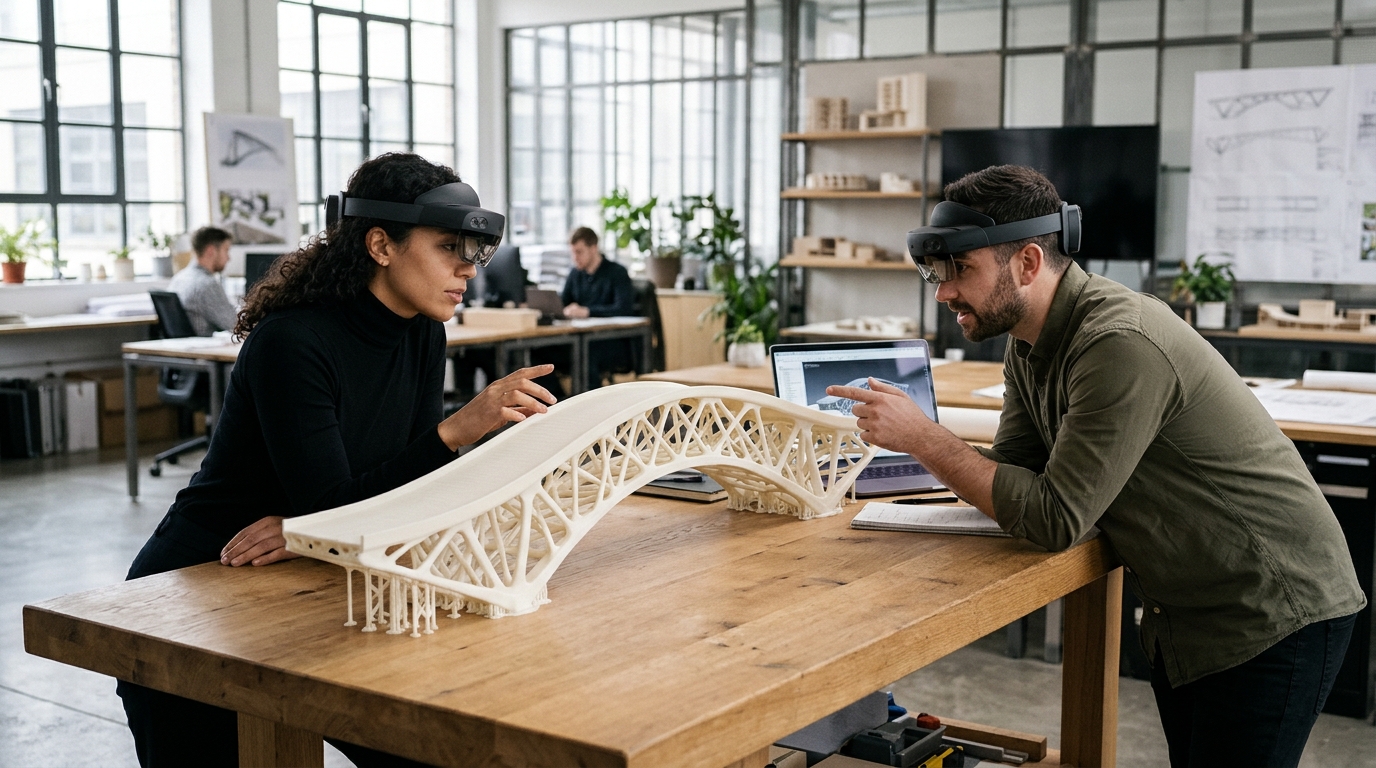
The optimized model was fabricated on a Bambu Lab A1 printer using biodegradable polylactic acid material, giving students a tangible model of load-bearing structure and material distribution. For the mixed reality phase, students used a four-point spatial anchoring method set within Rhino to define the coordinates of the virtual model, then generated spatial positioning QR codes with the Fologram plugin. Using HoloLens 2 headsets alongside mobile devices such as smartphones and iPads, students interacted with bridge models embedded in the physical context, completing what the authors describe as a feedback loop from digital modeling to physical-virtual integration.
Evaluation relied on a structured questionnaire administered to all seventeen participants, containing eight closed-ended items on a five-point Likert scale and two open-ended questions. The closed items mapped onto three research hypotheses: that mixed reality presentation enhances perceived realism, spatial immersion and environmental integration; that parametric modeling combined with topology optimization helps students understand force transmission, material distribution and the load-structure-form relationship; and that the integrated workflow supports scale judgment, spatial proportion understanding and design issue identification. Descriptive statistics showed every item scored above 4.24 on the five-point scale, indicating generally positive perceptions across realism, immersion, scale understanding and design decision-making support.
Item-level results revealed some nuance. The highest mean score, 4.82 with a standard deviation of 0.39, went to the item measuring spatial perception and interactive engagement during mixed reality use. Two items on scale relationships and spatial proportions both averaged 4.65, while items on design issue identification and design efficiency scored 4.29 and 4.47 respectively, slightly lower than the immersion and scale measures. At the dimensional level, immersion led with a mean of 4.68, followed by scale understanding at 4.65, design decision-making support at 4.38 and realism at 4.24. The authors suggest the relatively more cautious ratings for decision-making support may reflect that such skills require longer training, repeated design iteration and more systematic task evaluation.
Because the sample was small, the team used Spearman’s rank correlation as an exploratory analysis of relationships among items. Positive associations emerged within and across related dimensions: material realism correlated with environmental integration, spatial immersion correlated with interactive engagement, and students who reported stronger immersion also tended to report clearer understanding of scale relationships and spatial proportions. Open-ended responses, coded and visualized in a Sankey diagram, showed that when asked what modifications they made after using mixed reality, students focused mainly on scale and proportion and environmental relationships, while comparisons with traditional two-dimensional representation or virtual reality emphasized immersion, realism and intuitiveness.
The authors are explicit that these findings should be read as preliminary evidence rather than proof of pedagogical effectiveness. The study had no pre-test or post-test design and no control group, so it cannot demonstrate that spatial cognition, structural understanding or design decision-making actually improved. The sample consisted of third-year undergraduates of similar age and disciplinary background, limiting generalizability, and the printed models remained small-scale, so structural performance, construction details and assembly feasibility at real scale were not validated. Printed materials also did not fully match the material parameters used in optimization, and the optimized components underwent no systematic load-bearing or structural testing. The researchers call for larger samples, multi-institution implementations, controlled comparisons, longer-term tracking and an integrated platform to reduce the cross-platform switching burden that students and instructors both experienced during the compressed workshop format.
Subject of Research: An exploratory landscape architecture teaching workshop that integrated parametric modeling, topology optimization, 3D printing and mixed reality for bridge design education.
Article Title: From Digital to Immersive: Applying Parametric Modeling and Mixed Reality in Landscape Architecture Design Education
Article References: Yang, H., Kuang, B., Qi, J., Chang, Z., & Han, J. (2026). From Digital to Immersive: Applying Parametric Modeling and Mixed Reality in Landscape Architecture Design Education. Architectural Research, 28(1), Article 8. https://doi.org/10.1007/s44515-026-00010-4
Image Credits: AI Generated
DOI: 10.1007/s44515-026-00010-4
Keywords: landscape architecture, design education, parametric modeling, topology optimization, mixed reality, HoloLens 2, 3D printing, Grasshopper, BESO algorithm, Zhaozhou Bridge, student questionnaire, digital learning spaces
News Source: Reid Dalton. (November 5, 2026). Mixed reality and topology optimization reshape a bridge design studio. Scienmag.