Wildflower plantings sown to help declining pollinators can also reshape the fortunes of farmland birds and rodents, but only if they are big enough and placed in the right kind of landscape, according to a new experimental study from Central Hungary. The research, published in the journal Web Ecology, found that a single large wildflower field significantly increased bird species number, individual number and Shannon-diversity in landscapes dominated by arable land, while smaller strips of the same total area offered no measurable benefit over ordinary crop fields. The same plantings, however, also provided undisturbed refuge for common voles, a potential agricultural pest.
The study was carried out by Gyula Szabó, László Somay, Fruzsina Kőhalmi and András Báldi of the HUN-REN Centre for Ecological Research, who set up a landscape-scale experiment in 2020 by sowing wildflower plantings across agricultural land in Central Hungary. The team wanted to know whether the benefits of these pollinator-friendly interventions extend beyond insects, and whether the answer depends on how the plantings are arranged and on the structure of the surrounding landscape. Their motivation was partly geographic: most existing evidence on wildflower plantings and birds comes from Western and Northern Europe, while Eastern parts of the European Union, which often hold higher farmland biodiversity, remain poorly studied.
The researchers selected eight triplets of landscape circles, each with a 500 metre radius, half in homogeneous agricultural landscapes with 90 to 99 percent arable fields and only 1 to 10 percent semi-natural habitat, and half in heterogeneous landscapes with 40 to 60 percent semi-natural habitats such as extensive grasslands, forest belts and wetlands. That made 24 landscape plots in total. Within each triplet, one plot received a single compact wildflower field of 50 by 100 metres, or 0.5 hectares, another received three smaller strips of roughly 24 by 70 metres each, about 100 metres apart, with the same total area of 0.5 hectares, and the third was left as a control. The seed mixture contained 32 native, insect-pollinated flowering herb species, and the plantings were managed by mowing, first once a year in autumn and later by rotational early summer mowing that cut half of each planting every year.
Birds were surveyed in the spring of 2024, five years after the plantings were established, in two rounds on 18 to 19 April and 13 to 14 May. A single point count station was placed in the middle of each field, strip and control plot, and one of two observers spent ten minutes at each station between sunrise and 10:00, recording all birds seen or heard within a 100 metre radius, along with their behaviour and the habitat in which they first interacted with the plot. Surveys were skipped in winds above 16 kilometres per hour and during rain. The team excluded birds that merely flew over without interacting with the plot, as well as woodland passerines recorded only in plantings next to forest strips, and three landscape plots with outlying values, including one on the edge of a strictly protected national park and two with open water on waterlogged cereal fields where most birds were drinking at the water’s edge.
In total the researchers recorded 24 bird species and 183 individuals, with skylark and stonechat the most abundant. Statistical models revealed significant effects of spatial configuration, landscape context and, crucially, their interaction on species number, individual number and diversity. The pattern was clear: in homogeneous landscapes, plots with large wildflower fields had significantly more bird species, more individuals and higher Shannon-diversity than both strip plots and control plots, while strips did not differ from controls at all. In heterogeneous landscapes, by contrast, there were no significant differences between fields, strips and controls, because bird communities there were already richer regardless of the plantings.
The landscape comparison itself was striking. Heterogeneous landscape plots supported significantly more species, individuals and diversity than homogeneous ones in both strip plots and control areas, and in field plots the difference appeared in individual numbers. Only in homogeneous landscapes did the presence of a large wildflower field raise bird species number and diversity to levels comparable with those seen in heterogeneous landscapes. The authors suggest that the additional benefits of wildflower plantings may be limited where baseline habitat heterogeneity is already high, and that plantings larger than those typically implemented, which are usually under 0.5 hectares and 12 to 20 metres wide, are more effective at attracting birds.
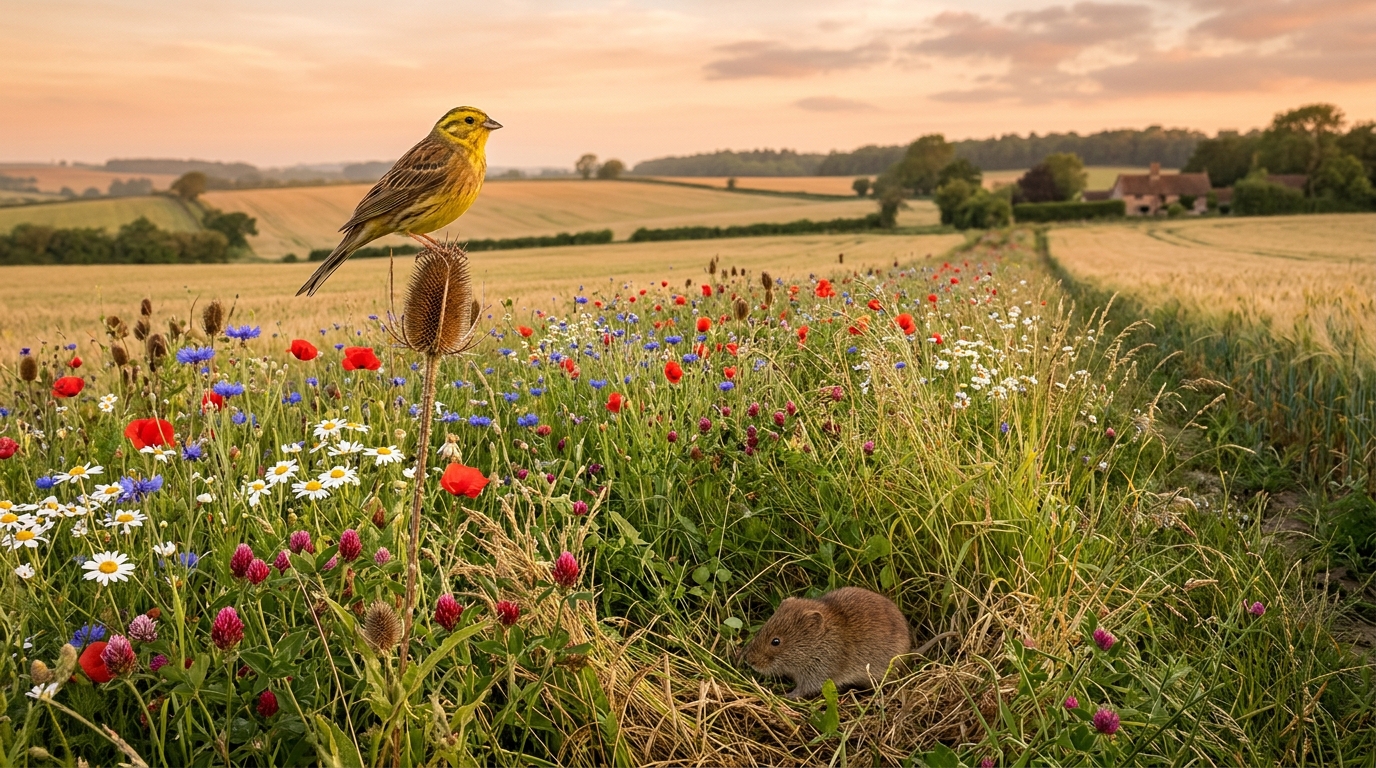
The rodent results added an unexpected twist. Because wildflower plantings are not tilled, they offer undisturbed soil for burrowing and a constant food supply, conditions that suit common voles, a species that can seriously damage crops. The researchers searched for active vole burrows in each wildflower field and in a paired control area within the same arable field, walking across each 0.5 hectare plot, marking burrows, loosely filling the openings with soil and counting how many were reopened 24 hours later. Strips were excluded from the rodent work due to lack of resources, and only three inactive steppe mouse mounds were found, so the analysis focused on common voles. Active burrows were significantly more numerous in wildflower fields than in controls, and the only control plots with active burrows were two on alfalfa fields, which were mown but not tilled. Notably, the number of active burrows was higher in April than in October, a decrease the authors suspect may reflect predation, possibly aided by the roughly three metre tall marker posts at the corners of the plantings, which raptors such as common kestrels and marsh harriers were repeatedly seen using as perches.
The authors are careful to frame these findings as preliminary. This was a small-scale pilot study with only eight replicates for birds and eight field-control pairs for voles, each surveyed in two rounds, and three bird plots had to be excluded from the analysis. Bird observations were typically limited to three to five individuals per visit, so some effects may reflect chance detection, and subtler benefits of plantings in heterogeneous landscapes may have gone undetected. The landscape classification was also coarse, pooling grasslands and wetlands as semi-natural habitat, and the study measured only alpha diversity, not community composition, breeding success or foraging behaviour. The burrow surveys were likewise restricted to wildflower fields and crop fields, so other uncultivated habitats that certainly support voles were not sampled. Longer-term monitoring, the team writes, is needed to confirm the patterns and assess finer-scale responses.
Nevertheless, the study carries practical weight for conservation policy. In the same experimental system, earlier work by Bihaly and colleagues showed that both fields and strips increased pollinator species number and abundance in homogeneous landscapes, particularly in late summer. Birds, it now appears, respond primarily to fields. On that basis the authors recommend promoting larger wildflower fields, of the 50 by 100 metre scale used in their study, in agri-environmental schemes, while acknowledging a real trade-off: wider and larger plantings take productive crop area out of cultivation, which may reduce farmer acceptance even as ecological benefits grow, a problem that dedicated payments and outreach could help address.
The findings arrive as European Union member states prepare national implementation plans under the Nature Restoration Regulation, which calls for restoring semi-natural habitats in agricultural landscapes to recover biodiversity and ecosystem functions, especially pollination. The authors argue that locally specific evidence is badly needed for those plans, and their results suggest that well-designed wildflower plantings can deliver multiple biodiversity benefits beyond pollinators, provided their size and placement are matched to landscape context. The same plantings that give skylarks and stonechats a foothold in simplified farmland also shelter voles, though those rodents may in turn serve as a key food source for the raptors that patrol the fields. Design, in other words, determines whether the ledger tips toward benefit, and the balance is likely to differ from one landscape to the next.
Subject of Research: Effects of wildflower field configuration and landscape context on farmland birds and rodents in Central Hungary
Article Title: Pollinator-promoting wildflower fields attract farmland birds and rodents, depending on spatial configuration and landscape context
Article References: Szabó, G., Somay, L., Kőhalmi, F., & Báldi, A. (2026). Pollinator-promoting wildflower fields attract farmland birds and rodents, depending on spatial configuration and landscape context. Web Ecology, 26(2), 243-249. https://doi.org/10.5194/we-26-243-2026
Image Credits: AI Generated
Keywords: wildflower plantings, farmland birds, pollinators, common vole, landscape heterogeneity, agri-environment schemes, Central Hungary, Nature Restoration Regulation, biodiversity, rodent pests, spatial configuration, experimental ecology
News Source: Drew Townsend. (November 5, 2026). Large Wildflower Fields Boost Farmland Birds in Simplified Landscapes, but Also Shelter Voles. Scienmag.