• HOME
  • NEWS
  • EXPLORE
    • CAREER
      • Companies
      • Jobs
    • EVENTS
    • iGEM
      • News
      • Team
    • PHOTOS
    • VIDEO
    • WIKI
  • BLOG
  • COMMUNITY
    • FACEBOOK
    • INSTAGRAM
    • TWITTER
Saturday, February 7, 2026
BIOENGINEER.ORG
No Result
View All Result
  • Login
  • HOME
  • NEWS
  • EXPLORE
    • CAREER
      • Companies
      • Jobs
        • Lecturer
        • PhD Studentship
        • Postdoc
        • Research Assistant
    • EVENTS
    • iGEM
      • News
      • Team
    • PHOTOS
    • VIDEO
    • WIKI
  • BLOG
  • COMMUNITY
    • FACEBOOK
    • INSTAGRAM
    • TWITTER
  • HOME
  • NEWS
  • EXPLORE
    • CAREER
      • Companies
      • Jobs
        • Lecturer
        • PhD Studentship
        • Postdoc
        • Research Assistant
    • EVENTS
    • iGEM
      • News
      • Team
    • PHOTOS
    • VIDEO
    • WIKI
  • BLOG
  • COMMUNITY
    • FACEBOOK
    • INSTAGRAM
    • TWITTER
No Result
View All Result
Bioengineer.org
No Result
View All Result
Home NEWS Science News

Frequent sun exposure may cue gene fusion found in skin cancer

Bioengineer by Bioengineer
December 14, 2017
in Science News
Reading Time: 2 mins read
0
Share on FacebookShare on TwitterShare on LinkedinShare on RedditShare on Telegram
IMAGE

Credit: Dr. Masatoshi Jinnin

A fusion gene is a single composite gene that is the result of the combination of two formerly independent genes. Researchers from Kumamoto University , Japan have determined that a particular fusion gene has a tendency to be found in cutaneous squamous cell carcinoma (cSCC) lesions on skin exposed frequently to the sun.

Many cSCCs are easily treated by simple removal, but if left untreated they can become deadly. Current detection methods can be slow, particularly for abnormal cases, and some cSCCs are resistant to standard treatments emphasizing the need for improved diagnostics and therapies.

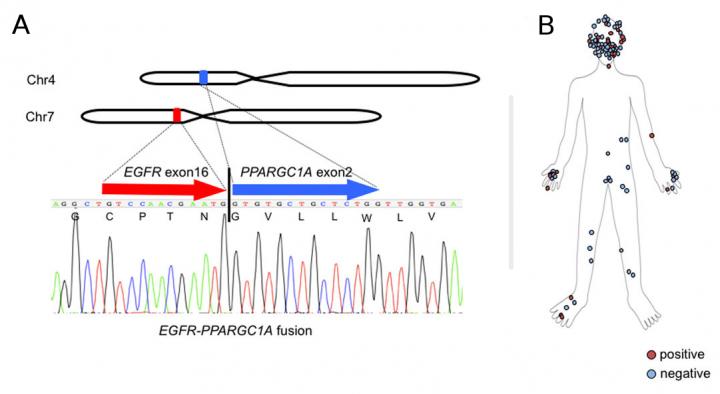
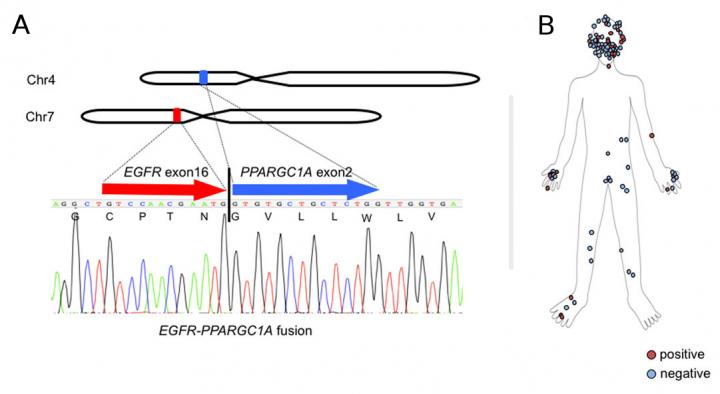
Fusion genes may be found in various types of connective tissue tumors, and some treatments have been developed that inhibit the tumor-forming actions of those genes. However, no fusion gene had been identified for cSCC before the Kumamoto University research team began their search. The researchers started with the cell lines A431 and DJM-1, which are frequently used in SCC studies, and normal human epidermal keratinocytes (NHEKs) as a control. Using transcriptome sequencing, they found a fusion between exon16 of epidermal growth factor receptor (EGFR) and exon2 of PPARγ coactivator 1-α (PPARGC1A) in the A431 cell line but not in the normal skin samples or other tumor tissues.

In samples of human tumor tissues, the fusion gene EGFR-PPARGC1A was found in areas frequently exposed to the sun, like the face or hands, but not in areas of the body that are typically concealed in the daylight. Furthermore, fusion genes typically found in other types of SCCs were rarely found in cSCC. The researchers believe that this is because of cSCC's interrelationship with sun exposure, and that EGFR-PPARGC1A may play a part in cancers caused by ultraviolet irradiation.

"We still have more work to do to determine this fusion gene's role in cSCC tumorigenesis, but our work should provide some insights into new drug development for this type of cancer," said project scientist, Dr. Sho Egashira. "It may be possible, for example, to assess the fusion genes in a cancerous lesion and apply a customized therapy based on the results. This would greatly reduce the risk of any side effects of the treatment."

###

This research was published online in the journal Scientific Reports on 04 Oct. 2017.

[Source]

Egashira, S., Jinnin, M., Ajino, M., Shimozono, N., Okamoto, S., Tasaki, Y., … Ihn, H. (2017). Chronic sun exposure-related fusion oncogenes EGFR-PPARGC1A in cutaneous squamous cell carcinoma. Scientific Reports, 7(1). doi:10.1038/s41598-017-12836-z

Media Contact

J. Sanderson
[email protected]

http://ewww.kumamoto-u.ac.jp/en/news/

Original Source

https://www.nature.com/articles/s41598-017-12836-z http://dx.doi.org/10.1038/s41598-017-12836-z
Share24Tweet8Share2ShareShareShare2

Related Posts

Phage-Antibiotic Combo Beats Resistant Peritoneal Infection

February 7, 2026

Boosting Remote Healthcare: Stepped-Wedge Trial Insights

February 7, 2026

Barriers and Boosters of Seniors’ Physical Activity in Karachi

February 7, 2026

Evaluating Pediatric Emergency Care Quality in Ethiopia

February 7, 2026
Please login to join discussion

POPULAR NEWS

  • Robotic Ureteral Reconstruction: A Novel Approach

    Robotic Ureteral Reconstruction: A Novel Approach

    82 shares
    Share 33 Tweet 21
  • Digital Privacy: Health Data Control in Incarceration

    63 shares
    Share 25 Tweet 16
  • Study Reveals Lipid Accumulation in ME/CFS Cells

    57 shares
    Share 23 Tweet 14
  • Breakthrough in RNA Research Accelerates Medical Innovations Timeline

    53 shares
    Share 21 Tweet 13

About

We bring you the latest biotechnology news from best research centers and universities around the world. Check our website.

Follow us

Recent News

Phage-Antibiotic Combo Beats Resistant Peritoneal Infection

Boosting Remote Healthcare: Stepped-Wedge Trial Insights

Barriers and Boosters of Seniors’ Physical Activity in Karachi

Subscribe to Blog via Email

Enter your email address to subscribe to this blog and receive notifications of new posts by email.

Join 73 other subscribers
  • Contact Us

Bioengineer.org © Copyright 2023 All Rights Reserved.

Welcome Back!

Login to your account below

Forgotten Password?

Retrieve your password

Please enter your username or email address to reset your password.

Log In
No Result
View All Result
  • Homepages
    • Home Page 1
    • Home Page 2
  • News
  • National
  • Business
  • Health
  • Lifestyle
  • Science

Bioengineer.org © Copyright 2023 All Rights Reserved.