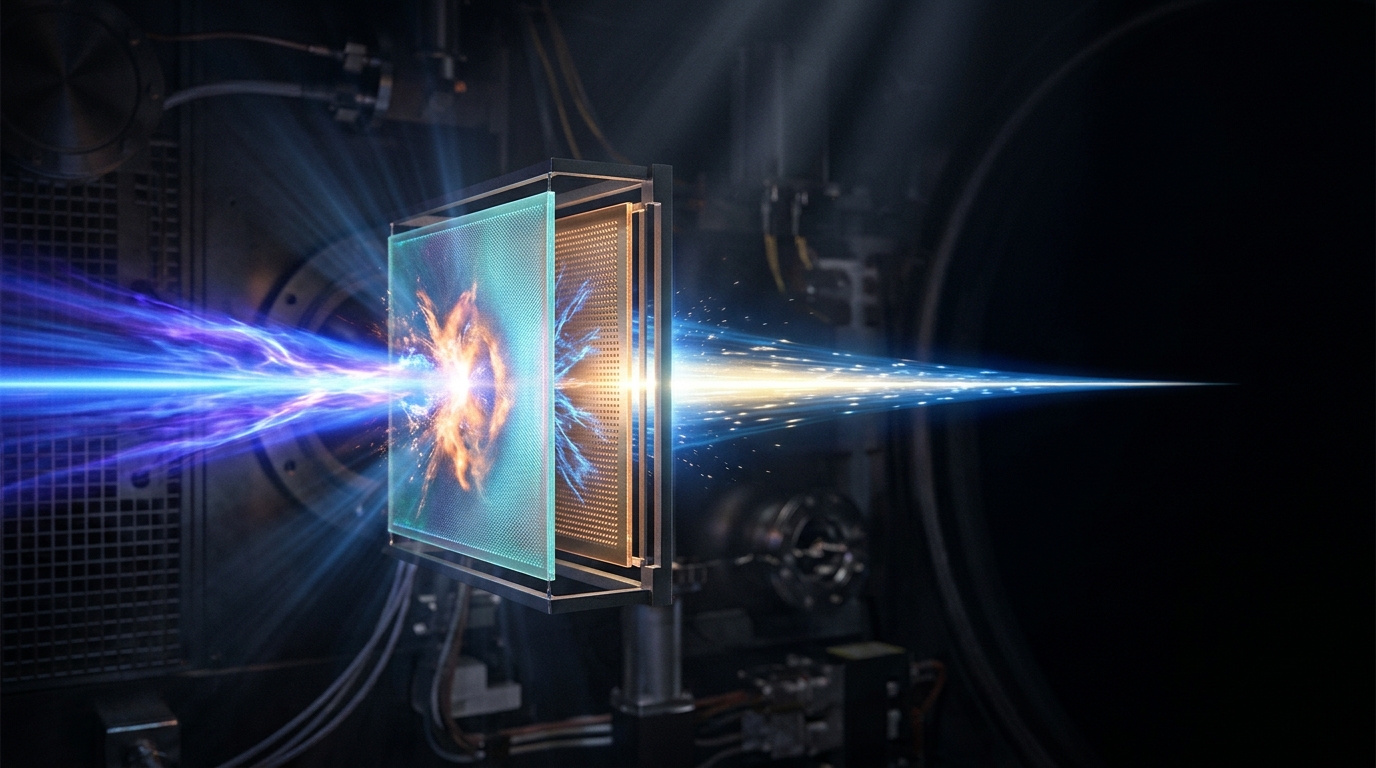
Physicists have taken a step toward shrinking particle accelerators to tabletop size by showing that carefully engineered double-layer targets can boost the performance of compact, 20-terawatt lasers to levels approaching conventional machines. In a study published in EPJ Techniques and Instrumentation, a team at the Politecnico di Milano reports that double-layer targets, produced entirely with deposition techniques, significantly increase both the energy and the number of protons accelerated by a laser pulse. When combined with simulations of environmental analysis, the results suggest that such compact laser-driven sources could one day perform particle-induced X-ray emission, a widely used analytical technique, with performance comparable to that of standard accelerators.
The appeal of laser-driven acceleration lies in its potential to sidestep several drawbacks of conventional accelerators, including high cost, large footprint, limited portability, and radioprotection concerns. In a typical laser-driven scheme known as target normal sheath acceleration, an ultra-intense, ultra-short laser pulse strikes a micrometric solid target, partially ionizing it into a plasma. Electrons heated to relativistic energies stream toward the rear of the target, generating a sheath electric field of a few megavolts per micrometer. This field accelerates light ions, mostly protons, from the rear surface, producing bunches of roughly 10^8 to 10^12 protons per shot with broad, exponentially shaped spectra and cut-off energies from a few MeV up to several tens of MeV.
Conventional accelerators, however, still hold the advantage for demanding applications. The authors note two main paths in laser technology: multi-petawatt systems with pulse energies of tens to hundreds of joules but low repetition rates, available only at a limited number of top-class facilities, and table-top lasers with peak powers of tens to hundreds of terawatts and repetition rates from hertz up to the kilohertz regime. The second class offers a practical, compact, and cost-effective alternative, but only if the energy and number of accelerated ions can be enhanced through better control of the laser-target coupling. Double-layer targets are designed to do exactly that: a thin solid foil is covered with a very low-density layer, such as a near-critical carbon foam, that acts as an enhanced laser absorber. The laser pulse interacts strongly with the near-critical layer, raising the conversion efficiency of laser energy into the hot electrons that drive the sheath field.
A major contribution of the new work is the production of these targets entirely by physical vapor deposition. The team fabricated solid-density substrates by magnetron sputtering, a technique that can tune density, morphology, and stoichiometry with good uniformity over areas of several square centimeters. For titanium substrates, the researchers alternated direct current magnetron sputtering with high-power impulse magnetron sputtering, combining the tensile-stressed, columnar films of the former with the compact structure of the latter. The resulting compact, quasi-amorphous titanium substrates ranged from 200 nanometers to 2 micrometers thick, with a maximum measured thickness uncertainty of plus or minus 5 percent over several square centimeters and a density greater than 80 percent of the bulk value. By contrast, commercially rolled foils used in typical experiments carry thickness tolerances of up to plus or minus 30 percent and often contain pinholes and ripples, uncertainties that degrade shot-to-shot reproducibility.
The researchers also demonstrated a second fabrication route based on a fishing approach. A metallic film is deposited on a silicon wafer or glass slide coated with a thin layer of commercial soap; water then detaches the film, which floats on the surface thanks to surface tension and can be scooped directly onto the perforated target holder. This method suits ductile materials, and the team mainly investigated copper and aluminum. Free-standing copper targets ranged from 50 nanometers to 1.8 micrometers thick with low stress and bulk density, while aluminum substrates spanned 50 nanometers to 1 micrometer. Each strategy has trade-offs: hole-filling yields flat, grid-attached films but is time-consuming, whereas fishing is faster and allows thinner substrates but demands careful handling to avoid creasing.
Compatibility between the metallic layer and the low-density foam proved equally important. Using titanium films as a reference, the team observed that when the free-standing metallic film was thinner than 400 nanometers, deposition of the low-density layer was less effective: the total amount of foam material decreased, showed a radial decline from the periphery toward the center, and its microstructure changed. The authors suggest that vibrations of the film induced by impinging clusters during deposition may prevent further adhesion of aggregates or facilitate their partial detachment, a mass-dependent effect analogous to elastic membrane vibrations.
To assess how these targets would perform under laser irradiation, the team ran an extensive campaign of particle-in-cell simulations with the codes WarpX and Smilei, using laser parameters representative of a compact 20-terawatt system: 30-femtosecond pulses at a wavelength of 0.8 micrometers focused to a spot radius of 2.4 micrometers, corresponding to an intensity of about 2.2 times 10^20 watts per square centimeter. The simulated targets consisted of a fully ionized carbon foam with an electron density of 2.6 times the critical density attached to an aluminum foil, with a thin hydrogen layer on the rear surface representing contaminants, the source of the protons. Scans covered substrate thicknesses of 200 nanometers, 600 nanometers, and 2 micrometers, each combined with foam thicknesses of 0, 2, 4, and 8 micrometers, with 4 micrometers identified as optimal by a model predicting the foam density and thickness that maximize proton energy.
The two-dimensional simulations showed that adding the foam clearly enhanced both the energy and the number of accelerated protons compared with bare substrates, mainly by reducing reflection and increasing laser absorption, which generates a hotter electron population. Proton quantities also increased as substrate thickness decreased, owing to enhanced electron recirculation along the substrate. Because two-dimensional simulations alter some physical details of the acceleration process, the team followed with a realistic three-dimensional simulation of the optimal case, a 0.2-micrometer substrate with a 4-micrometer foam, explicitly including the three-dimensional nanostructure morphology of the foam as clusters of 40-nanometer-radius nanoparticles aggregated into a mean density of 2.6 times the critical density. In this more realistic case, the disordered nanostructure increased laser absorption and conversion efficiency, but density inhomogeneities caused chaotic electron motion that reduced the maximum proton energy while keeping conversion efficiency relatively high.
The researchers then coupled these simulated proton spectra to Monte Carlo simulations of particle-induced X-ray emission, using the Geant4 toolkit to model the irradiation of an aerosol sample representative of atmospheric analysis, a 150-micrometer-thick, 5-centimeter-diameter disk of nitrocellulose-based material containing trace heavier elements. For conventional sources, they considered monoenergetic protons of 2.5, 4.0, and 5.5 MeV with beam currents of 1 to 10 nanoamperes. For laser-driven sources, they scaled the simulated proton numbers using published data, estimating about 10^9 protons per shot in the forward direction for a bare 2-micrometer target, and assumed a repetition rate of 1 hertz. With bare targets alone, the emitted X-ray rates remained one to two orders of magnitude below those of conventional accelerators. With double-layer targets, however, the simulated X-ray emission rates per unit time became comparable to those of 1-to-10-nanoampere conventional machines, and the results showed only a mild dependence on substrate and foam thickness, which could benefit the stability of the laser-driven source.
A final simulation using the realistic three-dimensional proton spectrum, whose average proton energy was lower than the equivalent two-dimensional result, still yielded comparable X-ray emission rates because the higher number of accelerated protons per shot compensated for the lower average energy. The authors conclude that nanostructured carbon foam-based double-layer targets can make laser-driven particle-induced X-ray emission with compact lasers competitive with conventional accelerators for environmental sample analysis, and they suggest that the same combination could enable other applications based on secondary radiation, such as neutron imaging and radiography. The findings rest entirely on simulations, so experimental validation with fabricated targets under real laser irradiation remains the necessary next step before compact laser-driven accelerators reach routine use in pollution monitoring and other fields.
Subject of Research: Development and simulation of double-layer targets for compact laser-driven ion acceleration and particle-induced X-ray emission analysis
Article Title: Towards compact laser-driven accelerators: exploring the potential of advanced double-layer targets
Article References: Maffini, A., Mirani, F., Galbiati, M., Ambrogioni, K., Gatti, F., Galli De Magistris, M. S., Vavassori, D., Orecchia, D., Dellasega, D., Russo, V., Zavelani-Rossi, M., & Passoni, M. (2023). Towards compact laser-driven accelerators: exploring the potential of advanced double-layer targets. EPJ Techniques and Instrumentation, 10(1), Article 15. https://doi.org/10.1140/epjti/s40485-023-00102-8
Image Credits: AI Generated
DOI: 10.1140/epjti/s40485-023-00102-8
Keywords: laser-driven acceleration, double-layer targets, particle-in-cell simulations, carbon foam, PIXE, environmental monitoring, magnetron sputtering, pulsed-laser deposition, proton beams, compact lasers, Monte Carlo simulation, target fabrication
News Source: Katie Riggs. (November 4, 2026). Laser-driven accelerators edge closer with engineered double-layer targets. Scienmag.