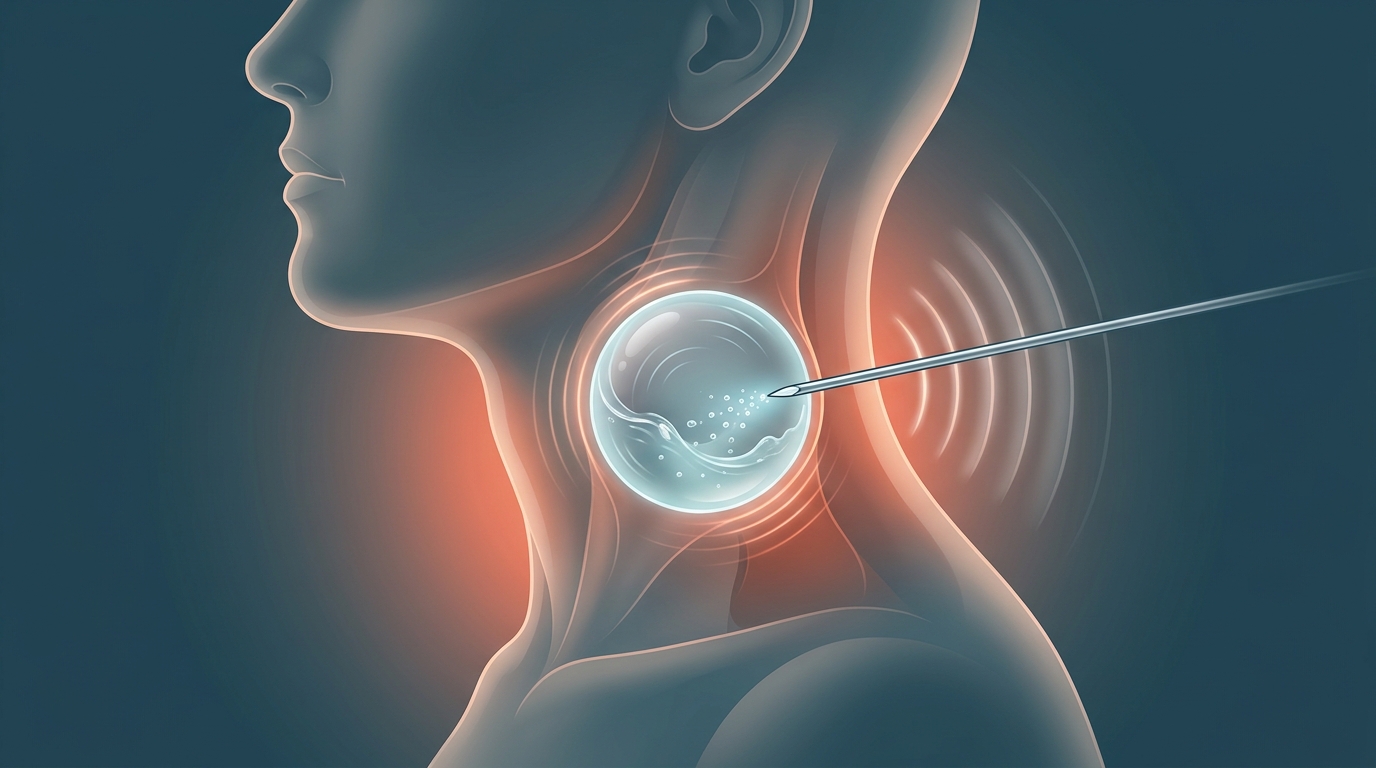
Ultrasound-guided injections of 95% sterile ethanol shrank second branchial cleft cysts in all nine patients treated across two institutions in Egypt and Bosnia and Herzegovina, according to a retrospective case series published in the Egyptian Journal of Radiology and Nuclear Medicine. At twelve months, mean cyst volume had fallen from 26.5 millilitres to 1.3 millilitres, a mean volume reduction rate of 95.0 ± 1.0 percent, and every patient met the study’s definition of complete response: a volume reduction of at least 90 percent together with complete clinical resolution of the palpable or visible neck mass. No recurrences and no major complications were recorded during the twelve-month follow-up window.
The nine patients, five men and four women with a mean age of 33.8 ± 7.5 years, had all declined surgical excision, the traditional treatment for these congenital neck lesions. Each had a single ablation session in which the cyst was completely aspirated under real-time ultrasound guidance, irrigated twice with sterile normal saline, and then instilled with ethanol at a volume corresponding to roughly 70 percent of the aspirated fluid. The mean ethanol volume delivered was 17.0 ± 4.3 millilitres, capped at 10 millilitres per instillation cycle, with each aliquot retained for ten minutes before complete aspiration. The single recorded complication was transient mild neck pain in one patient, or 11.1 percent of the cohort, which resolved spontaneously within 24 hours without analgesics. Mean patient satisfaction on a five-point Likert scale was 4.9 ± 0.3.
Second branchial cleft cysts arise from incomplete regression of the pharyngeal apparatus during embryonic development and account for approximately 95 percent of all branchial cleft anomalies. They typically present in the second through fourth decades of life as painless, slowly enlarging masses along the anteromedial border of the sternocleidomastoid muscle, lateral to the carotid space and posterior to the submandibular gland. Left untreated, they carry risks of local pain, swallowing difficulties and recurrent infection. Surgical excision, the historical standard, requires dissection near the carotid sheath, internal jugular vein and several cranial nerves, and carries complication rates of 3 to 6 percent, including wound infection, haematoma and nerve palsy, in addition to the general risks of anaesthesia and visible scarring.
The mechanism behind ethanol ablation is chemical rather than mechanical. Ethanol causes cytotoxic injury to the cyst epithelium through protein coagulation and lipid dissolution, triggers thrombosis of nearby capillaries, and provokes a sterile inflammatory response that promotes fibrosis and eventual obliteration of the cyst cavity. The same principle underpins the technique’s established use in benign cystic lesions of the thyroid, parathyroid, kidney and liver. The authors note that applying it to branchial cleft cysts is reasonable because these lesions are predominantly epithelial-lined structures, though published series remain limited and data from Southeastern Europe, North Africa and the broader Middle East and Africa region were, before this report, virtually absent from the literature.
Procedural technique followed a standardised protocol at both sites, the Endocrinology and Diabetes Unit of Mansoura University Faculty of Medicine in Egypt, which contributed seven patients, and the Department of Nuclear Medicine at Poliklinika Vitalis in Mostar, Bosnia and Herzegovina, which contributed two. Operators used 7.5 to 12 MHz linear transducers for pre-procedural imaging, measured cyst dimensions in three orthogonal planes, and calculated volume with the ellipsoid formula. Needle gauge was selected according to cyst content: 21-gauge needles for purely anechoic cysts and 18-gauge needles for cysts containing thick debris, to achieve complete aspiration. Colour Doppler was used to delineate the carotid artery and internal jugular vein before needle placement, and injection was stopped immediately if unexpected resistance, severe pain, rapid cyst wall distension or suspected extravasation occurred. Both operators had prior experience of at least 50 ultrasound-guided ethanol ablations of thyroid cysts before undertaking these procedures.
Patients were selected under strict criteria: an ultrasound appearance consistent with a cystic lesion, a location matching second branchial cleft anatomy, fine-needle aspiration cytology confirming a benign lesion, refusal of or medical contraindication to surgery, and availability for structured follow-up. Exclusion criteria covered suspected malignancy, active cervical infection, coagulopathy, previous ipsilateral neck surgery or irradiation, and pregnancy. All nine patients had undergone cross-sectional imaging with computed tomography or magnetic resonance imaging before referral, and cytology was examined for squamous cells, cholesterol crystals and amorphous debris characteristic of branchial cleft cysts as well as for the absence of malignant cells. Follow-up ultrasound examinations were scheduled at one, three, six and twelve months, with volume reduction rate calculated as the percentage decrease from initial volume.
The longitudinal data showed progressive shrinkage at every interval. Mean cyst volume fell from 26.5 ± 6.5 millilitres at baseline to 12.7 ± 2.9 millilitres at one month, 5.8 ± 0.9 millilitres at three months, 2.8 ± 0.9 millilitres at six months and 1.3 ± 0.5 millilitres at twelve months. The twelve-month volume reduction rate ranged from 93.3 to 96.7 percent across the cohort. Notably, all cases containing internal septations, which made up 55.6 percent of the cohort, achieved complete response, a finding the authors attribute to the typically thin, incomplete septa of branchial cleft cysts, which may permit ethanol diffusion across compartments more readily than the multi-loculated thyroid cysts in which fragmented septations can obstruct even distribution.
The results compare favourably with the largest previous study, by Ha and colleagues in South Korea, which treated 20 cases and reported a mean volume reduction rate of 86.2 percent with complete response in 80 percent of treated cysts and no major complications. The authors caution, however, that direct comparison should be interpreted cautiously because of differences in sample size, patient selection, lesion characteristics, procedural protocols and outcome definitions. Their own study was not designed to determine whether saline irrigation, staged ethanol instillation, retention time or needle selection independently contributed to the observed response. The retrospective design also means follow-up ultrasound examinations were performed by the treating operators rather than independent blinded assessors, and no formal assessment of intra-observer or inter-observer reproducibility was performed for the volume measurements.
The limitations are substantial and the authors state them plainly. The single-arm architecture without a surgical control group, the small sample of nine patients, the retrospective data collection and the twelve-month follow-up all preclude definitive conclusions about superiority or equivalence to surgical excision. Recurrence after ethanol ablation may manifest beyond twelve months, so the true long-term recurrence rate cannot be determined from these data. The heterogeneity of needle gauge selection between centres introduces a technical variable that should be standardised in future prospective protocols, and the staged dosing approach should be considered centre-specific rather than a validated dose recommendation. The study also lacked a formal health-economic analysis, so no conclusions regarding comparative cost-effectiveness can be drawn, even though outpatient delivery without general anaesthesia or theatre time suggests potential practical advantages in resource-constrained settings.
Within those constraints, the authors position percutaneous ethanol ablation as a promising, well-tolerated alternative warranting prospective evaluation with follow-up extended to at least 24 to 36 months, rather than as a definitively curative treatment. They suggest it may be considered for carefully selected patients with benign, uncomplicated second branchial cleft cysts who decline or are unfit for surgery, provided multidisciplinary evaluation has excluded malignancy and an experienced operator performs the procedure under real-time ultrasound guidance. A prospective registry is currently being planned to address the limitations of the present series, and the authors call for prospective multicentre randomised or registry-based studies with extended follow-up to establish standardised patient selection criteria, optimal ethanol dosing protocols and long-term efficacy data before any definitive practice recommendations can be made.
Subject of Research: Ultrasound-guided percutaneous ethanol ablation as a minimally invasive treatment for second branchial cleft cysts
Article Title: Safety and efficacy of ultrasound-guided ethanol ablation for branchial cleft cysts: a retrospective multicenter case series
Article References: Ghazi, H., & Pušić, P. (2026). Safety and efficacy of ultrasound-guided ethanol ablation for branchial cleft cysts: a retrospective multicenter case series. Egyptian Journal of Radiology and Nuclear Medicine, 57(1), Article 235. https://doi.org/10.1186/s43055-026-01901-1
Image Credits: AI Generated
DOI: 10.1186/s43055-026-01901-1
Keywords: branchial cleft cyst, ethanol ablation, ultrasound guidance, minimally invasive, volume reduction rate, retrospective case series, neck masses, sclerotherapy, interventional radiology, surgical alternative, Egypt, Bosnia and Herzegovina
News Source: Ophelia Keating. (November 3, 2026). Ethanol ablation shrinks branchial cleft cysts in small two-country series. Scienmag.