A single round of household contact investigation paired with short-course tuberculosis preventive treatment in two Nepali districts could avert 141 tuberculosis episodes and 24 deaths over two decades, at a cost of roughly 119 to 163 US dollars per disability-adjusted life-year averted, according to a model-based analysis published in BMC Global and Public Health. The study, led by researchers including Rajan Paudel, Anchal Thapa and Sourya Shrestha, combined primary costing data from a real-world pilot with district-level transmission models calibrated to local tuberculosis epidemiology, offering one of the most detailed local evidence bases yet for scaling up preventive treatment among adult household contacts in a high-burden country.
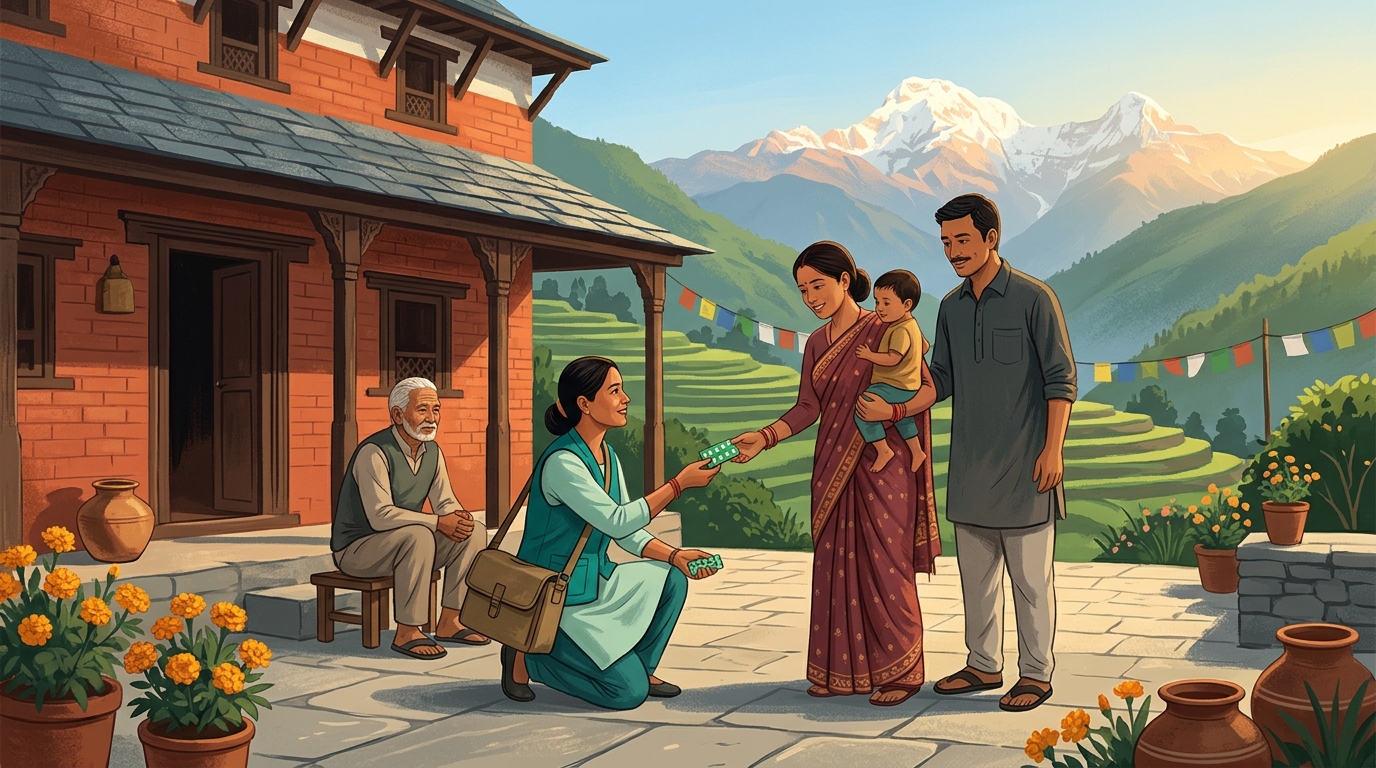
The intervention itself was modest in scale but carefully documented. Between August 2022 and March 2023, the Birat Nepal Medical Trust piloted contact investigation among adult household members of people diagnosed with tuberculosis in Chitwan, a more economically developed district spanning urban plains and rural hills, and Pyuthan, a predominantly rural district in the mid-hills region. Community health workers identified people diagnosed with tuberculosis within the previous 12 months, screened their consenting household members for tuberculosis symptoms using a standardized questionnaire, and referred symptomatic individuals for GeneXpert testing. Those without symptoms received a Mantoux tuberculin skin test, and individuals testing positive underwent chest X-rays to rule out active disease before being enrolled in preventive treatment with three months of weekly isoniazid and rifapentine, known as 3HP.
In total, the pilot screened 1,711 adult household contacts for both active tuberculosis and latent tuberculosis infection. Of 538 individuals who tested positive for latent infection after active disease was ruled out, 500 initiated 3HP and 475 completed the regimen. Acceptance reached 98 percent and completion 95 percent, figures the authors attribute in part to the shorter regimen’s reduced pill burden and lower toxicity compared with older six- to nine-month isoniazid-based courses. The cost per contact person treated, including drug and test procurement and implementation, came to 150 US dollars. Contacts with a history of liver disease, HIV infection, high alcohol consumption, or pregnancy were excluded from 3HP and instead received counseling on tuberculosis symptoms and referral information.
The costing analysis, built from Birat Nepal Medical Trust financial records using an ingredient-based approach, revealed that implementation dominated the budget. Total test and drug procurement costs, covering 3HP components procured through the Global Drug Facility, locally sourced pyridoxine, approval and logistics, tuberculin skin tests and pregnancy tests, were 7,522 dollars in Chitwan and 4,116 dollars in Pyuthan. Implementation costs, including field screening, diagnostic testing, enrollment, healthcare worker salaries and patient travel reimbursements, were far larger at 52,897 dollars in Chitwan and 42,942 dollars in Pyuthan, bringing aggregate totals to 60,419 and 47,058 dollars respectively. Implementation costs excluding procurement constituted over 90 percent of the total, with patient travel for screening and directly observed treatment by healthcare workers comprising a substantial share. Per-person costs were about 1.5 times higher in Pyuthan, a more remote and mountainous district, underscoring how geography shapes delivery expenses even within a single country.
To project long-term impact, the team developed separate deterministic compartmental transmission models for each district, tracking individuals through six states: uninfected, early latent infection, late latent infection, asymptomatic active tuberculosis, symptomatic active tuberculosis, and recovered. The models captured progression from recent to established latent infection, self-clearance, reinfection with partial immunity, and treatment pathways, and were calibrated to district-specific targets including 2022 population sizes, birth rates, tuberculosis prevalence, incidence, mortality and annual rates of decline. In the calibrated Chitwan model, median 2022 prevalence was 360 per 100,000 against a data estimate of 392, incidence was 280 per 100,000 against 294, and mortality was 35 per 100,000 against 34. Pyuthan’s calibrated figures were similarly close to data estimates of 400, 330 and 34 per 100,000. Latent infection prevalence in 2022 was estimated at 34 percent in Chitwan and 35 percent in Pyuthan, and incidence was declining at about 2.3 percent annually before the intervention.
Projecting forward from 2023 to 2042, the models estimated that the pilot-scale intervention would avert 85 cases and 14 deaths in Chitwan and 56 cases and 9 deaths in Pyuthan, totaling 141 cases and 24 deaths across the two districts. Relative to the number screened, that translates to 8.5 cases and 1.4 deaths averted per 100 contacts in Chitwan and 7.9 cases and 1.3 deaths per 100 in Pyuthan. Most of the benefit arrived early: 76 percent of averted cases and nearly 80 percent of prevented deaths occurred within ten years. Notably, only 45 percent of averted cases and 30 percent of prevented deaths were attributable to latent infection treatment alone, with the remainder reflecting the active case-finding component of the screening algorithm, which identified and treated individuals with existing tuberculosis disease.
Combining discounted net costs with discounted health benefits measured in disability-adjusted life-years, the incremental cost-effectiveness ratio was 141 dollars per DALY averted overall, 119 dollars in Chitwan and 163 dollars in Pyuthan. Against Nepal’s country-specific cost-effectiveness threshold of 38 to 612 dollars per DALY averted, the intervention comfortably qualified as cost-effective in both settings. The upper Pyuthan figure equals roughly one-ninth of Nepal’s per capita gross domestic product of 1,386 dollars in 2022. Multivariate sensitivity analysis, which varied individual parameters across their calibrated distributions, found the most influential drivers were the proportion of household contacts with active tuberculosis and the overall unit cost per case; median cost-effectiveness ratios shifted by no more than 64 percent and remained within the national threshold across all parameter combinations.
Probabilistic sensitivity analysis added nuance about certainty. At a willingness-to-pay threshold of 100 dollars per DALY averted, 39 percent of simulations in Chitwan and 17 percent in Pyuthan were cost-effective, rising to 90 percent at thresholds of 212 dollars in Chitwan and 289 dollars in Pyuthan. The authors also modeled a hypothetical five-year scale-up screening all household contacts of expected index patients, projecting 974 cases and 153 deaths averted in Chitwan and 186 cases and 28 deaths in Pyuthan, or 5.77 and 5.23 cases averted per 100 contacts screened respectively. Even so, the scaled intervention was projected to reduce tuberculosis incidence by only about 5.3 percent in Chitwan and 2.9 percent in Pyuthan, a ceiling the authors link to the limited reach of household-based screening: nearly 54 percent of incident tuberculosis cases in Nepal go unnotified, and household transmission accounts for only 10 to 20 percent of overall transmission.
The study has clear limitations that shape how the findings should be read. The transmission models omit age structure, assume equal infectiousness for asymptomatic and symptomatic disease, and treat districts as closed populations, though migration could dilute observed impact. The assumption that contacted individuals with latent infection were predominantly recent infections, at 50 to 80 percent, is consistent with prior studies but could overestimate impact if the true elapsed time since infection were longer. Projections also assume tuberculosis incidence continues declining at 3 percent annually without intervention, an estimate subject to uncertainty from programmatic fluctuations and health system shocks. Perhaps most importantly, the pilot’s high acceptance and completion rates, and rare adverse events none of which required hospitalization, may reflect stringent exclusion criteria and intensive support; other studies report acceptance ranging from 73 to 95 percent, completion from 90 to 97 percent, and drug-related adverse events in 7.8 percent of cases, some requiring hospitalization. The health-system perspective also excludes potential benefits from averting post-tuberculosis sequelae and broader societal costs.
Even with those caveats, the authors argue the evidence supports prioritizing household contact investigation with short-course preventive treatment in Nepal and similar high-burden settings, where current practice restricts preventive treatment to people living with HIV and children under five, and global coverage stands at only 21 percent against a 90 percent target for 2027. Cost-effectiveness could improve further with recently negotiated price reductions: a full adult treatment course of 3HP using fixed-dose combination tablets now costs 10.96 dollars through the Global Drug Facility. The team also suggests that directly observed treatment, used in the pilot because Nepal lacked experience with 3HP, could be replaced with adherence monitoring, unsupervised self-administration or family-based supervision, strategies shown safe elsewhere that would likely lower costs. Birat Nepal Medical Trust is now evaluating monthly clinician-based 3HP monitoring within the CRITIC project. For a country that has pledged to be tuberculosis-free by 2050, the analysis indicates that household-focused screening and treatment is a feasible, affordable and highly cost-effective component, even if broader community-wide case-finding and preventive treatment will be needed to bend the epidemic’s trajectory substantially.
Subject of Research: Model-based evaluation of the impact, costs and cost-effectiveness of household tuberculosis contact investigation with 3HP preventive treatment in Nepal
Article Title: The epidemiological impact, costs, and cost-effectiveness of implementing household contact investigation with tuberculosis preventive treatment in Nepal: a model-based analysis
Article References: Paudel, R., Thapa, A., Shrestha, S., Dorjee, K., Dhital, R., Dowdy, D. W., Caws, M., & Shrestha, S. (2026). The epidemiological impact, costs, and cost-effectiveness of implementing household contact investigation with tuberculosis preventive treatment in Nepal: a model-based analysis. BMC Global and Public Health, 4(1), Article 88. https://doi.org/10.1186/s44263-026-00324-4
Image Credits: AI Generated
DOI: 10.1186/s44263-026-00324-4
Keywords: tuberculosis, latent tuberculosis infection, 3HP preventive treatment, household contact investigation, cost-effectiveness, Nepal, transmission model, DALYs averted, Birat Nepal Medical Trust, Global Drug Facility, active case finding, public health
News Source: Phoebe Ingram. (November 3, 2026). Household TB screening with short preventive treatment is cost-effective in Nepal model study. Scienmag.