


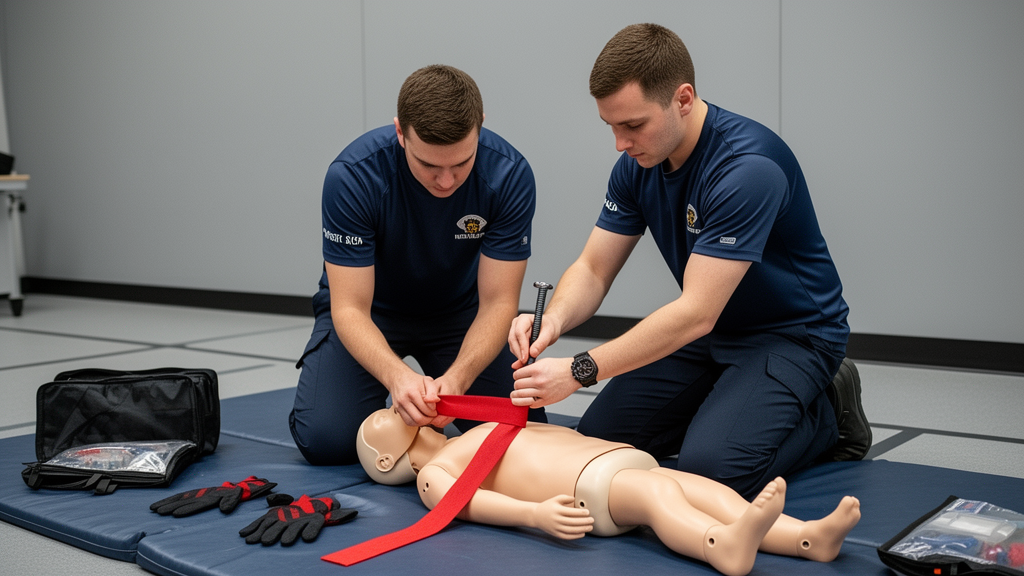
Rapid control of life-threatening extremity hemorrhage is central to tactical and civilian prehospital care, and a two-year registry study published in BMC Emergency Medicine compares the two operational training pathways used to teach windlass tourniquet application. The retrospective training-registry analysis covered 200 unique operators assessed between 15 January 2024 and 19 December 2025, split into 98 one-handed self-aid/restricted-hand records and 102 two-handed buddy-aid/responder-assisted records. Its central finding is a consistent pattern: the two-handed pathway was associated with faster application times and higher recorded simulated hemorrhage-control success, along with clearly identifiable differences in technical errors.
The study’s authors note that training research in this field has often emphasized speed without separating technical errors and measurement quality. Their objective was therefore twofold: to compare primary timing and recorded simulated hemorrhage-control success between the two operational training pathways, and to characterize actionable technical-error patterns that instructors could target. Because the design was a retrospective registry study, the researchers analyzed records already generated during routine competency assessment rather than assigning operators to pathways prospectively. That distinction matters for how the results should be read, and the authors are explicit that the findings support pathway-specific training and competency assessment rather than a causal conclusion that two-handed application is mechanically or clinically superior.
The headline timing result is straightforward. Median total application time was 51.0 seconds for the one-handed pathway and 42.5 seconds for the two-handed pathway, a median difference of 8.5 seconds in favor of the two-handed group. The 95% bootstrap confidence interval for that difference ranged from 13.0 to 5.5 seconds, and the p-value was below 0.001. When the researchers adjusted for other factors using median quantile regression, the adjusted median difference was 9.0 seconds, with a 95% confidence interval of 11.6 to 6.3 seconds and a p-value below 0.001. In practical terms, operators in the two-handed buddy-aid or responder-assisted mode completed the task roughly nine seconds faster at the median.
Success rates told a similar story. Recorded simulated hemorrhage-control success was 82 out of 98 records, or 83.7%, in the one-handed pathway, compared with 96 out of 102 records, or 94.1%, in the two-handed pathway. That corresponds to a risk difference of 10.4 percentage points, with a 95% confidence interval of 1.7 to 19.6 percentage points and a p-value of 0.018. Because success was a binary outcome and some categories contained few failures, the researchers used Firth penalized logistic regression, a statistical method designed to reduce small-sample bias in odds ratio estimates. That model estimated higher odds of recorded success with the two-handed pathway, with an adjusted odds ratio of 4.75 and a 95% profile-likelihood confidence interval of 1.59 to 16.64, and a p-value of 0.004.
To test whether the association was robust, the researchers ran a second model with additional adjustment for sex, glove use, and limb location. The estimate remained similar, with an odds ratio of 5.03 and a 95% profile-likelihood confidence interval of 1.65 to 18.37, again with a p-value of 0.004. They also conducted an objective-only sensitivity analysis that excluded legacy checkbox-only records, a step aimed at addressing measurement quality concerns. In the 184 records that contained objective fields, success was 75 out of 90, or 83.3%, in the one-handed pathway versus 90 out of 94, or 95.7%, in the two-handed pathway, a risk difference of 12.4 percentage points with a 95% confidence interval of 3.6 to 21.8. The consistency of the direction and magnitude of the association across unadjusted, adjusted, and sensitivity analyses strengthens the observational finding, even though it cannot establish causation.
Beyond timing and success, the study characterized technical-error patterns, and two specific errors showed the clearest between-pathway differences: incomplete rod securing and second-tourniquet use. These are actionable findings for instructors. The fact that these two error types separated the pathways most clearly suggests that the demands of one-handed or restricted-hand application create specific, teachable failure modes that differ from those seen when both hands and an assistant are available.
One important caveat shapes the interpretation. The authors note that pathway classification incorporated assistance context and other operational circumstances in addition to the number of hands used. In other words, the one-handed and two-handed groups were not defined purely by hand count; the classification also reflected whether an operator was working alone, had a restricted hand, or was assisted by a buddy or responder. This entanglement means the observed differences could reflect the operational context as much as the mechanics of hand use. The authors therefore conclude that the findings support pathway-specific training and competency assessment rather than a causal claim that two-handed application is mechanically or clinically superior.
The study’s scope also frames its relevance. It is a registry study of 200 unique operators over roughly two years, conducted in a training environment with simulated hemorrhage rather than live casualties. Simulated success is a proxy for real-world performance, and registry data cannot capture every variable that influences outcomes in actual emergencies. Still, the combination of a large sample for a skills study, objective timing, penalized regression for sparse binary outcomes, and a sensitivity analysis excluding legacy records makes this a methodologically careful comparison in the tourniquet training literature. For emergency care educators, the message is concrete: the two-handed buddy-aid/responder-assisted pathway was associated with faster application and higher recorded simulated success, and the one-handed self-aid/restricted-hand pathway carries distinct technical-error risks that deserve targeted remediation in curriculum design and competency testing.
Subject of Research: A retrospective training-registry study comparing application time, simulated hemorrhage-control success and technical errors between one-handed and two-handed windlass tourniquet training pathways.
Article Title: Timeliness, simulated hemorrhage-control success, and technical errors across one-handed self-aid/restricted-hand and two-handed buddy-aid/responder-assisted windlass tourniquet training pathways: a two-year registry study
Article References: Xu, N., Wang, X., Ai, L., Feng, J., Ke, X., Zhang, C., Li, F., & Du, L. (2026). Timeliness, simulated hemorrhage-control success, and technical errors across one-handed self-aid/restricted-hand and two-handed buddy-aid/responder-assisted windlass tourniquet training pathways: a two-year registry study. BMC Emergency Medicine. https://doi.org/10.1186/s12873-026-01799-y
Image Credits: AI Generated
DOI: 10.1186/s12873-026-01799-y
Keywords: tourniquet, hemorrhage control, prehospital care, buddy-aid, self-aid, training registry, technical errors, windlass tourniquet, emergency medicine, bleeding control, Timeliness, simulated
News Source: Ophelia Keating. (October 30, 2026). Two-Handed Buddy-Aid Tourniquet Training Linked to Faster Application and Higher Simulated Bleeding-Control Success. Scienmag.



