


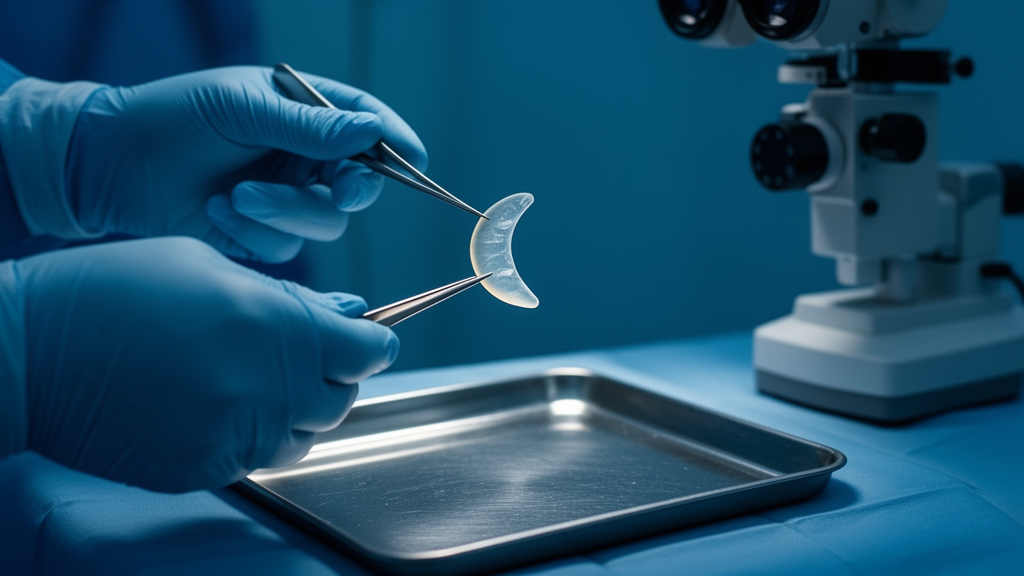
In a prospective contralateral-eye study published in BMC Ophthalmology, researchers report that eyes retaining tiny fragments of the removed corneal tissue, known as subtle residual lenticules, developed significantly larger postoperative changes in corneal higher-order aberrations than their unaffected fellow eyes.
The study enrolled 33 myopic patients who had undergone SMILE and who, three months after surgery, showed a subtle residual lenticule in only one eye. The team defined a subtle residual lenticule as retained fragments spanning fewer than two quadrants of the cornea, a size range small enough to escape routine detection.
Identifying such fragments required a new detection strategy. The researchers combined corneal densitometry, which quantifies how much light the corneal tissue scatters, with anterior elevation maps of the corneal surface. Any eye flagged by this densitometry-guided protocol was then confirmed with anterior segment optical coherence tomography, an imaging technique that resolves the cornea in fine cross-sectional detail.
To quantify the optical consequences, the team compared the change in corneal higher-order aberrations between surgery and the three-month visit across two analysis zones, 6.0 mm and 8.0 mm in diameter, in the affected eyes and the control eyes.
The results were consistent across both zones. Compared with control eyes, eyes with a subtle residual lenticule showed significantly greater changes in total higher-order aberration root mean square values at both the 6.0 mm and 8.0 mm zones, with P values of 0.006 and less than 0.001 respectively. The change in spherical aberration was also significantly larger in the affected eyes at both zones, with P values of 0.026 and 0.001. In addition, the affected eyes showed a significant negative shift in horizontal coma in the 8.0 mm zone, with a P value of 0.001, meaning that this coma component moved in the negative direction to a degree unlikely to be explained by chance alone.
Multiple linear regression analysis then asked which factors were associated with these aberration changes. The exploratory analysis linked the presence of a subtle residual lenticule to the negative change in 8.0 mm horizontal coma, with a P value of 0.004. Spherical aberration told a different story. The increase in 8.0 mm spherical aberration was associated with higher preoperative myopia and a smaller postoperative effective optical zone, both with P values below 0.001, but not directly with the retained fragment itself, which showed no significant association with a P value of 0.990.
The authors conclude that the presence of a subtle residual lenticule after SMILE is associated with statistically significant increases in postoperative higher-order aberrations, notably the negative shift in horizontal coma. They also emphasize that complete lenticule removal remains the ideal goal for optimizing postoperative optical quality. Because the study was small, involving 33 patients, and focused on a three-month postoperative window, the findings describe associations within this specific cohort rather than long-term outcomes, and the regression result on horizontal coma is described by the authors as exploratory.
The densitometry-guided protocol offers a way to flag such cases early, combining a quantitative scattering measurement with elevation mapping before confirming with optical coherence tomography.
Subject of Research: The association between subtle residual lenticules and corneal higher-order aberrations after small incision lenticule extraction
Article Title: Densitometry-detected subtle residual lenticule and post-SMILE corneal higher-order aberrations: a contralateral-eye study
Article References: Gui, F., He, M., Huang, F., Miao, H., Zhou, M., Ai, C., Lu, Y., Wang, W., & Xiong, J. (2026). Densitometry-detected subtle residual lenticule and post-SMILE corneal higher-order aberrations: a contralateral-eye study. BMC Ophthalmology. https://doi.org/10.1186/s12886-026-05458-5
Image Credits: AI Generated
DOI: 10.1186/s12886-026-05458-5
Keywords: SMILE, subtle residual lenticule, corneal higher-order aberrations, corneal densitometry, horizontal coma, spherical aberration, refractive surgery, myopia, optical coherence tomography, effective optical zone, contralateral-eye study, BMC Ophthalmology
News Source: Ophelia Keating. (October 30, 2026). Residual Lenticule Fragments After SMILE Surgery Linked to Sharply Higher Corneal Aberrations. Scienmag.



