


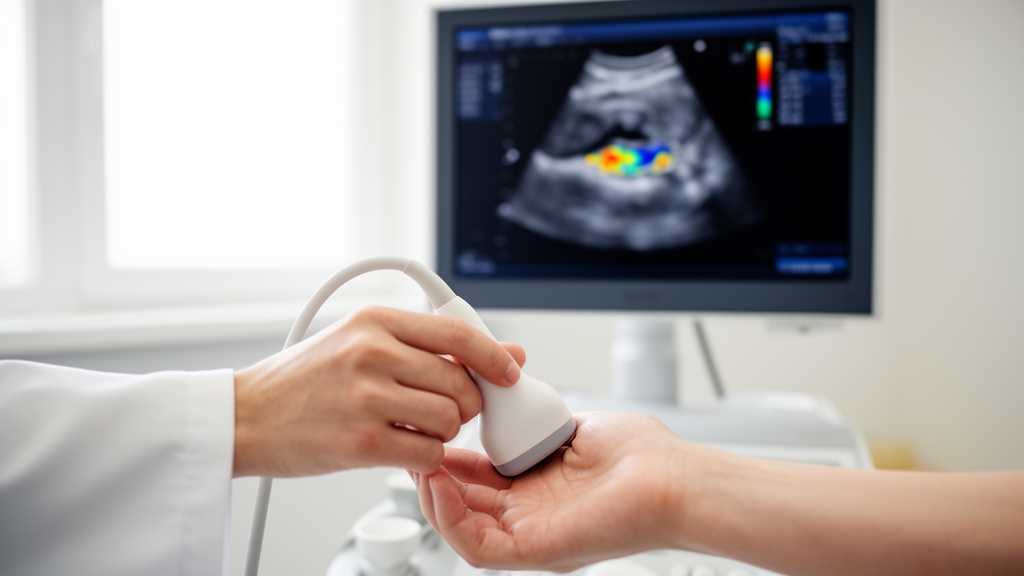
People who seek medical care for aching hands and feet but show no visible joint swelling on physical examination pose a persistent diagnostic dilemma. Clinicians cannot tell from symptoms alone which of these patients, labelled as having clinically suspect arthralgia, will go on to develop inflammatory arthritis such as rheumatoid arthritis. A prospective longitudinal study now reports that a baseline power Doppler ultrasound score, together with a patient’s own sensation of swelling and antibody status, independently predicts that progression over two years.
The study followed 69 patients who fulfilled the EULAR criteria for clinically suspect arthralgia, a definition that requires joint pain without clinical synovitis on examination. The investigators excluded anyone with clinical synovitis, previous treatment with disease-modifying antirheumatic drugs or corticosteroids, or a diagnosis of fibromyalgia or osteoarthritis. Nine in ten participants were women. At entry, 17 percent tested positive for rheumatoid factor and 13 percent for anti-citrullinated peptide antibody, the serological markers most closely associated with rheumatoid arthritis.
Each patient underwent an extensive blinded ultrasound examination at baseline covering 36 joints and 14 tendon compartments. From these images the team calculated several ultrasound scores, capturing both greyscale abnormalities and power Doppler signals, the latter reflecting active inflammation of the joint lining.
Over two years of follow-up, the researchers evaluated clinical and sociodemographic characteristics and tracked progression to inflammatory arthritis. Twenty-nine patients, or 42 percent, developed inflammatory arthritis, and 17 percent developed rheumatoid arthritis specifically.
To separate genuine predictors from coincidental associations, the team used multivariate logistic regression with backward stepwise selection based on the likelihood ratio, entering both clinical and ultrasound parameters. Three factors emerged as independent predictors of progression to inflammatory arthritis. A subjective sensation of swelling carried an odds ratio of 6.292 (95 percent confidence interval 1.391 to 28.460, p = 0.017). ACPA positivity carried an odds ratio of 24.527 (95 percent confidence interval 2.051 to 293.343, p = 0.011). The global power Doppler score carried an odds ratio of 1.272 per unit (95 percent confidence interval 1.065 to 1.519, p = 0.008).
The model itself performed well on the internal checks reported. The Hosmer-Lemeshow statistic gave p = 0.249, indicating no significant lack of fit, the Nagelkerke R² reached 0.473, and overall classification accuracy was 76.6 percent. These figures describe how well the model fit this particular cohort; they do not establish that the same equations would perform identically in other populations, which is why the authors call for validation in larger, multicentre cohorts.
Seronegativity is a common reason for clinicians to downplay arthritis risk, so the researchers ran a subgroup analysis restricted to the 60 patients who were ACPA-negative. Within this group, the subjective sensation of swelling and the global power Doppler score remained independent predictors of progression to inflammatory arthritis.
The ultrasound findings themselves also differed clearly between progressors and non-progressors. Patients who developed inflammatory arthritis had significantly higher scores in both greyscale and power Doppler imaging, with the largest differences seen in the wrists, the proximal interphalangeal joints of the fingers, and the metatarsophalangeal joints of the toes.
One of the most striking observations concerned erosions, the small bony defects that ultrasound can detect at baseline. Every patient who had erosions on the initial scan progressed to rheumatoid arthritis during follow-up.
The authors conclude that in patients with clinically suspect arthralgia, the independent predictors of progression to inflammatory arthritis are subjective sensation of swelling, ACPA positivity, and the global power Doppler ultrasound score. They argue that these findings support combining clinical assessment, serological testing, and baseline Doppler ultrasound evaluation when stratifying risk in this population, irrespective of seropositivity. Because the study was a single-cohort prospective design with 69 participants and awaits multicentre validation, the results should be read as a step toward better risk stratification rather than a settled clinical rule.
Subject of Research: Predictive value of baseline ultrasound and clinical markers for progression from clinically suspect arthralgia to inflammatory arthritis
Article Title: Predictive utility of ultrasound in a cohort of patients with clinically suspect arthralgia
Article References: Peiteado-López, D., Monjo-Henry, I., Nuño-Nuño, L., Villalba-Yllán, A., Novella-Navarro, M., Miranda-Carús, M. E., Plasencia-Rodríguez, C., Tornero-Marín, C., Bohórquez-Heras, C., Losantos-Garcia, I., & Mendieta, E. D. M. (2026). Predictive utility of ultrasound in a cohort of patients with clinically suspect arthralgia. BMC Rheumatology. https://doi.org/10.1186/s41927-026-00687-z
Image Credits: AI Generated
DOI: 10.1186/s41927-026-00687-z
Keywords: clinically suspect arthralgia, power Doppler ultrasound, rheumatoid arthritis, ACPA, inflammatory arthritis, risk stratification, joint pain, erosions, greyscale ultrasound, EULAR criteria, Predictive, utility
News Source: Ophelia Keating. (October 30, 2026). Ultrasound Doppler score predicts arthritis in joint pain without clinical swelling. Scienmag.



