


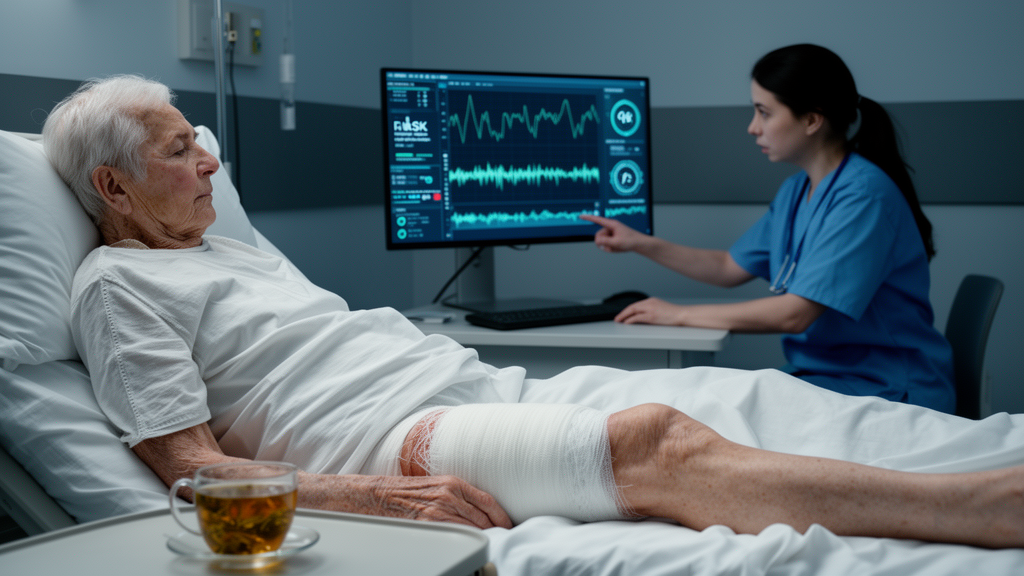
Postoperative lower-extremity deep vein thrombosis (DVT) remains a clinically important complication after hip arthroplasty performed for femoral neck fracture, and a new retrospective, single-center study from China reports the development and internal validation of machine-learning models built to predict it. The work, published in Frontiers in Artificial Intelligence, used a fixed panel of eight preoperative variables that included two Traditional Chinese Medicine (TCM) syndrome features alongside conventional measures such as D-dimer, fibrinogen, platelet count, type 2 diabetes, fasting blood glucose, and the triglyceride-glucose (TyG) index. It also examined whether the TyG index is associated with postoperative DVT after multivariable adjustment.
The study included 380 patients, of whom 105, or 27.6 percent, developed postoperative lower-extremity DVT. Rather than splitting the data at random, the researchers used group-constrained partitioning and resampling so that identical prespecified multivariable profiles could not cross evaluation boundaries. This produced a development set of 267 patients containing 74 DVT events and a profile-disjoint held-out validation set of 113 patients containing 31 events.
Nine machine-learning algorithms were evaluated on the fixed eight-variable panel, which combined D-dimer, fibrinogen, platelet count, type 2 diabetes, fasting blood glucose, TyG, Qi stagnation with blood stasis (QSBS), and Qi deficiency with blood stasis (QDBS). Random forest was selected on the basis of development-set out-of-fold performance before held-out validation took place. In the pooled group-aware development out-of-fold evaluation, the random-forest model achieved an area under the curve (AUC) of 0.774, with a 95 percent confidence interval of 0.710 to 0.837. When applied to the single profile-disjoint held-out validation partition, the AUC was 0.859 (95 percent CI 0.782 to 0.935).
That held-out figure, however, comes with an important caveat the authors themselves emphasize. Across 30 repeated group-constrained partitions, the mean validation AUC was a more modest 0.792, suggesting the strong single-partition result should be interpreted with caution. The study is explicitly framed as an internal validation exercise, and the conclusion states that external validation and assessment of recalibration are required before any clinical implementation.
Discrimination is only part of the story, and the researchers also reported how well predicted probabilities matched observed outcomes in the held-out partition. Using a development-derived threshold of 0.298, the model achieved a sensitivity of 0.903, a specificity of 0.720, a positive predictive value of 0.549, and a negative predictive value of 0.952. In that same partition, the calibration slope was 1.136 (95 percent CI 0.753 to 1.867), the observed-to-expected ratio was 0.846, and the Brier score was 0.132.
A central question was whether the TCM syndrome features add predictive information beyond conventional preoperative variables. On the evidence presented, they did not. Adding QSBS and QDBS did not materially improve discrimination: the AUC was 0.855 without the two syndrome variables versus 0.859 with them, a difference of just 0.003 that was not statistically significant (DeLong p = 0.746). The two TCM variables were retained in the fixed panel, but their contribution to predictive performance was negligible in this cohort.
The TyG index told a different story. Higher TyG remained associated with postoperative DVT after multivariable adjustment, with an odds ratio of 1.550 per 1 standard deviation increase (95 percent CI 1.186 to 2.026; p = 0.001). Restricted cubic splines supported an overall association between TyG and DVT (p = 0.007), and the spline analysis found no significant evidence of nonlinearity (p = 0.082), meaning the data did not indicate that the relationship departed meaningfully from a straight-line pattern across the observed range.
The analysis also employed SHAP, a technique for attributing model predictions to individual input variables, as reflected in the article’s keywords, though the abstract reports the key quantitative findings through the AUC comparisons and the adjusted TyG association rather than through detailed SHAP rankings. What the abstract makes clear is the overall architecture: a fixed prespecified variable panel, nine candidate algorithms, selection of random forest on development data only, and evaluation that separates the development out-of-fold estimate from the held-out result and from the repeated-partition average.
The study’s limitations are stated in its own conclusions. This was a retrospective, single-center analysis of 380 patients, the validation was internal rather than external, and the authors explicitly call for external validation and recalibration assessment before the model could be implemented clinically. The calibration confidence interval in the held-out partition was wide, and the gap between the single-partition AUC of 0.859 and the repeated-partition mean of 0.792 underscores that performance estimates from a single split can be optimistic. Until those further steps are completed, the model should be regarded as a promising internally validated tool rather than a ready-to-deploy clinical instrument.
Subject of Research: Machine-learning prediction of postoperative deep vein thrombosis after hip arthroplasty for femoral neck fracture, including Traditional Chinese Medicine syndrome features and the TyG index.
Article Title: Development and internal validation of machine-learning models for postoperative deep vein thrombosis after hip arthroplasty for femoral neck fracture: evaluation of Traditional Chinese Medicine syndrome features
Article References: Liu, Y., Pi, Z., Shen, Y., Cao, P., Qian, Y., Jiang, D., Li, J., & Yuan, P. (2026). Development and internal validation of machine-learning models for postoperative deep vein thrombosis after hip arthroplasty for femoral neck fracture: evaluation of Traditional Chinese Medicine syndrome features. Frontiers in Artificial Intelligence, 9, Article 1798230. https://doi.org/10.3389/frai.2026.1798230
Image Credits: AI Generated
DOI: 10.3389/frai.2026.1798230
Keywords: deep vein thrombosis, hip arthroplasty, femoral neck fracture, machine learning, random forest, Traditional Chinese Medicine, TyG index, D-dimer, model validation, retrospective study, Qi stagnation with blood stasis, calibration
News Source: Blake Davidson. (October 30, 2026). Machine Learning Flags Postoperative Clot Risk After Hip Fracture Surgery, but TCM Patterns Add Little. Scienmag.



