


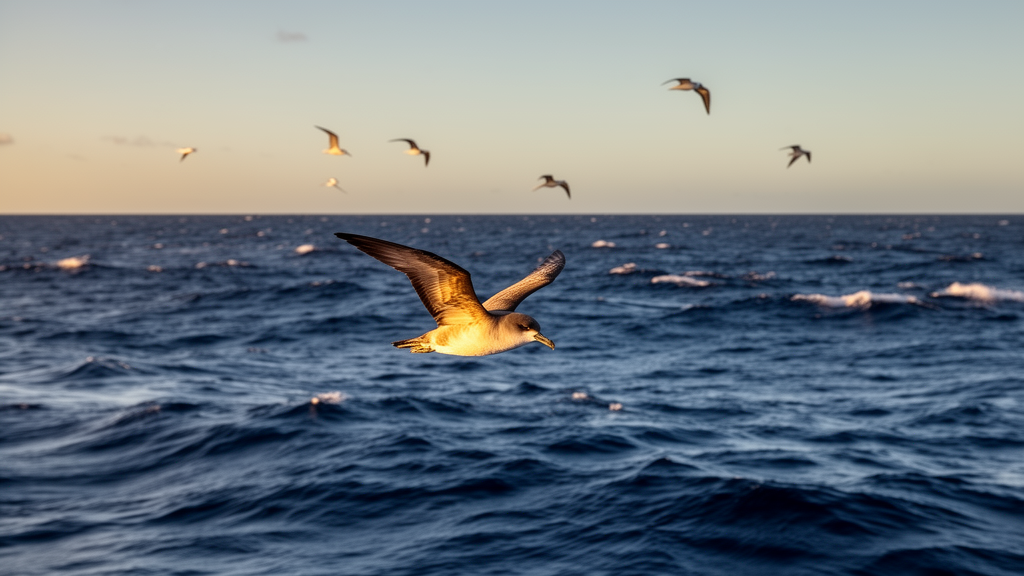
Fledgling Sable Shearwaters leave Lord Howe Island and fly roughly 1,000 kilometres north within their first two weeks of life at sea, reaching the Solomon Sea by week three, according to new tracking research published in Animal Biotelemetry.
Researchers led by Jennifer L. Lavers of Lord Howe Island and Alexander L. Bond attached solar-powered GPS loggers to the central tail feathers of 15 fledglings in 2022 and another 15 in 2024, capturing the birds by hand on the colony surface immediately before they fledged. The devices recorded locations accurate to five metres at one-hour intervals, producing a detailed picture of where the young birds travelled once they departed.
The tracks showed a strikingly consistent pattern across both years. Juveniles departed Lord Howe Island rapidly and moved northward, with some individuals covering more than 2,500 kilometres within the first fortnight. By the third week, the birds had arrived in the Solomon Sea, where they shifted behaviour and moved relatively short distances from east to west during the following weeks.
This consistency matters because juvenile survival is a critical yet poorly resolved demographic parameter in long-lived seabirds. Fledglings must independently and rapidly acquire foraging and navigational competency to migrate vast distances, and their spatial ecology can differ markedly from that of adults in dispersal extent, habitat use and migratory routing. That knowledge gap has limited evidence-based marine spatial planning for vulnerable seabird populations.
The authors argue that identifying the Solomon Sea as a stopover site gives conservation planners a clear spatial focus.
The study’s sample size of 30 tracked individuals across two breeding seasons is modest, and the authors note that juvenile spatial ecology in long-lived seabirds remains poorly resolved more broadly. The tracked birds were captured from a single colony, so the tracks describe migration from Lord Howe Island specifically rather than from the species’ full breeding range. The article was published as open access on 13 August 2026 under the journal’s early-release policy, meaning the version is citable and carries a permanent DOI but remains subject to further edits before the final Version of Record.
Even with those limitations, the consistency of the northward routing across two separate years strengthens the case that the Solomon Sea functions as a genuine stopover rather than an incidental waypoint.
Subject of Research: Post-fledging migration routes of Sable Shearwater fledglings tracked by GPS from Lord Howe Island
Article Title: Post-fledging migration of Sable Shearwaters (Ardenna carneipes) identifies the Solomon Sea as a potential conservation priority
Article References: Lavers, J. L., Gilmour, M. E., de Jersey, A. M., Rivers-Auty, J., & Bond, A. L. (2026). Post-fledging migration of Sable Shearwaters (Ardenna carneipes) identifies the Solomon Sea as a potential conservation priority. Animal Biotelemetry. https://doi.org/10.1186/s40317-026-00487-9
Image Credits: AI Generated
DOI: 10.1186/s40317-026-00487-9
Keywords: Sable Shearwater, Ardenna carneipes, Lord Howe Island, Solomon Sea, post-fledging migration, GPS tracking, seabird conservation, juvenile survival, marine spatial planning, stopover site, Animal Biotelemetry, fledgling ecology
News Source: Drew Townsend. (October 30, 2026). Fledgling shearwaters reveal Solomon Sea as vital stopover on first migration. Scienmag.



