


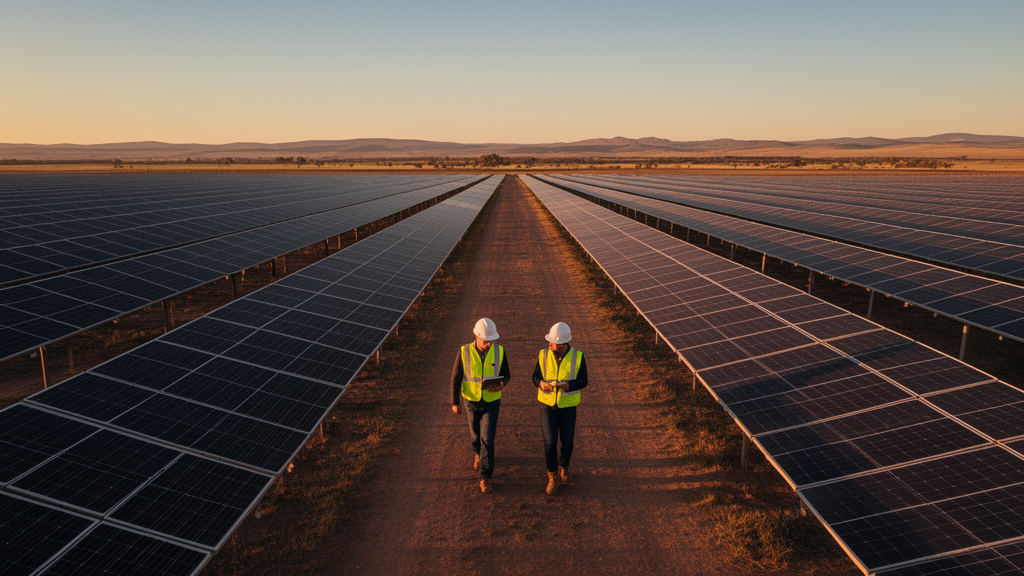
Utility-scale solar farms are multiplying across the world’s grids faster than anyone can consistently judge whether they are actually delivering on their promises. A study published in Discover Energy on 17 September 2026 argues that the missing piece is not more technology but a common yardstick, and it proposes one: a standardised auditing protocol that folds economic, environmental and social performance into a single, reproducible benchmarking module for grid-connected photovoltaic plants.
The research, led by Kaovinath Appalasamy, R. Mamat and Sudhakar Kumarasamy, responds to what the authors describe as a fragmented assessment landscape. Existing studies, they note, tend to isolate technical efficiency or financial returns, leaving stakeholders without clear thresholds for sustainability. Even widely used metrics such as the levelized cost of energy are calculated inconsistently across projects, undermining cross-project comparison. The new framework is designed to let auditors evaluate any solar farm without bespoke consulting models or proprietary software, using standardised formulas and transparent benchmark values.
At the core of the proposal is a three-stream workflow. Auditors begin with plant-level data collection, gathering financial records, energy generation figures, land use information, water consumption, biodiversity measures, labour records and community-related information. These inputs are then processed through parallel economic, environmental and social assessments. The economic stream evaluates levelized cost of electricity, levelized cost of storage, net present value, internal rate of return, payback period and benefit-cost ratio. The environmental stream examines carbon dioxide reduction, water footprint, land footprint and native tree replantation. The social stream covers fair labour standards, occupational health and safety, community engagement, complaint management, human rights, land use conflict and labour sufficiency.
Results are then compared against benchmark values synthesised from a three-tier evidence hierarchy: Malaysian regulatory limits and national policy guidelines first, peer-reviewed empirical studies from Malaysia or climatically comparable Southeast Asian contexts published within the last ten years second, and industry datasets or international peer-reviewed studies where regional data were unavailable. Studies were included only if they reported a quantified value for at least one target indicator from an operating or simulated utility-scale installation of at least one megawatt. Where multiple sources reported values for the same indicator, the benchmark is presented as a range reflecting the observed spread, so the range itself communicates uncertainty rather than implying false precision.
The economic benchmarks point to strong financial viability under current Malaysian market conditions. The framework places the levelized cost of energy between RM 0.24 and RM 0.48 per kilowatt-hour, with a payback period of four to eight years. A benefit-cost ratio greater than 1.0 indicates financial viability, although the analysis cautions that projects with ratios close to 1.2 remain vulnerable to cost overruns and revenue delays. For plants incorporating storage, the levelized cost of storage ranges between RM 0.65 and RM 0.95 per kilowatt-hour, which the study says can still yield favourable returns when matched with peak tariff demand. The framework also sets a strategic benchmark for total initial investment: solar farms exceeding RM 4 million per megawatt typically overspend on modules or inverters, while those below RM 2.5 million often compromise on quality, leading to premature component degradation.
On the environmental side, the audit quantifies a carbon mitigation potential of 700 to 800 tonnes of carbon dioxide per megawatt per year for a well-performing one-megawatt plant in Malaysia, based on current grid emission factors. The study stresses that these reported mitigation yields are maximised only when maintenance protocols prevent efficiency losses, keeping greenhouse gas reductions consistent with theoretical models. Biodiversity is addressed through a restoration goal of at least 1,000 native trees replanted per megawatt, alongside recommended land footprint limits per megawatt of installed capacity. The authors acknowledge that biodiversity loss from land clearing can be reduced but not fully avoided, with partial ecological recovery observed when operators adopt habitat restoration and native planting.
Water consumption is regulated through a benchmark of 20 litres per megawatt-hour annually, a reference value intended to let operators track usage against a reasonable baseline. Panel cleaning and cooling can strain local resources, particularly in drier regions where water stress is already present, and the study argues that unmonitored cleaning systems can lead to unsustainable resource depletion. Simple measures such as rainwater harvesting are recommended to keep consumption near the benchmark. All environmental benchmarks are drawn from peer-reviewed studies and national guidelines, which the authors say keeps the framework transparent and adaptable across different sites and scales.
The social dimension is anchored by a Labour Sufficiency Index that sets a minimum workforce ratio of 0.7 full-time equivalent staff per megawatt, or roughly 35 employees for a 50-megawatt facility. Unlike construction-phase employment, operational staffing directly influences long-term plant reliability and worker well-being, and the assessment deliberately excludes construction-phase labour. Understaffed sites, the study notes, often rely on excessive overtime, increasing fatigue and safety risks while reducing productivity and job satisfaction. The ratio is intended to ensure adequate coverage for routine tasks including panel cleaning, electrical inspections and inverter maintenance, transforming social sustainability from a qualitative concept into a measurable performance indicator. A companion checklist audits six social parameters: community engagement, land use management, employment conditions, workplace health and safety, grievance systems and human rights standards.
Beyond the benchmarks, the framework prescribes targeted mitigation strategies for each dimension. Routine panel cleaning is prioritised because dust and debris reduce energy output and contribute to heat buildup that accelerates material degradation. Active or passive cooling systems are recommended to mitigate overheating, extending module longevity and reducing lifecycle replacement costs. Bifacial photovoltaic modules at optimal tilt angles are proposed to enhance energy density by capturing additional irradiance, while agrivoltaics integration offers dual-purpose site utility, supporting both energy generation and local vegetation and reducing the facility’s land and water footprint when passive cooling is applied. On the social front, meeting workforce benchmarks requires hiring adequate local staff during the operational phase.
The authors position their framework against existing sustainability assessment approaches, arguing that none is specifically designed for standardised operational assessment of utility-scale solar farms. Life Cycle Sustainability Assessment is comprehensive but its application depends on assessment boundaries and data quality, limiting consistency between studies. ISO 14001 and ISO 26000 provide guidance for environmental management and social responsibility but lack quantitative operational indicators for photovoltaic systems. Multi-criteria decision-making tools such as AHP and TOPSIS produce relative rankings rather than universal performance benchmarks, and the Triple Bottom Line framework relies on case-specific indicators that reduce comparability. ESG reporting frameworks emphasise reporting quality rather than technical performance, with scoring methods differing among them. The proposed framework, by contrast, focuses exclusively on solar farm operation and can be reproduced using a supplementary spreadsheet without external consultants. The authors acknowledge that their benchmarks are derived from secondary data rather than direct field validation, which may limit accuracy under site-specific conditions, and that the framework focuses on the operational phase without fully capturing construction or decommissioning impacts. When audited performance meets or exceeds a benchmark, the system provides positive feedback and assigns a star rating; when it falls below, the framework generates targeted recommendations followed by corrective actions and re-evaluation after one year.
Subject of Research: A standardised auditing framework for evaluating the economic, environmental and social sustainability of utility-scale solar farms
Article Title: A standardised auditing framework of economic, environmental, and social impact of utility-scale solar farms
Article References: Appalasamy, K., Mamat, R., & Kumarasamy, S. (2026). A standardised auditing framework of economic, environmental, and social impact of utility-scale solar farms. Discover Energy, 6(1), Article 65. https://doi.org/10.1007/s43937-026-00189-6
Image Credits: AI Generated
DOI: 10.1007/s43937-026-00189-6
Keywords: solar energy, utility-scale solar, sustainability auditing, levelized cost of energy, carbon mitigation, biodiversity, water footprint, labour standards, photovoltaics, benchmarking, Malaysia, agrivoltaics
News Source: Faith Mcneil. (October 30, 2026). New audit framework benchmarks solar farms on cost, carbon and labour. Scienmag.



