


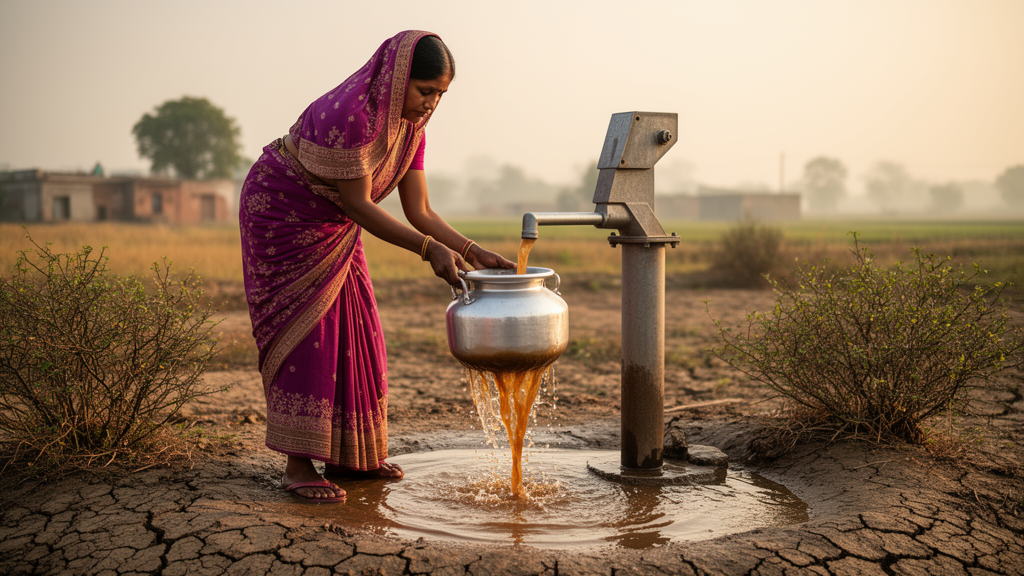
India’s water crisis cannot be solved by counting raindrops alone. A comprehensive review published in Green Technology, Resilience, and Sustainability argues that diminished water quality significantly exacerbates scarcity even in regions possessing an adequate supply of freshwater, and that national and regional evaluations of water scarcity must integrate quality alongside volume. The study, led by Abhijeet Das and Satchidananda Mishra, conducts a qualitative examination of India’s water footprint that considers both the volume and quality of water, examines virtual water flows embedded in goods and services across urban regions and economic domains, and offers policymakers strategic recommendations for water-use frameworks that are robust, equitable, and sustainable amid rising demand and climate variability.
The scale of the challenge is stark. Although water covers about 70 percent of the Earth’s surface, only approximately 3 percent is freshwater and less than 1 percent is easily accessible for human use, with most locked up in polar ice caps and glaciers. More than 1.2 billion people worldwide still lack consistent access to clean water, and projections suggest a 55 percent increase in global water demand by 2050 compared with 2000 levels, driven by shifting consumption patterns, pollution, and increased irrigation requirements. Over-exploitation and pollution of freshwater from fast industrialization, urbanization, and agricultural intensification aggravate scarcity and directly threaten environmental sustainability and public health.
India exemplifies the mismatch. Despite supporting nearly 18 percent of the global population, the country has access to only 4 percent of the world’s freshwater resources. Per capita freshwater availability has dropped from 5,177 cubic meters in 1951 to 1,368 cubic meters in 2019 and is projected to fall further to 1,140 cubic meters by 2050, far below the Falkenmark water stress threshold of 1,700 cubic meters. The NITI Aayog’s Composite Water Management Index revealed that nearly 600 million people face high to extreme water stress, while the India Water Tool 2.0 developed by the World Resources Institute shows that about 54 percent of the country is under high to extremely high baseline water stress, particularly in Rajasthan, Tamil Nadu, Karnataka, and Andhra Pradesh.
Groundwater lies at the heart of the problem. It meets over 70 to 80 percent of agricultural irrigation needs, a dependence reinforced by heavily subsidized or free electricity that encourages the unregulated use of more than 20 million privately owned tube wells. According to the Central Ground Water Board of India, 1,499 groundwater assessment units across six states have been categorized as either over-exploited or critical, indicating abstraction that far exceeds recharge capacity. Water levels are declining alarmingly in the Indo-Gangetic plain, Maharashtra, Gujarat, and peninsular India, leading to salinity intrusion, aquifer depletion, and soil degradation. Fast-growing cities including Delhi, Bengaluru, Chennai, and Hyderabad face repeated droughts, supply disruptions, and dependence on cross-basin water transport that often triggers regional disputes.
The review’s methodological core is the water footprint framework, which divides water use into three components: green water, the rainwater stored in soil and used mainly for agriculture; blue water, surface and groundwater abstracted for irrigation, industry, and household use; and grey water, the freshwater needed to assimilate pollutants and uphold water quality standards. The authors pair these volumetric measures with a Blue Water Scarcity index, the ratio of total blue water footprint to available blue water resources, which categorizes stress as low below 1.0, moderate from 1.0 to 1.5, considerable from 1.5 to 2.0, and severe above 2.0. The framework aligns with the ISO 14046 standard, which formalizes life cycle-based assessment of water scarcity and water quality degradation impacts.
Sectoral analysis reveals where the pressure concentrates. Agriculture dominates India’s water footprint, with over 85 percent originating from farming, particularly paddy and sugarcane cultivation, which carry substantial green and blue water footprints. Rice contributes disproportionately to both blue and green footprints, while cotton and sugarcane significantly drive virtual water flows through export-oriented trade. The Indo-Gangetic plains emerge as a dominant hotspot, with Punjab, Haryana, and Uttar Pradesh showing the highest concentration of water-intensive crops coupled with intensive dairy production. In the south, Tamil Nadu and Karnataka face industrial activity, particularly textiles and leather processing, that adds a significant grey water footprint to already scarce resources. Regional contrasts are dramatic: Madhya Pradesh registers very high blue water footprints of roughly 334 cubic meters per capita per year from intensive wheat irrigation, while Mizoram, dominated by rain-fed rice systems, reports a minimal 6 cubic meters per capita per year.
Industry adds its own heavy toll. Coal-fired power plants alone account for nearly 70 percent of industrial water consumption, largely for cooling. Steel, one of the most water-intensive sectors, consumed approximately 450 million cubic meters of water in 2017, averaging 5 cubic meters per tonne of steel, though more efficient plants achieved around 3.3 cubic meters, still far above the global best-practice benchmark of 1.0 cubic meter per tonne. In textiles, dyeing and finishing processes are responsible for approximately 20 percent of clean water pollution worldwide, and the average blue water footprint of finished textiles in Punjab reaches 4,650 cubic meters per tonne. The dairy sector withdraws around 11,900 cubic kilometers of freshwater annually, equivalent to 10 percent of the world’s water flow, and field-level studies in Punjab found consumptive water use of 940 cubic meters per ton for dairy milk, notably lower than 1,870 cubic meters per ton for rice in the same region.
The double-stress regions, where high demand coincides with compromised quality, pose the greatest challenges. The Yamuna basin downstream of Delhi and industrial belts in Tamil Nadu illustrate areas where water availability may be relatively high, yet poor quality severely restricts safe use. Industrial effluents from textiles, tanneries, and steel production substantially increase grey water footprints, reducing the usability of available water. Textile clusters such as Tirupur, Ludhiana, and Surat are recognized pollution hotspots, while older steel facilities in Jharkhand, Odisha, and Chhattisgarh create localized stress around industrial hubs. The construction sector introduces an emerging dimension, with cement manufacturing and expressway projects carrying significant embedded water footprints often overlooked in policy frameworks.
On the technology front, the review charts a path toward smart, circular water systems. Modern wastewater treatment plants are evolving from linear, end-of-pipe solutions into circular bio-refineries capable of recovering energy, nutrients such as nitrogen and phosphorus, and materials including cellulose, bioplastics, and alginate-like exopolymers from sewage sludge. Internet of Things sensor networks monitoring temperature, pH, turbidity, flow rate, and chemical oxygen demand enable continuous diagnostics and early anomaly detection, and when combined with AI-powered analytics, treatment plants can decrease chemical and energy consumption by as much as 30 to 50 percent by adjusting chemical dosing, aeration schedules, and sludge management in real time. Digital twin models support predictive maintenance that can extend the lifespan of mechanical components in aged infrastructure by up to 40 percent, while blockchain applications are emerging for data integrity and smart contracts governing water reuse agreements.
The policy prescriptions are equally concrete. The authors call for reforming water and power subsidies that inadvertently encourage groundwater overuse, noting that volumetric pricing for electricity used by agricultural pumps, prepaid schemes, and smart metering can more effectively monitor and control consumption. They advocate cropping pattern shifts toward less water-intensive, climate-resilient crops such as oilseeds, pulses, and millets, aligned with Minimum Support Price incentives, alongside micro-irrigation methods that improve water use efficiency by 30 to 70 percent. Managed aquifer recharge through recharge wells, percolation tanks, check dams, and infiltration basins, widely used in Rajasthan, Karnataka, and Maharashtra, has been shown in studies using MODFLOW and GIS-based optimization to significantly raise groundwater levels within 3 to 5 years of implementation. Community-based groundwater budgeting initiatives in Gujarat, Maharashtra, and Telangana have shown promising results, and the authors argue that integrating water quality into scarcity evaluations, embedding water footprint metrics into corporate reporting and environmental assessments, and coordinating governance across the Water-Energy-Food-Ecosystem nexus are essential to securing India’s water future.
Subject of Research: A qualitative review of India's water footprint integrating water quality, virtual water flows, and sectoral water use to assess localized scarcity risks and policy pathways.
Article Title: Smart and sustainable water management: policy, technology, and innovation pathways for resource resilience
Article References: Das, A., & Mishra, S. (2025). Smart and sustainable water management: policy, technology, and innovation pathways for resource resilience. Green Technology, Resilience, and Sustainability, 5(1), Article 5. https://doi.org/10.1007/s44173-025-00022-8
Image Credits: AI Generated
DOI: 10.1007/s44173-025-00022-8
Keywords: water scarcity, India, water footprint, groundwater depletion, water quality, virtual water, circular economy, wastewater treatment, ISO 14046, agriculture, managed aquifer recharge, water policy
News Source: Sloane Callahan. (October 30, 2026). Water quality, not just quantity, drives India’s deepening scarcity crisis. Scienmag.



