


By scanning a rapidly tunable ultraviolet laser across three absorption transitions of nitric oxide, the researchers extracted both temperature and pressure from the shape of the fluorescence signal alone, validating the method from 295 to 1350 kelvin and from 2.1 to 47.0 kilopascals.
The work, published in Applied Physics B, reports average errors of 3.0 percent for temperature and 5.5 percent for pressure in the regime where collisional broadening dominates the spectral lineshape.
Spectrally resolved laser-induced fluorescence works by sweeping a narrow-linewidth laser across one or more quantum state transitions of a molecule. At each wavelength, a fraction of the light is absorbed and re-emitted as fluorescence, producing a time-dependent signal whose shape, the excitation lineshape, encodes the local thermodynamic conditions. The Doppler width of the lineshape depends only on temperature, while the collisional width grows with pressure, so the ratio of two fluorescence signals at different transitions yields temperature and the overall width yields pressure. Crucially, because the measurement relies on ratios and widths rather than absolute signal strength, the technique can be calibration-free: knowledge of the collection efficiency or the fluorescence quantum yield is not required.
Nitric oxide is an attractive target because it is a key species in atmospheric chemistry and an important combustion byproduct, making it particularly relevant to the hypersonic community. Earlier demonstrations of the technique, dating back to work by Di Rosa and colleagues with a modified continuous-wave ring dye laser, achieved measurement rates of 3 kilohertz in an underexpanded jet, and later efforts by Wang and co-workers reached 4 hertz in a static cell using a frequency-quadrupled Ti:Sapphire laser. But until now, the method had never been demonstrated at elevated temperatures, and no rigorous theoretical model existed to explain its behavior or predict its limits.
To close that gap, the Stanford team, led by Spencer Barnes, Sean Clees, Joshua Vandervort, Christopher Strand, and Ronald Hanson, built a quantum-state-resolved fluorescence model covering the X, A, and B electronic states of nitric oxide, vibrational levels from 0 to 6, and rotational levels from 0.5 to 80.5, with state energies and transition probabilities drawn from the ExoMol database. The model tracks radiative processes such as spontaneous emission, stimulated emission, and induced absorption alongside collisional processes including rotational energy transfer, vibrational energy transfer, electronic energy transfer, and collisional quenching, solving the resulting system of stiff ordinary differential equations numerically.
The model revealed two critical requirements for the technique to work. First, rapid rotational energy transfer in the excited electronic state must equalize the fluorescence quantum yield across the transitions used for multi-line thermometry; without it, the fluorescence signal would not mirror the absorption profile, breaking the link between lineshape and thermodynamic state. Second, short fluorescence lifetimes are needed so that the signal at any instant comes from a single excitation frequency rather than a smear of recent history. When the researchers ran the model across a range of conditions, they found the maximum scan rate depends strongly on the bath gas: roughly 3500 nanometers per second for nitric oxide diluted in argon at the lowest temperature and highest pressure, but 10000 nanometers per second in nitrogen and 100000 nanometers per second in air, where efficient quenching by oxygen shortens the fluorescence lifetime dramatically.
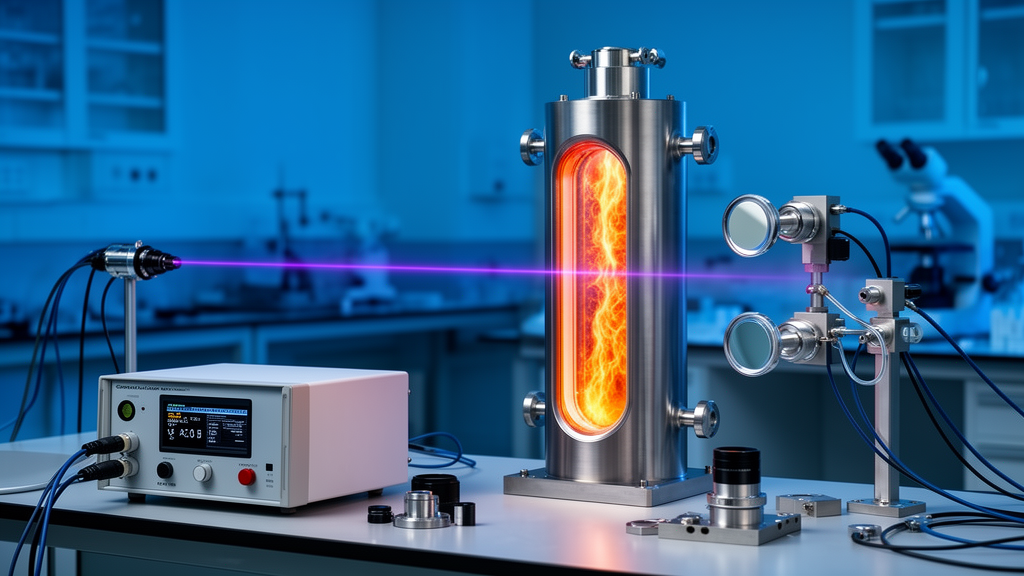
Armed with these insights, the team assembled a diagnostic around a rapidly tunable continuous-wave ultraviolet laser system producing about 40 milliwatts of narrow-linewidth radiation near 225.31 nanometers, scanned across roughly 5 picometers at rates up to 1 kilohertz. They selected three transitions in the gamma (0,0) band of nitric oxide near 225.315 nanometers, chosen for their temperature sensitivity, line strength, and spacing within the laser tuning range. Fluorescence was collected at 90 degrees to the beam with a photomultiplier tube and a steep longpass filter that rejects scattered laser light while capturing emission from the (0,1) and (0,2) vibrational bands, a scheme that collects only 22 percent of the emitted signal but cleanly separates the fluorescence from the excitation wavelength.
Validation proceeded in two stages. First, room-temperature experiments in a static gas cell filled with a 2 percent nitric oxide in nitrogen mixture confirmed the pressure measurement from 2.1 to 20.7 kilopascals, with good agreement above 5 kilopascals and underprediction below, where collisional broadening becomes too small a fraction of the total linewidth. The team found that the ratio of collisional to Doppler width must exceed roughly 0.29 for pressure errors to stay below 10 percent. Second, the diagnostic moved into the Stanford Flexible Applications Shock Tube, where reflected shock waves heated a dilute mixture of nitric oxide in argon to temperatures up to 1350 kelvin. In a representative experiment at 1390 kelvin and 50.4 kilopascals, the measured temperature and pressure tracked the independently determined isentropic temperature and transducer pressure within their uncertainty bounds throughout the test time.
Combining static cell and shock tube results, the researchers mapped out an operating envelope divided into three regions based on the ratio of collisional to Doppler width. Below 0.18, pressure measurement is infeasible and only temperature can be extracted, with 16.0 percent average error in that regime. Between 0.18 and 0.30, pressure is measurable but carries 12.6 percent average error. Above 0.30, the technique delivers its best performance, with 5.5 percent average pressure error and 3.0 percent average temperature error. Temperature inference, which depends on the peak ratio of two transitions rather than the linewidth, remains reliable across the full temperature-sensitive range of roughly 230 to 2000 kelvin regardless of the broadening regime.
The remaining bottleneck is not the measurement concept but the spectroscopic data itself. Pressure uncertainty exceeds 10 percent, driven primarily by uncertainty in the collisional broadening coefficient of nitric oxide, whose reference value carries a 5 percent uncertainty for both argon and nitrogen bath gases. The authors note that a rigorous meta-analysis of existing broadening data or a new dedicated study would be needed to break through this barrier. Looking ahead, the team aims to extend the technique to two-dimensional imaging in a high-enthalpy flow facility, with laser power and accessible scan rate identified as the major impediments, and a parallel effort underway to develop rapidly tunable diode-based ultraviolet laser sources that could make the diagnostic more practical for routine deployment in high-speed flow facilities.
Subject of Research: Spectrally resolved nitric oxide laser-induced fluorescence for temperature and pressure measurement in high-temperature shock tube flows
Article Title: High-temperature spectrally resolved NO laser-induced fluorescence for temperature and pressure measurement using a rapidly tunable UV laser
Article References: Barnes, S. C., Clees, S., Vandervort, J. A., Strand, C. L., & Hanson, R. K. (2026). High-temperature spectrally resolved NO laser-induced fluorescence for temperature and pressure measurement using a rapidly tunable UV laser. Applied Physics B, 132(8), Article 95. https://doi.org/10.1007/s00340-026-08706-0
Image Credits: AI Generated
DOI: 10.1007/s00340-026-08706-0
Keywords: nitric oxide, laser-induced fluorescence, shock tube, temperature measurement, pressure measurement, hypersonics, UV laser, spectroscopy, collisional broadening, combustion diagnostics, flow diagnostics, High-temperature
News Source: Denise Maddox. (October 30, 2026). Rapidly Tunable UV Laser Brings Nitric Oxide Fluorescence Thermometry Into High-Temperature Shock Tube Flows. Scienmag.



