


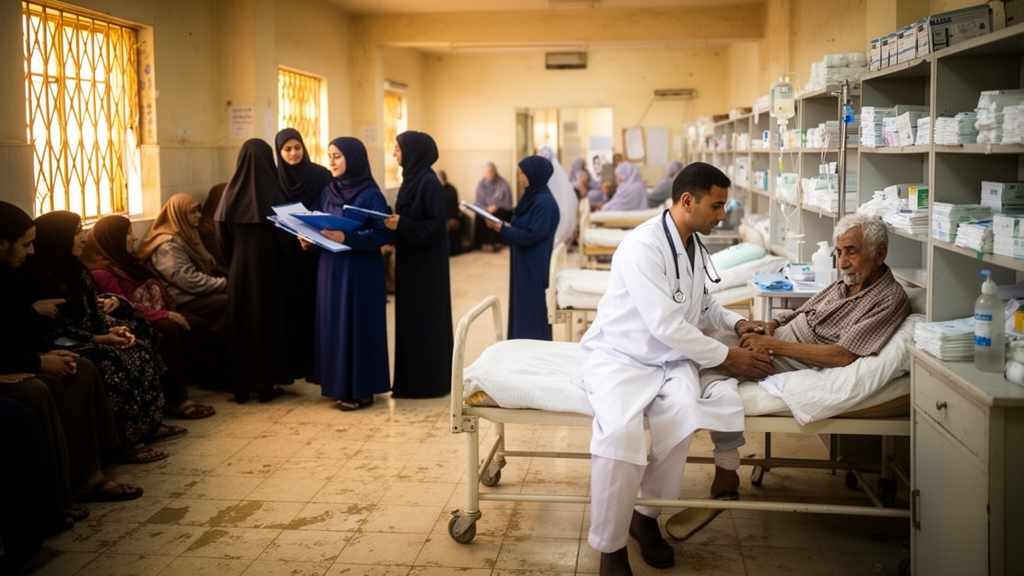
Healthcare workers in four total quality management hospitals in Sana’a rated the quality of care they deliver relatively highly, and the strongest drivers of those perceptions were process management, policy and strategy, and partnerships and resources, according to a cross-sectional study published in Conflict and Health. The survey of 410 healthcare professionals found that leadership commitment showed no significant direct association with perceived service quality, while human resources displayed a marginally significant negative trend.
Yemen’s Ministry of Public Health mandated the implementation of total quality management across hospitals in 2021, a policy move made against the backdrop of a protracted conflict that has placed compounded pressures on the country’s healthcare systems. The new study examined the association between TQM implementation and perceived healthcare service quality from the provider’s perspective, and its authors explicitly framed the findings as hypothesis-generating rather than causal.
Participants completed a validated questionnaire measuring five European Foundation for Quality Management-based TQM dimensions and five SERVQUAL-adapted provider proxy service quality dimensions. The researchers analysed the responses using multiple linear regression with robust Huber-White standard errors, bootstrap mediation, and moderated regression. On a 7-point scale, overall TQM implementation received a median rating of 5.48 with an interquartile range of 1.28, and overall perceived service quality received a median of 5.82 with an interquartile range of 1.39.
The regression model was statistically significant, explaining 65.1 percent of the variance in perceived service quality. Processes emerged as the strongest predictor, with a standardised coefficient of 0.458 and a 95 percent confidence interval spanning 0.269 to 0.647. Policy and strategy followed with a coefficient of 0.283, and partnerships and resources contributed a coefficient of 0.144. All three associations were statistically significant.
Leadership commitment, by contrast, showed no significant direct association with perceived service quality, with a coefficient of just 0.009. Post-hoc mediation analysis suggested that its effect on service quality operated largely through other dimensions: the indirect effect through processes was 0.506, representing 82.4 percent mediation, and the indirect effect through policy and strategy was 0.489, representing 79.7 percent mediation. In other words, leadership appeared to matter for quality perceptions mainly insofar as it shaped how processes and policies were implemented on the ground.
Human resources showed a marginally significant negative trend, with a coefficient of -0.089 and a confidence interval that just touched zero. The authors report this as a trend rather than a confirmed effect, and it stands in contrast to the clear positive signals from the process, policy, and partnership dimensions.
Gender significantly moderated four of the five relationships examined, with steeper TQM-quality slopes among female staff than among male staff. For the processes dimension, the slope among female staff was 0.843 with a confidence interval of 0.771 to 0.915, compared with 0.625 among male staff. Experience, by contrast, was not a significant moderator of these relationships.
The study’s conclusions are deliberately modest. The authors state that process-oriented, policy-oriented, and partnership-oriented TQM dimensions were positively associated with perceived service quality in this conflict-affected setting, whereas leadership influence appeared indirect. Because the data are cross-sectional and provider-reported, they cannot establish that TQM implementation caused the quality perceptions; the findings instead generate hypotheses for future longitudinal and mixed-methods research.
Such future work, the authors suggest, should incorporate patient-reported outcomes and objective clinical indicators, moving beyond the provider’s perspective that this study captured. The research offers a rare quantitative window into how quality management frameworks function in one of the world’s most fragile health systems, where hospitals must deliver care under conditions of sustained conflict and resource strain.
Subject of Research: Cross-sectional study of TQM dimensions and perceived healthcare service quality among healthcare workers in conflict-affected Yemen
Article Title: Drivers of perceived healthcare service quality among healthcare workers in TQM-implementing hospitals in conflict-affected yemen: a cross-sectional study
Article References: Alsalit, G. M., Al-Wesabi, M. M., & Jowah, H. M. (2026). Drivers of perceived healthcare service quality among healthcare workers in TQM-implementing hospitals in conflict-affected yemen: a cross-sectional study. Conflict and Health. https://doi.org/10.1186/s13031-026-00839-5
Image Credits: AI Generated
DOI: 10.1186/s13031-026-00839-5
Keywords: total quality management, healthcare service quality, Yemen, conflict-affected hospitals, cross-sectional study, EFQM, SERVQUAL, Sana'a, healthcare workers, mediation analysis, provider perspective, Drivers
News Source: Courtney Benton. (October 30, 2026). Processes and Policy Drive Perceived Care Quality in Yemen’s Conflict-Hit Hospitals. Scienmag.



