


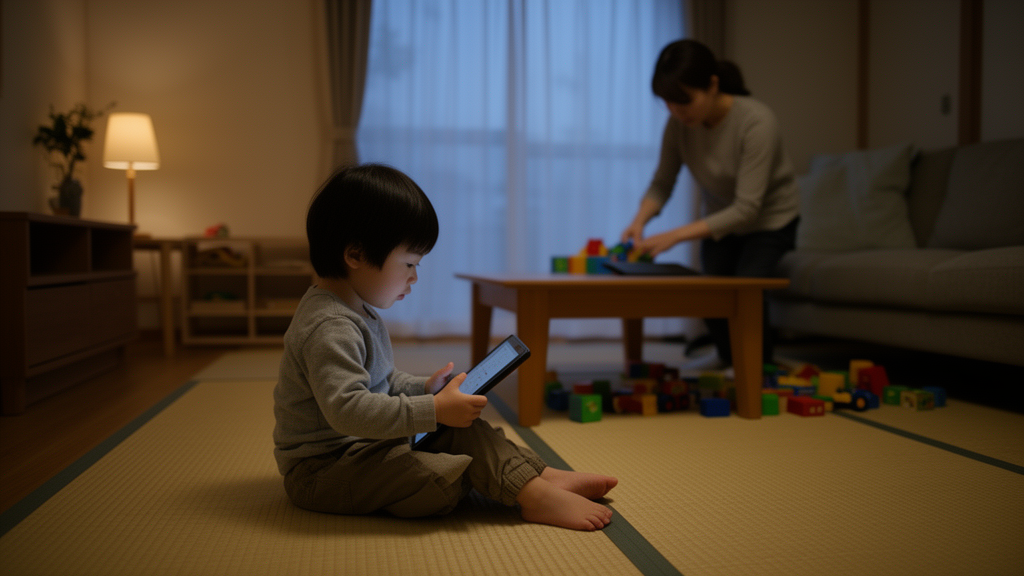
Television viewing and electronic game playing among Japanese preschool children are structurally linked to household socioeconomic conditions, parenting-related perceptions, and the involvement of both parents, according to a cross-sectional secondary analysis published in BMC Public Health. Using exploratory structural equation modeling, the study found that socioeconomic status carried the largest standardized total association with screen time, at −0.550, indicating that children from lower-status households tended to accumulate more screen time in this dataset.
The analysis drew on the fifth wave of the Longitudinal Survey of Newborns in the 21st Century, conducted in 2014 when the participating children were four years and six months old. After restricting the data to complete cases from two-parent households, the analytical sample comprised 19,577 children. Screen time was treated as a latent variable indicated by two observed behaviors: time spent watching television and time spent playing electronic games.
The descriptive figures highlight how common extended viewing was in this cohort. More than 30 percent of the children watched television for at least three hours per day, while 63.9 percent did not usually play electronic games at all. This split suggests that in 2014, television, rather than games, was the dominant screen medium for Japanese preschoolers.
To capture the home environment, the researchers ran exploratory factor analyses that produced indicators of parenting-related perceptions alongside separate measures of paternal and maternal involvement. They then constructed and compared three theory-informed exploratory structural equation models, selecting the final model on the basis of statistical fit, estimation stability, theoretical interpretability, and parsimony.
The winning model, which used the Factor 2 indicators of parental involvement, showed the most favorable overall fit of the three alternatives, with a comparative fit index of 0.907, an adjusted goodness-of-fit index of 0.962, a root mean square error of approximation of 0.047, and a standardized root mean square residual of 0.0407. Together, the model accounted for 50 percent of the variance in preschool screen time, a substantial share for a behavioral outcome measured at the household level.
Beyond socioeconomic status, parenting-related subjective appraisal and both paternal and maternal involvement showed model-implied associations with screen time, though their standardized magnitudes were smaller. The authors interpret this pattern as pointing to connections among household resources, caregiving burden, parent–child involvement, and screen-based behavior in early childhood.
Important limitations frame these results. As an exploratory cross-sectional analysis, the study cannot establish causality; the associations describe structural patterns within a single survey wave rather than effects of one factor on another. The sample was also limited to two-parent households with complete data, so the findings may not generalize to other family structures.
The temporal scope matters as well. Because the data reflect television- and game-based screen use in 2014, before smartphones and tablets became pervasive in young children’s lives, the authors caution that the results serve as a historical reference point rather than an estimate of contemporary total screen use. They argue the identified associations warrant longitudinal investigation to clarify how household socioeconomic conditions and parenting dynamics shape screen behaviors as children develop.
Subject of Research: Home environmental and socioeconomic factors associated with screen time among Japanese preschool children
Article Title: Home environmental factors associated with screen time among Japanese preschool children: a cross-sectional secondary analysis using exploratory structural equation modeling
Article References: Sezai, I., Nakayama, N., & Tabuchi, T. (2026). Home environmental factors associated with screen time among Japanese preschool children: a cross-sectional secondary analysis using exploratory structural equation modeling. BMC Public Health. https://doi.org/10.1186/s12889-026-30006-7
Image Credits: AI Generated
DOI: 10.1186/s12889-026-30006-7
Keywords: screen time, preschool children, socioeconomic status, parental involvement, structural equation modeling, television viewing, electronic games, Japan, cross-sectional study, home environment, Home, environmental
News Source: Ophelia Keating. (October 30, 2026). Household Conditions Tied to Screen Time in Japanese Preschoolers. Scienmag.



