


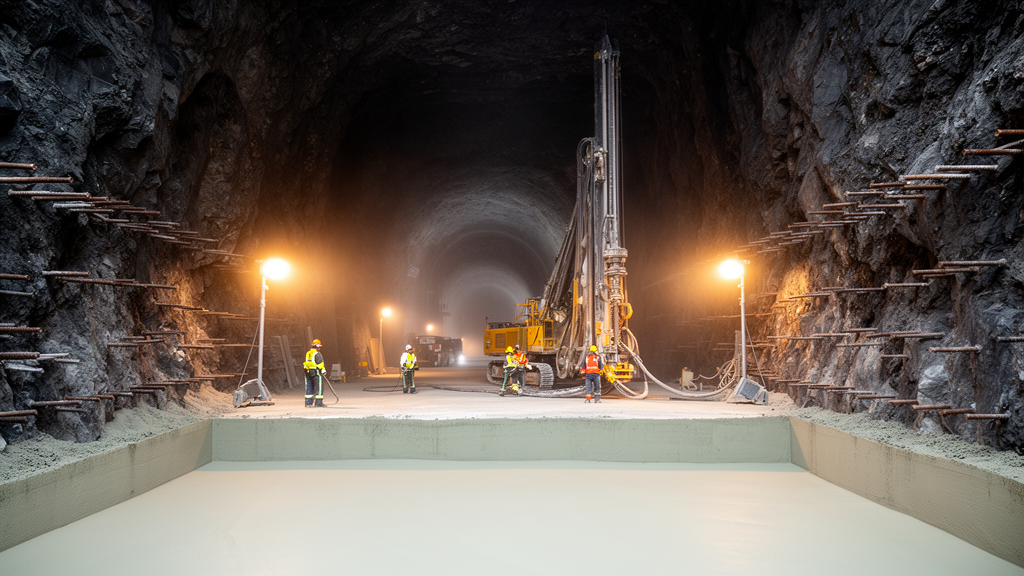
Engineers studying deep underground iron mining have identified a stope layout that increases ore production by one-fifth while keeping the surrounding rock stable, according to a numerical modeling study at the Tianxing iron mine in China. The research, published in Geomechanics and Geophysics for Geo-Energy and Geo-Resources, focused on test stopes located between 400 and 450 meters below the surface, where mining-induced disturbances and post-peak rock damage make large excavations far riskier than at shallower depths.
The team, led by Shuai Li, Jingliang Xue, Zhenyu Dan, Tubing Yin and Zhenlong Li, built a three-dimensional FLAC3D model that incorporated a cohesion weakening and friction strengthening approach, a constitutive framework designed to capture how rock behaves after it passes its peak strength. Using this model, the researchers evaluated how stope span, mining sequence, panel pillar width and staged backfill strength interact to control ground stability in large-scale backfilled stopes. Supplementary analyses extended the assessment to stope height, lateral pressure coefficient, multi-factor combinations and the contact conditions between rock mass and backfill.
Calibration was not left to guesswork. The cohesion weakening and friction strengthening parameters were tuned against monitored roof settlement and panel pillar stresses recorded at the mine, while drift convergence data were reserved as an independent check on the model’s validity. This separation of calibration and validation data is a common safeguard in geomechanical modeling, helping to confirm that a model reproduces observed deformation rather than merely fitting the measurements it was built on.
The central finding concerns stope geometry. A scheme using an 18-meter span and 50-meter stope length increased ore tonnage by 20.00 percent relative to a 15-meter scheme, and it did so without forming a through-going plastic zone, the connected region of failed rock that signals a pathway toward large-scale collapse. Because wider spans expose more ore between pillars, this result suggests that production scale and ground stability need not be treated as opposing goals, provided the layout is chosen with the right supporting measures.
Mining sequence proved equally important. The simulations showed that interval mining, in which stopes are excavated in an alternating pattern and backfilled promptly, reduced the superposition of mining-induced disturbances. When neighboring excavations proceed simultaneously, their zones of stress concentration and damage overlap, amplifying deformation in the roof and pillars. Alternating excavation and filling breaks up that overlap, limiting the build-up of ground disturbance during the extraction cycle.
Backfill strength, by contrast, delivered diminishing returns. Raising the first-step backfill strength from 2.0 to 3.0 megapascals reduced the maximum displacement by only 0.08 centimeters, a marginal improvement for a substantial increase in cement content. The study’s highlights note that strengthening the initial fill beyond 2.0 megapascals gave little added benefit, a result with direct cost implications, since cemented backfill is one of the more expensive consumables in bulk underground mining. The selected design therefore uses staged strengths of 2.0 and 0.5 megapascals rather than pushing the early-stage fill higher.
To weigh competing schemes systematically, the researchers applied orthogonal analysis, a statistical design method that examines multiple factors with a reduced set of trials. The analysis indicated that mining sequence primarily controlled roof settlement, stope span primarily controlled plastic damage, and pillar width primarily controlled pillar stress. In other words, each of the three governing variables dominates a different failure mode, which is why the authors describe their optimization as synergistic rather than a search for a single best parameter.
Quantitative risk scoring reinforced the choice of a moderate span. The comprehensive risk indices of the 15-meter, 18-meter and 20-meter schemes came out at 0.300, 0.573 and 0.700 respectively, a steep climb as the opening widens. The 20-meter layout, despite its production appeal, carries more than double the risk index of the 15-meter design, while the 18-meter option sits between the two, capturing most of the extra ore at a risk level the model indicates remains manageable.
The final recommendation combines an 18-meter span, 15-meter panel pillars, a timely backfilling sequence and staged backfill strengths of 2.0 and 0.5 megapascals. The authors describe this package as an engineering compromise between stability and production scale, one that addresses the specific challenges of deep mining: post-peak rock damage, the superposition of disturbances from adjacent stopes, and the need to match backfill strength to the loads it must carry.
For deep mines weighing a shift to larger stopes, the study offers a transferable workflow rather than a universal prescription. Its method links a calibrated numerical model to measured roof settlement, pillar stress and drift convergence, then uses orthogonal analysis to separate the influence of geometry, sequence and fill strength. Because the parameters were calibrated to one mine’s conditions at the Tianxing operation, the specific numbers would need site-specific recalibration elsewhere, but the framework demonstrates how monitoring data and modeling can jointly guide the design of safer, larger underground excavations.
Subject of Research: Numerical optimization of stope span, mining sequence, pillar width and backfill strength for deep large-scale backfilled stopes at an iron mine.
Article Title: Synergistic optimization of stope structural parameters and backfill strength in deep large-scale backfilled stopes
Article References: Li, S., Xue, J., Dan, Z., Yin, T., Guo, Z., Ma, Y., Liu, H., & Li, Z. (2026). Synergistic optimization of stope structural parameters and backfill strength in deep large-scale backfilled stopes. Geomechanics and Geophysics for Geo-Energy and Geo-Resources. https://doi.org/10.1007/s40948-026-01227-2
Image Credits: AI Generated
DOI: 10.1007/s40948-026-01227-2
Keywords: deep mining, stope design, backfill strength, FLAC3D modeling, cohesion weakening friction strengthening, roof settlement, panel pillars, mining sequence, orthogonal analysis, ore production, ground stability, Tianxing iron mine
News Source: Denise Maddox. (October 30, 2026). Wider Stopes and Timely Backfilling Boost Deep Mine Ore Output Without Sacrificing Stability. Scienmag.



