


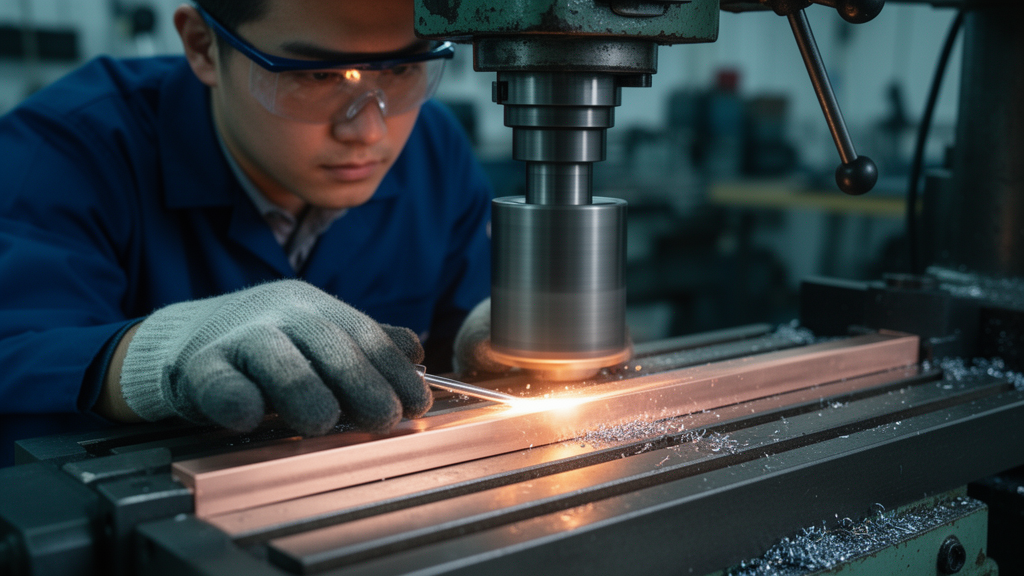
Friction stir welding is a solid-state joining technique in which a non-consumable rotating tool generates frictional heat and severe plastic deformation, softening metal enough to bond it without ever reaching the melting point. A new open-access study in Discover Mechanical Engineering reports a detailed experimental investigation of this process applied to commercially pure copper, a metal whose high thermal conductivity makes heat management notoriously difficult during welding. The researchers welded 5 mm thick copper plates on a conventional vertical milling machine, a deliberately low-cost alternative to dedicated friction stir welding systems, and then used statistical optimization methods to determine exactly which process parameters control the strength and hardness of the resulting joints.
The experimental design was systematic. The team selected three variables to study: tool pin profile, with cylindrical, threaded cylindrical, and square geometries; tool rotational speed, ranging from 910 to 1700 rpm; and welding speed, ranging from 16 to 44 mm/min. Using a Taguchi L9 orthogonal array, they ran nine parameter combinations, each repeated three times for a total of 27 welding trials. The tools were machined from H13 tool steel, chosen for its balance of hot hardness, toughness, and machinability, and the copper plates were clamped against a cast iron backing plate that acted as a heat sink. Tool wear was measured after all nine runs, with dimensional changes of at most 0.7 percent, indicating that the tools remained stable throughout the experiments.
The headline result concerns tensile strength. Analysis of variance showed that welding speed dominated tensile strength, contributing 76.90 percent of the variation with a p-value below 0.001. Rotational speed contributed 21.95 percent, also statistically significant, while tool profile accounted for only 1.15 percent. The best tensile result, 350.14 MPa, was achieved with the threaded cylindrical tool profile at 1700 rpm and 16 mm/min, a condition the authors label S6. That figure corresponds to roughly 87 percent of the base material’s strength. At the opposite extreme, condition S7, which used a square tool at 910 rpm and 44 mm/min, produced a tensile strength of just 53.28 MPa, reflecting incomplete consolidation and poor metallurgical bonding under low heat input.
Hardness told a strikingly different story. Here the hierarchy of influence inverted: tool geometry governed hardness with an 84.67 percent contribution, also with p below 0.001, while rotational speed contributed 12.11 percent and welding speed a negligible 1.53 percent, the latter not statistically significant. The maximum hardness of 94 HRE was obtained with the square pin profile at 910 rpm and 44 mm/min, condition S7, the very same condition that produced the weakest tensile joint. The square profile’s angular edges generate intense mechanical stirring and steep strain gradients, promoting dynamic recrystallization and fine grains, whereas tensile strength depends more on having enough heat input to fully plasticize and bond the material across the joint.
This trade-off between the two mechanical responses is one of the study’s central findings. The authors estimate heat input per unit length using a model adapted from friction stir welding thermal literature, with a friction coefficient of 0.4 and an axial pressure of 15 MPa. Under this model, condition S6 corresponds to roughly 583 J/mm, sufficient for complete material plasticization, while S7 corresponds to about 113 J/mm, inadequate for sound bonding. The estimated heat input correlated with tensile strength with an R-squared of approximately 0.89. These heat input figures are model estimates rather than direct measurements, and the authors present them as mechanistic context for the observed parameter hierarchy.
Microstructural analysis provided quantitative support for the mechanical trends. Using optical microscopy and the linear intercept method according to ASTM E112, the researchers measured grain sizes in the stir zone, the thermomechanically affected zone, and the heat-affected zone. The stir zone consistently showed the finest grains, ranging from 3.2 to 6.8 µm, a reduction of 73 to 87 percent compared with the base metal’s average grain size of 25.4 µm. For the highest hardness condition, S7, the stir zone grain size was 4.1 µm, and the authors attribute the hardness to Hall-Petch strengthening driven by dynamic recrystallization. For the highest strength condition, S6, the stir zone grain size was 3.2 µm, the finest observed, but the higher heat input left slightly coarser grains of 15.2 µm in the heat-affected zone.
Compositional analysis ruled out chemistry as an explanation for the property differences. Scanning electron microscopy combined with energy-dispersive X-ray spectroscopy, performed on a field emission instrument at 15 kV, examined specimens from both optimal conditions. Quantitative EDS analysis at three locations across the stir zone found a copper content of 99.6 plus or minus 0.2 weight percent, with trace elements uniformly distributed and no detectable aluminum or iron contamination from the tool or fixture. The absence of an oxygen signal in the EDS maps indicated that oxidation did not occur during welding, consistent with the solid-state nature of the process. The authors conclude that the mechanical property variations arose from thermo-mechanical processing rather than compositional differences.
To resolve the tension between single-response optima, the team applied Grey Relational Analysis, a multi-response optimization technique that normalizes the tensile strength and hardness data and computes an overall grey relational grade for each experimental run. Condition S6, the threaded tool at 1700 rpm and 16 mm/min, achieved the highest grade of 0.706, identifying it as the best overall balance of the two properties. Confirmation experiments run under this condition with three replicates showed errors of 0.66 percent for tensile strength and 0.39 percent for hardness relative to predicted values, supporting the optimization. The authors note that applications prioritizing hardness over strength, such as wear-resistant surfaces, might instead favor the square tool geometry while accepting the tensile strength penalty.
The choice of equipment carries practical weight. Dedicated friction stir welding machines are expensive and not available in every laboratory, so demonstrating that high-quality copper joints can be produced on a conventional vertical milling machine, with controlled rotation, traverse motion, and vertical positioning, lowers the barrier to parametric studies and prototyping. The authors are careful to scope this claim: the milling-machine setup is validated for laboratory-scale and prototyping applications, while dedicated friction stir welding machines with advanced force and temperature control remain necessary for full-scale industrial production requiring high throughput and stringent quality standards. Tensile testing followed the ASTM E8M standard on a 50 kN universal testing machine at a crosshead speed of 1 mm/min, and hardness was measured on the Rockwell E scale with a 100 kg load, a macro-scale test the authors explicitly distinguish from microhardness methods.
Fractographic examination added a failure-mechanism perspective. The fracture surface of the strongest specimen showed fine, well-developed dimples distributed uniformly across the surface, a signature of microvoid coalescence and ductile failure through a well-bonded stir zone. The weakest specimen displayed a mixed morphology with large shallow dimples interspersed with flat, featureless regions indicating inadequate bonding, while the intermediate specimen showed a transitional mixture. Stress-strain curves reinforced these observations, with the optimal condition exhibiting a yield point near 240 MPa, roughly 15 percent elongation, and stable deformation, contrasted with premature fracture at about 53 MPa for the low heat input condition. The authors suggest that future work should address fatigue performance, the electrical conductivity of the joints, and extension to dissimilar copper alloys, and they frame their parameter hierarchy as a mechanistic basis for selecting welding conditions in applications such as electrical connectors and heat exchangers.
Subject of Research: Multi-response optimization of friction stir welding parameters for commercially pure copper joints
Article Title: Process structure property correlation and multi response optimization of friction stir welded copper joints
Article References: Tefera, M. B., & Fetene, B. N. (2026). Process structure property correlation and multi response optimization of friction stir welded copper joints. Discover Mechanical Engineering, 5(1), Article 197. https://doi.org/10.1007/s44245-026-00392-8
Image Credits: AI Generated
DOI: 10.1007/s44245-026-00392-8
Keywords: friction stir welding, copper, Taguchi method, ANOVA, Grey Relational Analysis, tool geometry, tensile strength, hardness, grain refinement, milling machine, solid-state welding, microstructure
News Source: Denise Maddox. (October 30, 2026). Welding copper on a milling machine: study maps friction stir welding parameters. Scienmag.



