


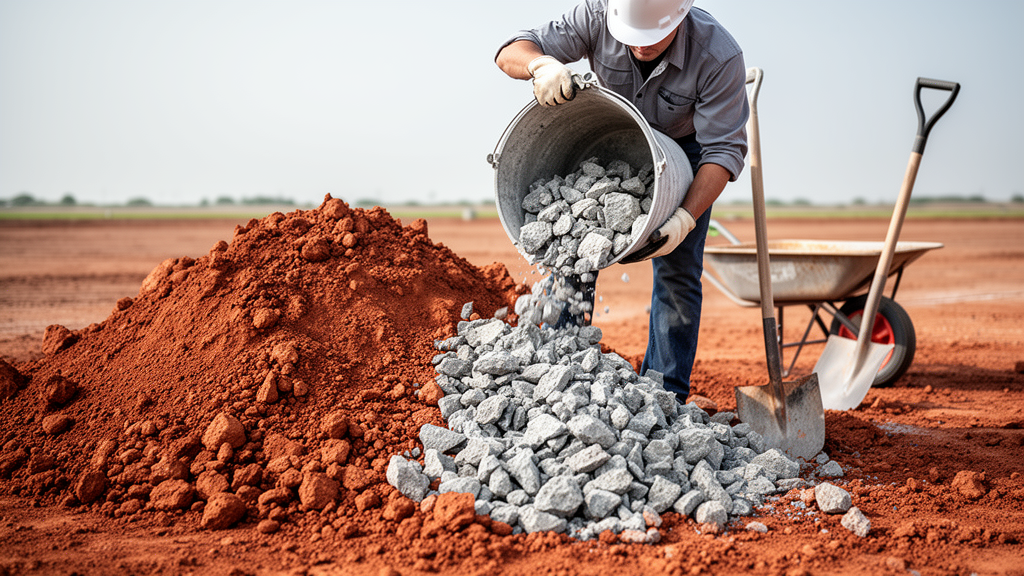
Engineers in the Gaza Strip have turned piles of demolition debris into a candidate material for road building, testing crushed concrete waste blended with small amounts of local clay as a subbase layer for pavements. In a laboratory program backed by a pilot field trial, a mixture of 95 percent demolition crushed aggregate and 5 percent clay delivered the most balanced engineering performance among the blends studied, according to the research published in Discover Civil Engineering.
The work addresses a practical problem created by repeated conflict in the territory. Large quantities of construction and demolition waste have accumulated in the Gaza Strip as buildings and infrastructure have been damaged, and the study’s authors argue that reusing this debris in road construction offers a way to manage the waste while reducing demand for natural aggregates. The demolition crushed aggregate used in the experiments came from local crushing plants where debris from damaged buildings was processed, and visual inspection showed the material consisted predominantly of crushed concrete fragments with smaller proportions of mortar residues and masonry particles.
To probe how clay content changes the behavior of the recycled material, the researchers prepared three mixtures: untreated demolition crushed aggregate, a blend with 5 percent clay, and a blend with 10 percent clay, both measured by dry weight. The clay soil was obtained from local deposits within the Gaza Strip, air-dried, pulverized, and sieved before testing. Aggregate samples were collected from two crushing plants to ensure the investigated materials were representative of locally available recycled aggregates, then transported to the laboratory and stored under controlled conditions to minimize contamination and segregation.
The laboratory testing program followed relevant AASHTO standard methods and covered particle size distribution, Atterberg limits, bulk specific gravity, water absorption, Modified Proctor compaction, California Bearing Ratio, Los Angeles abrasion, and sand equivalent tests. Gradation was measured with AASHTO T27, specific gravity and absorption with T84 and T85, Atterberg limits with T89 and T90, compaction with T180, CBR with T193, Los Angeles abrasion with T96, and sand equivalent with T176. The results were then compared with specifications and acceptance criteria reported for unbound granular materials used in pavement subbase applications.
The bearing capacity results showed that all three mixtures performed strongly under soaked conditions. Untreated demolition crushed aggregate recorded a California Bearing Ratio of 118 percent, while adding clay caused a gradual decrease to 111 percent for the 5 percent clay blend and 107 percent for the 10 percent clay blend. The authors attribute the reduction to the introduction of finer particles, which can modify particle interlocking, reduce internal friction, and influence penetration resistance during testing. They note that such high values are consistent with well-compacted granular and recycled aggregate mixtures, where dense particle packing and mechanical interlocking contribute to high penetration resistance, and that the values are interpreted primarily to compare relative performance among the mixtures.
Compaction behavior shifted only modestly with clay content. Maximum dry density fell slightly from 2.041 megagrams per cubic meter for untreated aggregate to 2.040 for the 5 percent clay mixture and 2.036 for the 10 percent clay mixture, a variation the authors describe as negligible. Optimum moisture content, by contrast, rose steadily from 9.30 percent for untreated aggregate to 9.90 percent and 10.40 percent for the 5 and 10 percent clay blends, a trend attributed to the increased proportion of fine particles, which raises specific surface area and water demand during compaction.
Plasticity and cleanliness measures responded more visibly to the clay additions. Untreated demolition crushed aggregate was non-plastic, but the clay introduced measurable plasticity, producing plasticity index values of 3.40 and 3.80 for the 5 and 10 percent clay mixtures, values the authors describe as low and within the typical range reported for granular sub-base materials. Sand equivalent values declined from 74 percent for untreated aggregate to 64 percent and 60 percent for the 5 and 10 percent clay mixtures, reflecting the increased proportion of fine clay particles, yet all tested mixtures remained above the 40 percent minimum specified by AASHTO T176.
Density-related and durability indicators showed smaller movements. Specific gravity rose slightly at 5 percent clay for both fine and coarse fractions before dipping marginally at 10 percent clay, a pattern linked to fine particles partially filling voids between larger aggregate particles at low clay content. Water absorption decreased at 5 percent clay compared with untreated aggregate, then increased slightly at 10 percent, which the authors connect to improved particle packing at low clay content and to the larger specific surface area and water retention of clay at higher content. Los Angeles abrasion loss edged down from 35.20 percent for untreated aggregate to 34.60 percent and 34.40 percent for the 5 and 10 percent clay blends, though the authors caution that these small differences fall within expected testing variability and do not necessarily represent a real improvement in abrasion resistance.
Gradation results were more complicated than a simple dose-response. The percentage passing the No. 200 sieve was 4.0 percent for untreated aggregate and the 5 percent clay mixture, and 5.6 percent for the 10 percent clay mixture, without a consistent monotonic trend across sieve sizes. The authors attribute this to the inherent heterogeneity of demolition crushed aggregates, which combine concrete, mortar, and masonry components with differing crushing characteristics, and note that the relatively low clay contents may not produce a proportional increase in measured fines. Despite the fluctuations, the overall gradation trends of the mixtures remained comparable, and the 5 percent clay blend showed a relatively continuous particle size distribution.
Weighing all the laboratory evidence together, the team identified the 95 percent demolition crushed aggregate and 5 percent clay mixture as the most balanced performer and took it to the field. In a pilot road section in the Gaza Strip, the mixture was placed as an unbound subbase layer with a total thickness of 30 centimeters, laid in two compacted layers of roughly 15 centimeters each. Field density was verified with conventional quality-control procedures and found generally consistent with the laboratory compaction characteristics, and a plate load test conducted to AASHTO T222 served as a preliminary qualitative assessment whose measured values were not presented. During a one-month observation period, the section showed no visible surface distress, excessive settlement, or material segregation, and the mixture exhibited satisfactory workability during placement and compaction. The authors stress that this was a pilot-scale application with limited monitoring, that long-term performance under repeated traffic loading and environmental exposure was beyond the scope of the study, and that further research involving replicated laboratory testing and long-term field monitoring is needed to validate the mixtures for wider use, particularly in resource-limited and post-conflict regions where demolition waste is abundant.
Subject of Research: Laboratory and pilot field evaluation of demolition crushed aggregate–clay mixtures as unbound pavement subbase materials in the Gaza Strip
Article Title: Performance evaluation of demolition crushed aggregate–clay mixtures for pavement subbase applications
Article References: Al Haj Ahmed, A. Y., & Jendia, S. (2026). Performance evaluation of demolition crushed aggregate–clay mixtures for pavement subbase applications. Discover Civil Engineering, 3(1), Article 254. https://doi.org/10.1007/s44290-026-00621-9
Image Credits: AI Generated
DOI: 10.1007/s44290-026-00621-9
Keywords: demolition crushed aggregate, construction and demolition waste, pavement subbase, clay stabilization, California Bearing Ratio, recycled aggregates, Gaza Strip, AASHTO testing, compaction, plate load test, sustainable road construction, post-conflict reconstruction
News Source: Denise Maddox. (October 30, 2026). Crushed Gaza demolition waste blended with clay shows promise as road subbase material. Scienmag.



