


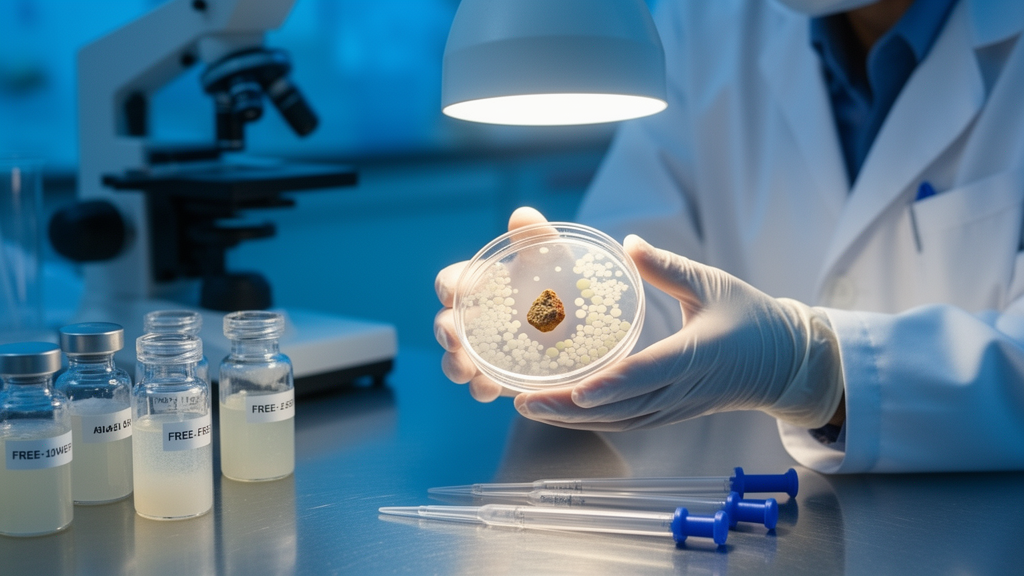
Kidney stones can carry bacteria that urine tests never detect, and a new prospective study suggests that culturing the stone itself during surgery may reveal the danger that conventional testing misses. In research published in the African Journal of Urology, a team at a tertiary care centre in India followed 143 patients undergoing endourological stone surgery and found that intra-operative stone cultures were positive far more often than pre-operative mid-stream urine cultures, and that only the stone culture showed a statistically significant association with postoperative sepsis.
The study, conducted between March 2023 and May 2024, enrolled patients with urolithiasis undergoing percutaneous nephrolithotomy, ureteroscopic pneumatic lithotripsy, or transurethral cystolithotripsy. The cohort comprised 82 men and 61 women, with a mean age of 44.6 years, and was heavily weighted toward kidney stones: 127 patients, or 88.8 percent, underwent percutaneous nephrolithotomy for renal calculi, while nine were treated for ureteric stones and only seven for bladder stones. Patients with urogenital malignancies, severe immunocompromise, recent broad-spectrum antibiotic use, steroid therapy, congenital anomalies, or prolonged catheterisation were excluded, narrowing the population to a relatively defined surgical group.
The contrast between the two culture sources was stark. Pre-operative mid-stream urine cultures, collected five to seven days before surgery, were positive in just 15 patients, or 10.5 percent of the cohort. Intra-operative stone cultures, harvested under sterile conditions and processed using the Nemoy–Stamey technique of sequential saline rinsing before the fragments were crushed and cultured, were positive in 40 patients, or 28 percent. That difference was statistically significant, with a p-value of 0.03.
The mismatch went deeper than simple positivity rates. Escherichia coli dominated both specimen types, appearing in 73 percent of positive urine cultures and 50 percent of positive stone cultures, but the stone cultures also yielded Pseudomonas aeruginosa, Klebsiella pneumoniae, Enterococcus species, and Proteus mirabilis. Only nine patients had both specimens culture-positive, and identical organisms were recovered from both in just four of those cases. Counted against all 55 positive cultures, exact concordance occurred in only 7.3 percent of cases. Some form of discordance, whether growth in only one specimen or growth of different organisms in each, affected 42 of the 143 patients, or 29.4 percent. A sterile pre-operative urine culture, the authors conclude, cannot be taken as evidence that the stone itself is free of infection.
Subgroup analysis sharpened the point. The significant discrepancy between urine and stone cultures appeared only among patients with renal calculi, where stone cultures were positive in 28.3 percent of cases against just 9.45 percent for mid-stream urine, a difference that reached statistical significance at p = 0.04. No such difference emerged for bladder or ureteric stones, though those groups were too small to draw firm conclusions. The renal predominance matters because percutaneous nephrolithotomy exposes the kidney to uniquely high intrarenal pressures and an open parenchymal tract, creating what the authors describe as an efficient conduit for bacteria and endotoxin to enter the bloodstream during stone fragmentation.
The clinical payoff came in the sepsis data. Nine patients, 6.3 percent of the cohort, developed postoperative sepsis, defined under the 2001 International Sepsis Definitions Conference criteria as a systemic inflammatory response provoked by infection, with at least two SIRS criteria met: temperature above 38 or below 36 degrees Celsius, heart rate above 90 beats per minute, respiratory rate above 12 breaths per minute, or a white-cell count above 12,000 or below 4,000 per cubic millimetre. Every patient who developed sepsis had undergone surgery for kidney stones, and none progressed to multi-organ failure. Three of the nine, one third of sepsis cases but only 2.1 percent of the overall cohort, required vasopressor support to maintain blood pressure.
When the researchers cross-tabulated sepsis against culture results, the stone culture emerged as the meaningful signal. Sepsis occurred in seven of 40 patients with positive stone cultures, or 17.5 percent, compared with just two of 103 patients with negative stone cultures, or 1.94 percent, a highly significant association at p = 0.002. By contrast, two of 15 patients with positive pre-operative urine cultures developed sepsis, against seven of 128 with negative urine cultures, an association that did not reach statistical significance at p = 0.24. Notably, the two sepsis patients with positive urine cultures also had positive stone cultures, but the organisms differed between the two specimens, reinforcing the study’s central message that the urine microbiology does not faithfully represent what lives on the stone.
The findings align with a body of earlier work. Fowler and colleagues reported that 77 percent of stones yielded positive cultures while only 12.5 percent of simultaneous bladder urine samples did; Mariappan and colleagues found mid-stream urine positivity of 11.1 percent against 35.2 percent for stone cultures; and Devraj and colleagues in 2016 reported stone-culture positivity of 30.1 percent versus 10.8 percent for urine. The new study’s rates of 28 percent and 10.5 percent sit comfortably within that pattern. The authors also point to the biology behind the discrepancy: antibiotics penetrate calculi poorly, organisms embedded in stone matrix may differ from those floating in bladder urine, and fragmentation releases endotoxin into irrigation fluid that, under pressure, can be driven into open venous and lymphatic channels.
Timing, however, limits what stone cultures can accomplish. Postoperative bacteraemia tends to emerge within the first six hours after surgery, whereas stone culture reports take roughly 48 hours to return. Culture results therefore cannot guide interventions to prevent early systemic inflammation, but the authors argue they become valuable for directing targeted antimicrobial therapy when fever persists beyond the two-day mark, and at minimal additional cost since the fragments are already in hand.
The authors are careful about the limits of their evidence. The study was single-centre, the sample was small, and only nine sepsis events occurred, which limits statistical power and precluded multivariable regression for fear of overfitting. With nearly 89 percent of patients undergoing percutaneous nephrolithotomy, ureteroscopic and cystolithotripsy cases were too few for procedure-specific analysis, and confounders such as operative duration, stone burden, stone composition, and irrigation pressure were not evaluated. The team also used the older SIRS-based sepsis definition rather than the currently recommended Sepsis-3 criteria, though they note this choice matches much of the existing stone-culture literature. Their conclusion is deliberately measured: stone culture demonstrated a significantly stronger association with postoperative sepsis than urine culture and may provide clinically useful information that complements conventional testing, but larger multicentre studies with balanced procedure-specific cohorts and adjusted analyses are required before routine stone culturing can be universally recommended.
Subject of Research: Comparison of pre-operative urine culture and intra-operative stone culture in predicting postoperative sepsis after endourological stone surgery
Article Title: “A comparison of pre-operative urine culture with intra-operative stone culture and its association with post-procedural sepsis: a prospective observational study”
Article References: Sarkar, D., Singh, S., & Ray, R. (2026). “A comparison of pre-operative urine culture with intra-operative stone culture and its association with post-procedural sepsis: a prospective observational study”. African Journal of Urology, 32(1), Article 59. https://doi.org/10.1186/s12301-026-00606-1
Image Credits: AI Generated
DOI: 10.1186/s12301-026-00606-1
Keywords: kidney stones, stone culture, urine culture, urosepsis, percutaneous nephrolithotomy, endourology, SIRS, Escherichia coli, antimicrobial therapy, prospective observational study, urolithiasis, surgical infection
News Source: Ophelia Keating. (October 30, 2026). Kidney stone cultures predict sepsis after surgery better than urine tests. Scienmag.



