


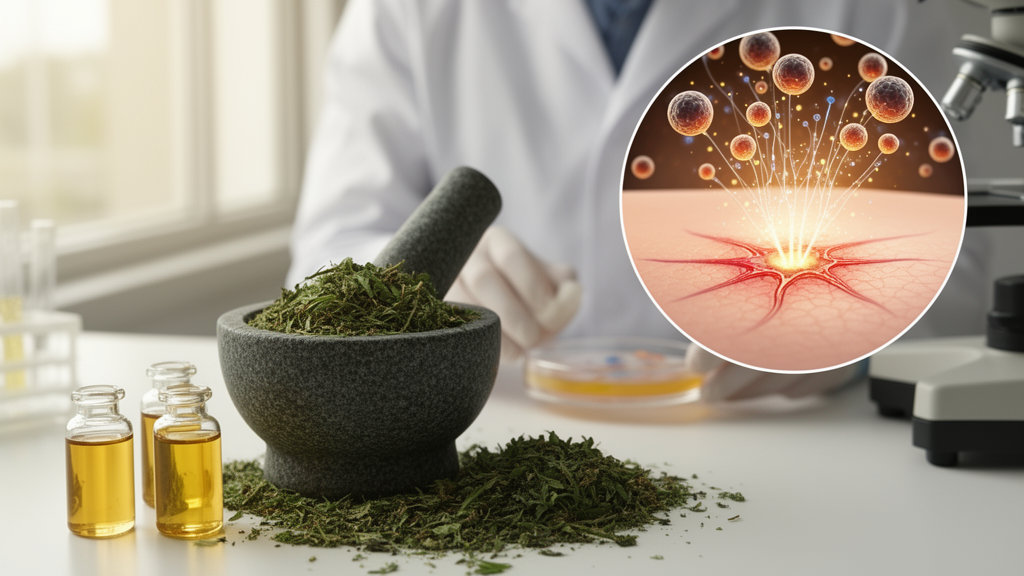
Perianal infectious wounds are among the most unforgiving repair environments in the body. After anorectal abscess drainage, fistula surgery, or treatment of anorectal infection, the wound bed is repeatedly exposed to stool, moisture, friction, mixed aerobic and anaerobic microbes, and irregular cavities or fistula tracts that a flat, dry skin wound never encounters. A critical narrative review published in Frontiers in Pharmacology examines whether natural-product pharmacology and extracellular vesicle (EV)-associated miRNA biology can be credibly connected in this setting, and its central conclusion is sobering: direct clinical and translational evidence now exists, but the proposed natural product–EV–miRNA mechanism remains unproven.
The review, led by researchers at Xi’an Hospital of Traditional Chinese Medicine and Southern Medical University, used a structured PubMed search updated through 29 September 2026, supplemented by Google Scholar citation tracking. Rather than pooling results, the authors appraised each core study on two separate axes: proximity to the clinical question, ranging from completed human perianal studies down to in silico analyses, and methodological credibility, including botanical authentication, chemical characterization, exposure conditions, comparators, EV characterization, causal miRNA evidence, and assay-interference risk. The authors emphasize that evidence level reflects anatomical and clinical proximity, not study quality, and that no single numerical score can capture such a heterogeneous evidence base.
The direct human evidence is no longer sparse. Several randomized postoperative studies have tested traditional preparations after anal-fistula or perianal-abscess surgery. A 2026 double-blind, placebo-controlled trial of Compound Phellodendron Decoction in 60 post-fistulotomy patients reported a clinically meaningful reduction in healing time alongside concordant changes in neutrophil extracellular trap-related readouts, though the review notes that the mechanistic experiments do not prove NETosis is the necessary mediator of benefit. Radix Arnebiae oil, tested in a three-arm randomized study of 90 patients after perianal-abscess drainage, was associated with shorter healing and lower pyroptosis-related biomarkers, while modified Hu-Lian-Bi-Guan decoction showed faster wound healing in complex anal fistula with TGF-beta/Smad-related tissue changes. In each case, the review stresses, pathway changes are treatment-associated rather than demonstrated causes of healing.
Material characterization emerges as a recurring weakness. Many trials report formulations only by traditional names, without voucher-authenticated botanical species, chemical fingerprinting, or batch-level standardization. The review checked identifiable plant taxa against the Royal Botanic Gardens Kew databases and recorded every gap in authentication, provenance, or exposure as a limitation rather than reconstructing it from secondary sources. Mixed-origin preparations containing botanical, zoological, and mineral components, such as Wugu Qilin Ointment and Xiangpi Shengji Ointment, carry particular uncertainty because missing provenance for any component limits reproducibility.
The most intriguing direct intersection between a traditional preparation and molecular biology comes from a 2025 Wugu Qilin study. Fifteen patients after low anal-fistula surgery were randomized to Wugu Qilin Ointment, Kangfuxin Solution, or Vaseline dressings, and vesicle-enriched material from wound exudate was profiled for miRNAs. The miRNA miR-93-3p was subsequently tested in macrophages, where direct mimic and inhibitor experiments plus luciferase assays supported regulation of EIF4EBP1. This makes the study more informative than a purely observational expression analysis, but the review is explicit about the gap: vesicle identity in the clinical samples rested mainly on ultracentrifugation and morphology rather than a full contemporary characterization panel, and the macrophage experiments used direct miRNA transfection rather than transfer of patient-derived vesicles. No EV-depletion experiment, cargo blockade, or rescue showed that the clinical treatment effect depends on EV-mediated miR-93-3p transfer.
Human EV therapy occupies a separate evidence strand. Small early-phase studies of locally administered mesenchymal stromal cell-derived EVs in perianal fistulas, including a five-patient Crohn’s phase I study in which four improved and three achieved complete healing, and an eleven-patient non-Crohn single-arm cohort in which ten improved and five achieved complete tract resolution, provide feasibility and closure signals. A later Crohn’s phase II study expanded the treated population but remained nonrandomized and nonblinded. The review reads these reports as an evolving clinical programme rather than independent confirmations, and notes that none includes a natural-product intervention, a defined miRNA mediator, or controlled comparative efficacy.
The strongest cargo-level mechanistic evidence comes from outside the perianal compartment entirely. In the astragaloside IV (AS-IV) research programme, endothelial progenitor cells were preconditioned with the defined plant-derived metabolite, and their EVs carried altered miRNA cargo: EV-associated miR-21 was tested with miRNA manipulation, luciferase analysis, and PTEN rescue in high-glucose-injured endothelial cells, and a later extension linked miR-126-3p to PIK3R2/SPRED1-related signaling with cargo inhibition across endothelial and diabetic-wound models. Conditioned EVs also improved closure, collagen deposition, and angiogenic markers in diabetic rat wounds. The review considers this the deepest available connection between a chemically defined metabolite and EV-miRNA signaling, while cautioning that it is one research programme, not independent replication, and that none of the experiments uses an infected perianal model. By contrast, curcumin-loaded macrophage EVs primarily demonstrate vesicle-assisted delivery; no evidence shows that curcumin altered EV-miRNA cargo.
Assay interference receives explicit attention. Frequently studied plant metabolites such as berberine, baicalein, curcumin, quercetin, and resveratrol are chemically promiscuous and can interfere with some assay formats, so PAINS alerts were treated as grounds for increased caution rather than automatic invalidation. Conclusions resting on a single biochemical assay were down-weighted, whereas concentration-response relationships, orthogonal assays, cytotoxicity controls, target validation, and clinically plausible exposure increased confidence. The review also separates plant-derived vesicle-like particles from mammalian EVs: herbal nanovesicle systems, including a lipidomics- and small-RNA-sequenced Salvia-Astragalus preparation tested in infected diabetic wounds, show feasibility, but no individual plant-derived RNA has been shown to be necessary for an in vivo wound effect.
Model fidelity is the other persistent translational gap. Anti-biofilm activity against a single planktonic laboratory strain cannot establish relevance to a moist, polymicrobial perianal wound, and dorsal infected-wound models with fecal contamination, however mechanistically sophisticated, remain anatomically indirect. Anatomically faithful anal-fistula rat models, including tests of a Danshen/Huanglian-loaded gelatin dressing and a pH-responsive berberine-EGCG hydrogel with sequential release, provide direct efficacy signals, but carrier, formulation, and metabolite effects remain partly inseparable and no EV-miRNA mechanism was tested in them. The review argues that future work should combine an anatomically faithful contaminated perianal model, a chemically and taxonomically defined intervention, contemporary EV characterization aligned with MISEV2023 principles, longitudinal wound-fluid miRNA profiling, donor- or recipient-side cargo perturbation with rescue, and clinically interpretable endpoints such as durable closure, recurrence, and bacterial burden.
The overall verdict is carefully graded. Natural products, extracellular vesicles, and miRNA signaling now intersect at several levels relevant to perianal repair: randomized postoperative studies show that herbal local regimens can influence clinically measured healing, early EV studies show local vesicle therapy is feasible, and Wugu Qilin demonstrates that treatment-associated vesicle-enriched miRNA profiling is technically possible in human wound exudate. But no study establishes the full causal sequence from defined natural-product exposure through rigorously characterized EV cargo alteration and transfer of a defined miRNA to a necessary recipient-cell effect and improved healing in an anatomically faithful perianal model. Until material standardization, clinically derived wound-fluid EV profiling, mixed-biofilm models, causal cargo perturbation, assay-interference controls, and stage-adapted local delivery converge in a single evidence chain, modulation of EV-miRNA communication by plant-derived compounds remains a specific, testable hypothesis rather than an established mechanism of perianal wound care.
Subject of Research: A critical narrative review of natural products, extracellular vesicles, and miRNA signaling in perianal infectious wound healing.
Article Title: Natural products and extracellular vesicle-associated miRNA networks in perianal infectious wound healing: a critical ethnopharmacological appraisal
Article References: Yang, W., Zhang, R., Hang, J., Su, Y., Ma, Y., Song, Q., Wang, C., & Zhang, X. (2026). Natural products and extracellular vesicle-associated miRNA networks in perianal infectious wound healing: a critical ethnopharmacological appraisal. Frontiers in Pharmacology, 17, Article 1917327. https://doi.org/10.3389/fphar.2026.1917327
Image Credits: AI Generated
DOI: 10.3389/fphar.2026.1917327
Keywords: perianal wounds, extracellular vesicles, microRNA, natural products, ethnopharmacology, wound healing, biofilm, hydrogels, mesenchymal stromal cells, astragaloside IV, Wugu Qilin ointment, MISEV2023
News Source: Morgan Morrow. (October 30, 2026). Plant Remedies and Vesicle miRNA Signals in Perianal Wounds: What the Evidence Actually Shows. Scienmag.



