


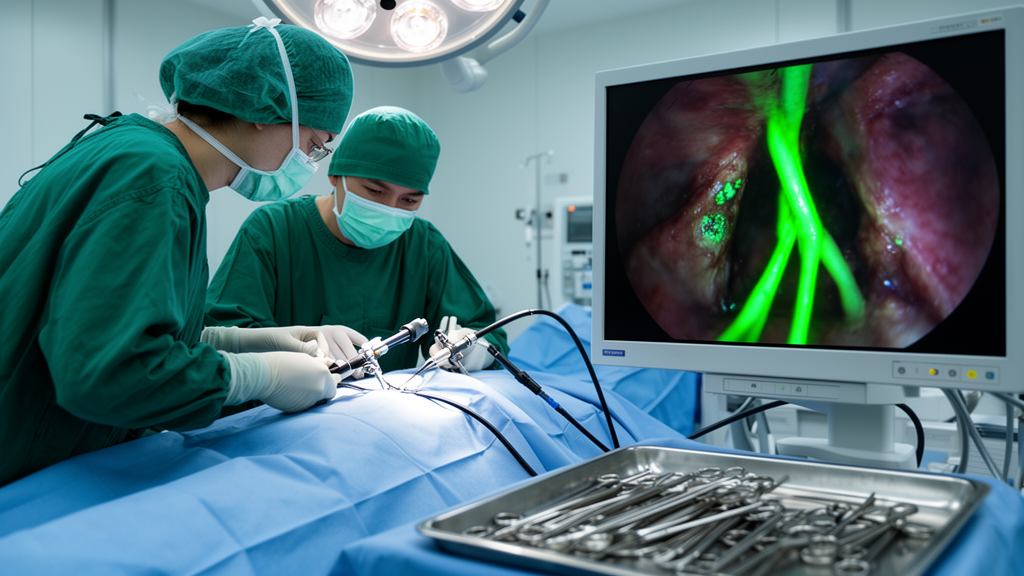
Surgeons operating on deep infiltrating endometriosis may soon have a clearer view of one of the operation’s most vulnerable structures. In the LAVIC trial, a prospective single-arm feasibility study, researchers tested whether injecting indocyanine green dye retrogradely into the ureters could make them glow under near-infrared fluorescence during laparoscopic surgery, allowing real-time visualisation of structures that are otherwise easy to injure.
The study enrolled 51 premenopausal women undergoing minimally invasive surgery for suspected deep infiltrating endometriosis. After laparoscopic confirmation of the disease, patients received bilateral retrograde intraureteral indocyanine green, and near-infrared fluorescence imaging was used to track the ureters throughout the operation. The primary outcome was the rate of successful ureteral visualisation, with secondary outcomes covering fluorescence characteristics, the extent of ureterolysis, and procedure-related adverse events. Data were analysed primarily with descriptive statistics, supplemented by exploratory analyses.
The results were striking on the feasibility endpoint. Bilateral ureteral fluorescence was achieved in 50 of 51 patients, a 98 percent success rate. Visualisation was immediate in every case in which it was achieved and persisted throughout surgery, giving surgeons a continuous fluorescent outline of the ureters as they dissected endometriotic tissue. Patients had a mean age of 36 years, and the mean duration of surgery was 217.3 plus or minus 81.1 minutes.
The dye-delivery procedure itself added relatively little time. Mean cystoscopy duration was 7.0 plus or minus 5.0 minutes, and intraureteral indocyanine green injection took a mean of 4.3 plus or minus 3.3 minutes.
Safety findings were reassuring within the limits of this design. No ureteral injuries and no indocyanine green-related complications occurred during the study. The authors conclude that intraureteral indocyanine green fluorescence appears feasible for real-time ureteral visualisation during complex surgery for deep infiltrating endometriosis, while noting that no adverse events attributable to the dye administration were observed in this cohort.
Important caveats remain. Because the trial was single-arm and designed to assess feasibility, it did not compare the fluorescence technique against standard practice, so any effect on ureteral injury rates or long-term outcomes cannot be inferred from these data. The authors state explicitly that the clinical utility of the approach requires further evaluation in comparative studies. The trial protocol is registered at clinicaltrials.gov under identifier NCT05206279, and the findings are published open access in Archives of Gynecology and Obstetrics.
Subject of Research: Feasibility of near-infrared ureter visualisation with retrograde indocyanine green during laparoscopic surgery for deep infiltrating endometriosis
Article Title: Laparoscopic visualisation of the ureters using near-infrared fluorescence imaging after retrograde indocyanine green injection in deep infiltrating endometriosis: the LAVIC trial
Article References: Vaineau, C., Schlatter, B., Imboden, S., Villiger, A.-S., Gulz, M., Mueller, M. D., & Siegenthaler, F. (2026). Laparoscopic visualisation of the ureters using near-infrared fluorescence imaging after retrograde indocyanine green injection in deep infiltrating endometriosis: the LAVIC trial. Archives of Gynecology and Obstetrics. https://doi.org/10.1007/s00404-026-08559-0
Image Credits: AI Generated
DOI: 10.1007/s00404-026-08559-0
Keywords: deep infiltrating endometriosis, indocyanine green, near-infrared fluorescence, ureter visualisation, laparoscopic surgery, ureterolysis, LAVIC trial, feasibility study, surgical safety, minimally invasive surgery, Laparoscopic, visualisation
News Source: Ophelia Keating. (October 30, 2026). Fluorescent Dye Lights Up Ureters During Endometriosis Surgery in Feasibility Trial. Scienmag.



