


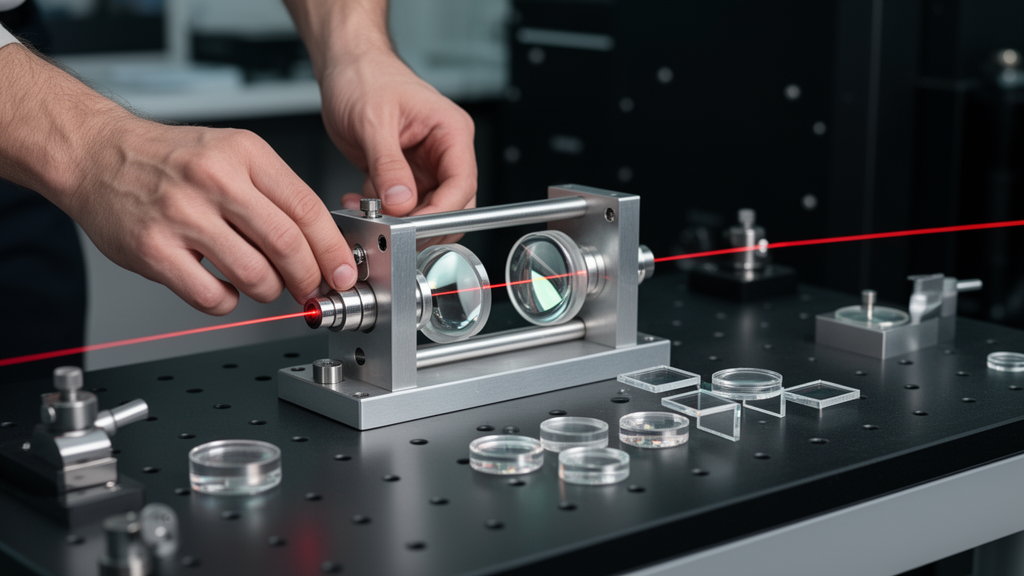
Physicists have unveiled a low-cost way to keep an optical cavity locked on target while still letting them slide its resonant frequency across a range of more than 100 megahertz with a precision of under 1 megahertz. The technique, described in the journal EPJ Techniques and Instrumentation, replaces the bulky transfer cavities that most laboratories rely on for tunable cavity locking with a clever arrangement of two lasers, an electro-optic modulator and a standard spectroscopy reference.
Optical cavities, formed by two facing high-reflectivity mirrors, sit at the heart of experiments ranging from cavity quantum electrodynamics to precision spectroscopy and even gravitational-wave detection. In cavity QED experiments, researchers confine a cloud of ultracold atoms so that it overlaps the standing light wave between the mirrors, coupling the atoms to the cavity’s optical mode. For those measurements to mean anything, the cavity’s resonant frequency must stay fixed relative to the atomic transition, even as temperature fluctuations and acoustic noise nudge the mirror separation back and forth.
The team, working with a magneto-optical trap of rubidium-85 atoms inside a moderate-finesse Fabry-Pérot cavity, scans a weak probe beam over several tens of megahertz within a few milliseconds and repeats the measurement many times to build up signal. Any drift in cavity length between repetitions shifts the resonance condition and corrupts the averaged data. Passive stabilization using ultralow-expansion materials helps, but the group needed active feedback that could also be tuned on demand.
Existing active schemes typically lock the cavity at one fixed frequency or use a transfer cavity to shift the lock point. The new approach bypasses the transfer cavity entirely. The cavity is locked to a Pound-Drever-Hall error signal generated by a 767-nanometer reference laser, which itself is locked to an electro-optic modulator-shifted saturation absorption spectroscopy signal from potassium. Changing the modulator’s drive frequency retunes the reference laser, and the cavity follows, all without unlocking and re-locking either laser or cavity.
The choice of wavelength was dictated by the physics. The atoms under study, rubidium-85, absorb strongly at 780 nanometers, so locking the cavity with that wavelength would disturb the atom-cavity system. The mirror coatings restricted the reference laser to within 100 nanometers of 780 nanometers, leading the team to pick 767 nanometers, far enough off the rubidium D2 transitions to leave the atoms untouched while still resonating with the same cavity.
The hardware is deliberately modest. The cavity consists of two identical spherical mirrors 12.5 millimeters in diameter with a radius of curvature of about 50 millimeters, separated by roughly 45 millimeters, giving a beam waist near 78 micrometers, a linewidth of about 8.8 megahertz at 780 nanometers and a free spectral range of 3.3 gigahertz. The input mirror is mounted on an annular piezoelectric transducer, which the feedback loop drives to hold the cavity length constant.
Setting up the lock required some care. Because the cavity linewidth at 767 nanometers exceeds 10 megahertz, the sidebands produced by the Pound-Drever-Hall modulation at 20 megahertz cannot be cleanly resolved from the central reflection dip, which itself amounts to only about a 1 percent dip in reflected intensity. By optimizing the amplitude and phase of the modulation, the researchers still obtained a steep, usable error signal that feeds a proportional-integral-derivative controller driving the piezo. The reference laser, stabilized to the potassium spectroscopy signal, showed a frequency standard deviation of roughly 100 kilohertz on a wavemeter, about the instrument’s resolution, and the cavity length stabilized to a comparable linewidth.
To demonstrate the tuning ability, the team swept the stabilized cavity across the resonance of a probe laser locked to a rubidium transition, stepping the fiber-based electro-optic modulator drive in 1-megahertz increments and recording the transmitted probe intensity for ten seconds at each step. The measurements resolved the average transmitted intensity at each step, and the cavity could be tuned over 100 megahertz without unlocking any component. The researchers note a subtlety: because the probe and reference wavelengths correspond to different longitudinal mode numbers of the cavity, a 1-megahertz shift in the reference laser does not translate to exactly 1 megahertz at the probe frequency.
The real payoff showed up in the atom-cavity data. In the collective strong coupling regime, the vacuum Rabi splitting, a double-peaked structure in the transmitted probe spectrum, has a separation given by the single-atom coupling strength multiplied by the square root of the number of coupled atoms. Before the lock was installed, small drifts in cavity length between averaging cycles made the two peaks asymmetric and shifted their splitting over time. After stabilization, the team could average more than 100 measurement cycles and obtain a symmetric double peak, allowing the number of atoms coupled to the cavity to be estimated far more reliably. With the lock active, the measured splitting held steady with a standard deviation of 0.83 megahertz.
The authors present the scheme as a relatively low-investment, robust alternative for any laboratory that wants to study how light scattered by a coupled atom-cavity system depends on the detuning between the atomic transition and the cavity frequency. They suggest the lock strategy can be made compact and portable for future experiments, and note that the wavemeter used in the demonstration is a convenience rather than a necessity. Because the underlying data are not publicly available, independent verification rests on the published measurements, but for cavity QED groups priced out of transfer-cavity setups, a two-laser lock that tunes over 100 megahertz while holding sub-megahertz precision is a notably accessible piece of kit.
Subject of Research: A cavity stabilization and dynamic tuning technique for atom-cavity quantum electrodynamics experiments
Article Title: Dynamic Fabry-Pérot cavity stabilization technique for atom-cavity experiments
Article References: Dinesh, S. P., Thakar, V. R., Gokul, V. I., Bahuleyan, A., & Rangwala, S. A. (2024). Dynamic Fabry-Pérot cavity stabilization technique for atom-cavity experiments. EPJ Techniques and Instrumentation, 11(1), Article 1. https://doi.org/10.1140/epjti/s40485-023-00107-3
Image Credits: AI Generated
DOI: 10.1140/epjti/s40485-023-00107-3
Keywords: Fabry-Pérot cavity, cavity QED, Pound-Drever-Hall locking, electro-optic modulator, saturation absorption spectroscopy, vacuum Rabi splitting, rubidium-85, magneto-optical trap, laser stabilization, piezoelectric transducer, reference laser, quantum optics
News Source: Denise Maddox. (October 30, 2026). Simple Lock Keeps Optical Cavities Tunable Across 100 MHz for Atom Experiments. Scienmag.



